



Important points
Between September 30 and November 21, wallets holding between 1,000 and 10,000 BTC collectively added 121,117 BTC (a 4.29% increase), even as Bitcoin’s value dropped by 29.5%. This shift contrasts with trends from seven of the prior nine quarters and also reverses a decrease of approximately 203,000 BTC seen in Q4 2025. Meanwhile, profits for these large holders diminished drastically, with unrealized profit dropping from $124.7 billion to $23.8 billion and profit margins shrinking from 33.9% to just 5.7%. Furthermore, while the influx to whale-dominated exchanges rose to an average of 5,012 BTC per day in November, U.S. spot Bitcoin ETFs experienced a significant net outflow of $453 million on Wednesday. A lasting recovery in Bitcoin’s price may hinge on the return of ETF inflows and the cryptocurrency maintaining a level above $60,000.
The question of whether Bitcoin can rebound by the end of 2026 has gained traction, especially following a recent study indicating that large Bitcoin holders have expanded their holdings despite a significant price downturn this past quarter.
The rise in total balance among addresses that hold between 1,000 and 10,000 BTC represents a change from the typical behavior observed last year, where there was a marked decrease in these balances. The recent accumulation appears particularly notable against the backdrop of deteriorating market conditions.
Additionally, there are hints of renewed buying enthusiasm in the derivatives market, highlighted by a $366 million purchase made by a key player recently.
Observations on Bitcoin Whales
A report from CryptoQuant, supported by CoinRabbit, reveals a striking 4.29% increase in balances held by Bitcoin addresses with 1,000 to 10,000 BTC from late September to mid-November, amounting to approximately 2.95 million BTC.
This uptick is especially noteworthy when compared to similar time frames last year, where the group witnessed a reduction of about 203,000 BTC during Q4 2025. This year’s notable increase indicates a possible confidence in Bitcoin’s current valuations, despite adverse market developments.
It is important to note, however, that rising balances do not always reflect direct market purchases; they can also result from internal account transfers. Despite these increases, Bitcoin’s ongoing struggles suggest that efforts for significant accumulation have yet to overcome other selling pressures in the market.
Profit Drops for Large Holders
The report emphasizes that the most revealing aspect is not just the accumulation by Bitcoin whales but the significant loss of profits. The unrealized gains for this group plummeted from $124.7 billion to $23.8 billion. At the end of September, the unrealized gains rate was 33.9%, but it dwindled to 5.7% by November 21.
Moreover, the analysis revealed an average daily loss of $41 million for this cohort throughout the quarter, complicating narratives suggesting that accumulation was solely strategic in anticipation of a price recovery.
Larger investors do not escape economic challenges, and if Bitcoin prices continue to decline, the potential for sell-offs by these whales looms, despite their recent accumulation efforts.
The increase in whale exchange deposits averaged out to 5,012 BTC each day in November, sparking potential market confusion about the intentions behind these movements.
Current economic pressures extend beyond just the largest Bitcoin holders. Data from Glassnode indicates realized losses on capital inflows have reached levels not seen since the collapse of FTX in 2022, mirroring past market downturns but not confirming definitive price recoveries.
Conditions for a Bitcoin Recovery
One significant barrier to Bitcoin’s recovery is the lack of demand for institutional capital.
As previously reported by NewsBTC, the withdrawal of support from the U.S. for spot Bitcoin ETFs has diminished the likelihood of achieving a stable recovery.
In a recent update, there were net outflows of $453 million on Wednesday, predominantly from BlackRock’s IBIT, which accounted for $329.7 million of this figure according to Farside Investors. At the time of writing, the latest figures for Friday remained unverified.
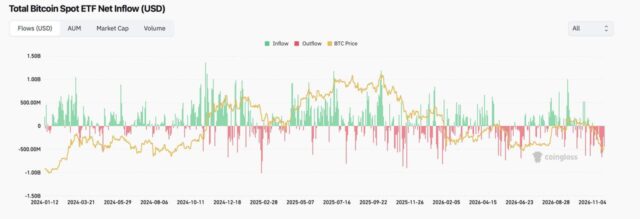
Analysis from CoinGlass depicts how Bitcoin ETF flows have transitioned through market downturns. Recent trading trends have reflected withdrawals rather than the substantial inflows experienced earlier in the rally.
For sustained recovery, consistent ETF inflows are essential to signal rising demand beyond the accumulation by large wallets.
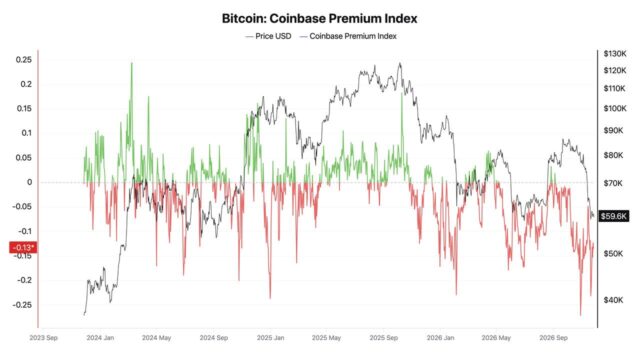
The Coinbase Premium Index, highlighting the price differences between Coinbase and Binance, currently reads around -0.13%, suggesting that relative buying pressure on Coinbase is significantly weaker compared to Binance. A return to positive values in this index, particularly in tandem with renewed ETF inflows, could bolster the argument for an uptick in demand in the U.S. market.
From a technical standpoint, Bitcoin’s daily chart shows little indication of a durable recovery in sight. The cryptocurrency continues to face fluctuating highs and lows, with the current price dipped below the $60,000 threshold.
A critical focus will be on reclaiming the price range of $63,000-$64,000, followed by a more essential resistance zone between $68,000 and $71,000. Successfully surpassing these levels could significantly improve the chances for a rebound.
Conversely, a recent low of around $55,000 is a key level to monitor, as breaching this could expose Bitcoin to additional losses and hinder recovery efforts.
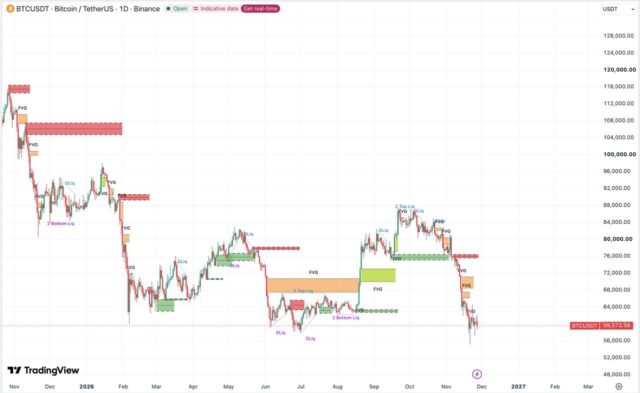
Currently, while certain indicators suggest the groundwork for recovery may be setting in, evidence of sufficiently strong buying pressure is lacking to overturn the overall decline.
Outlook for 2027
There remains potential for Bitcoin to recover by the year’s end, particularly if selling pressures begin to diminish and capital from institutional investors shifts back into positive territory.
However, the journey from recent lows back to previous all-time highs presents a significantly different challenge.
Current whale trends reinforce the possibility of selective accumulation by major holders during substantial market downturns, yet they do not confirm that Bitcoin has indeed reached its low point.
Investors are advised to focus less on immediate price fluctuations and more on evaluating continual demand across varying market segments.
While Bitcoin may present value for long-term investors, whether it is genuinely set for recovery remains a critical consideration.
