


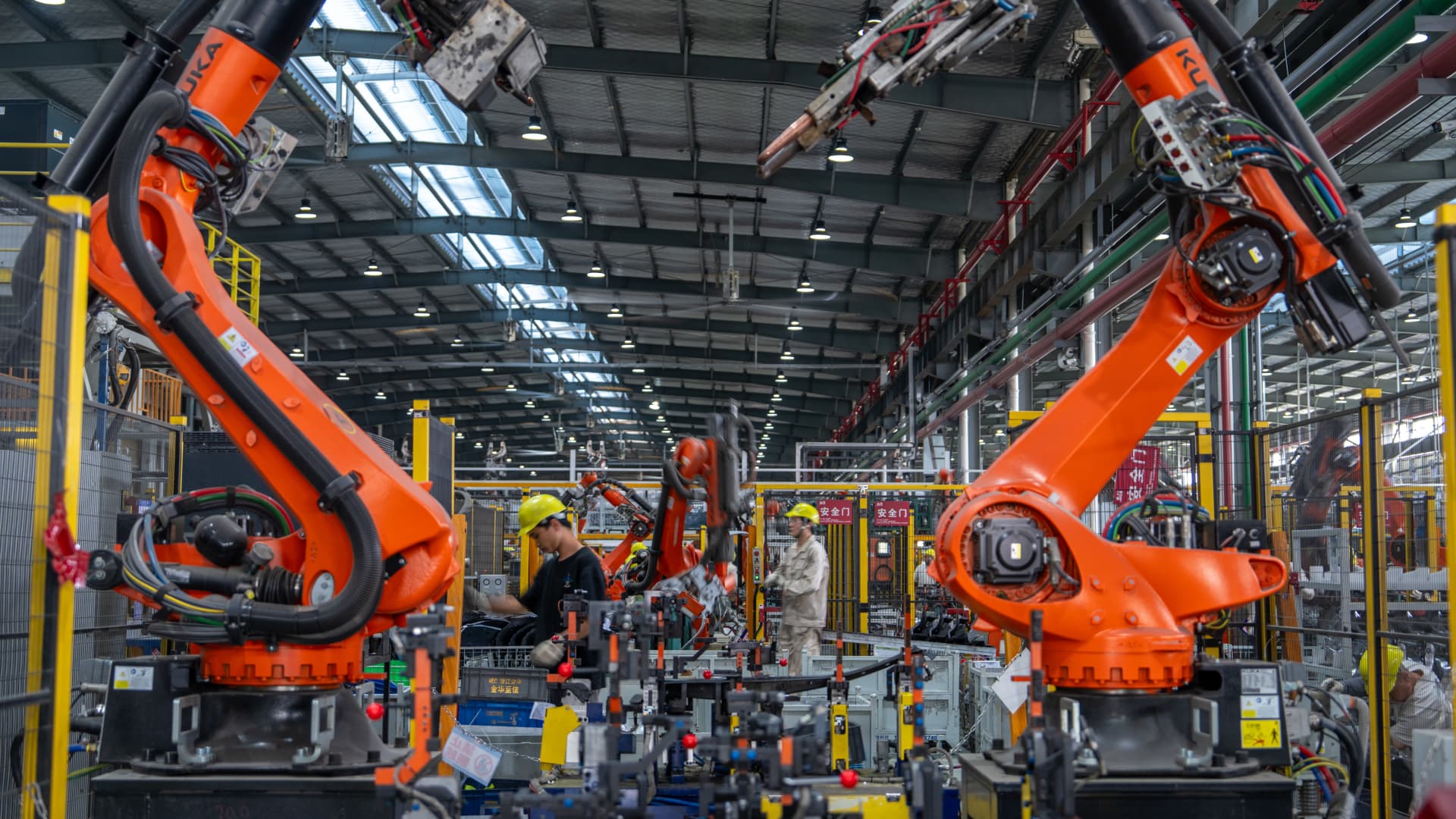
Industrial robots were observed operating on a production line at Jinhua Zhixin Technology Co., Ltd. for the manufacture of new energy vehicle parts on September 3, 2026, in Jinhua, Zhejiang Province, China.
Image Credit: Vcg | Visual China Group | Getty Images
Growth in Industrial Profits
China’s industrial sector reported significant profit growth in October, marking its most substantial rise since May. This surge has been fueled by advancements in AI-related electronics and increased energy prices, although consumer-driven industries are still suffering from lackluster demand.
According to the National Bureau of Statistics, the profits of major industrial firms rose by 20.1% year-on-year in October. Over the first ten months of 2026, profits increased by 16%, building on a gain of 15.5% recorded until September. This marks a notable recovery for the industry, particularly after experiencing three years of decline, followed by minimal growth of just 0.6% last year. If this trajectory continues, annual profits are set to exhibit the most robust growth since 2021.
However, experts caution that while these figures are impressive, they predominantly reflect gains in upstream sectors driven by elevated energy prices. “The recovery has yet to broaden into a more durable improvement in corporate profitability,” remarked Tianchen Xu, a senior economist at the Economist Intelligence Unit.
Economic Performance Overview
The Chinese economy appears to be divided into two distinct categories, with AI-focused manufacturing and exports contributing significantly to economic growth. In contrast, household consumption remains weak, putting pressure on retail sectors. Retail sales in October rose by only 0.4%, which was below expectations, while fixed-asset investments fell by 8.1% during the first ten months of the year.
High earnings have been predominantly noted in sectors connected to global AI advancements, as companies struggle to mitigate rising input costs. Notably, the electronics sector saw profits double in the first ten months when compared to the same period last year, driven by a surge in demand for AI computing power and memory chips. High-tech manufacturing profits surged by 50.9%, outpacing the broader industrial growth. Specializations such as spacecraft and launch vehicle producers experienced a remarkable 63.2% profit increase.
Conversely, industries reliant on consumer spending and construction materials are facing difficulties. For instance, the automotive sector’s profits fell by 26% over the same timeframe, with costs overshadowing modest revenue growth. Construction material producers—including cement and glass manufacturers—reported even steeper profit declines of 46.7% and 52.4%, respectively, exacerbated by a prolonged slump in the real estate market.
Official data also revealed a growing gap between accounts receivable and finished goods inventories against the backdrop of revenue performance, indicating financial strain among companies across various sectors.
Fiscal Measures and Economic Activity
Despite a significant increase in overall economic activity in October, which rose by 2.4% year-on-year as per the Capital Economics’ China Activity Proxy, the impact of local government fiscal measures has been minimal in combating the housing market downturn and revitalizing consumer demand.
Leah Fahy, a senior China economist at Capital Economics, noted that local governments increased fiscal spending for the first time since February, yet its effects have been limited. “Local governments are clearly struggling to utilize their allocated funds effectively, and there is a cap on how much fiscal policy can support the economy,” she commented.
Future Projections and Trade Challenges
Although external demand, particularly stemming from AI-related growth, has lessened the urgency for extensive stimulus measures to boost domestic demand, forecasts suggest that as global investments in AI begin to slow, exports may not sustain their current momentum. The GDP growth rate was 4.6% in the initial three quarters of the year, keeping China’s target of 4.5-5% within reach. However, projections estimate a decrease in overall economic growth to 2.8% in 2027 from 3.9% in 2025.
Additionally, fresh trade challenges have emerged due to the U.S. proposal for new tariffs, which include a 20% rate on Chinese goods and escalated rates on several Asian economies perceived to be involved in trading with China. This situation increases the likelihood of tariffs affecting intermediate goods and compounding risks for economies with substantial reliance on Chinese manufacturing inputs.
