


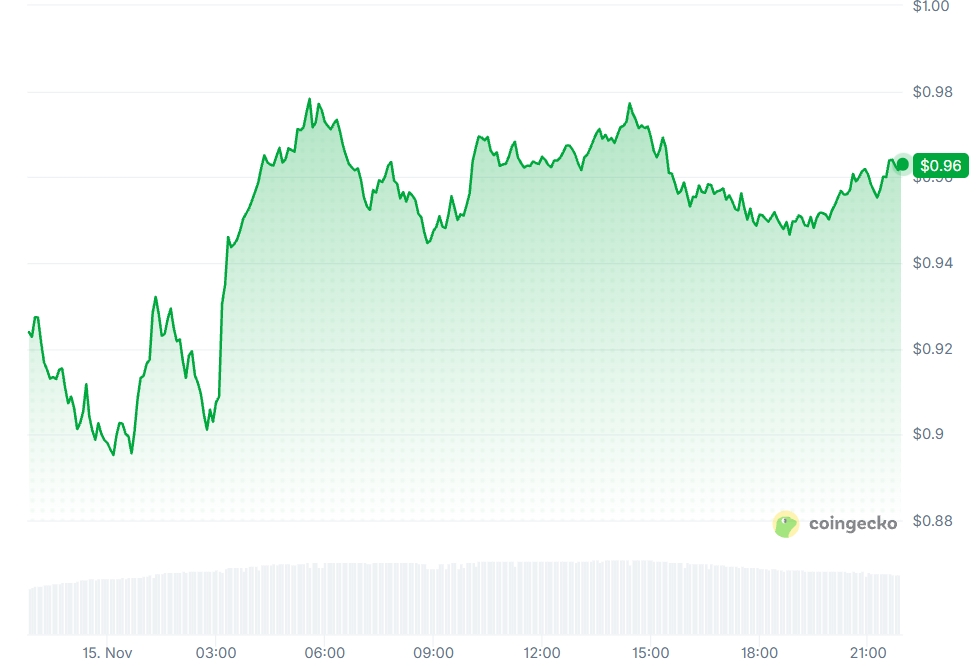
The cryptocurrency market is currently experiencing a downturn, as investors continue to pull funds amid rising uncertainties. XRP, a digital asset centered on payment solutions, has recently plunged to approximately $0.89, a price level it hasn’t seen since November 2024. This sharp decline coincides with notable withdrawals from XRP-related exchange-traded funds (ETFs) and a significant decrease in the availability of prominent dollar-backed stablecoins.
Since reaching a peak value above $3.60 in July 2025, XRP has suffered a considerable loss of about 36% this quarter. The trends in XRP mirror the overall sluggish sentiment in the cryptocurrency space, where both Bitcoin and Ethereum have also regressed to values reminiscent of August.
XRP Hits Lowest Price Since Late 2024
XRP’s brief dip to $0.89 marks the continuation of a downward trajectory following its surge past $3.60 in July 2025. The greater cryptocurrency market is undergoing a similar contraction, with an overall decline of approximately 36% in the past quarter, suggesting that XRP’s struggles reflect a broader market correction.
This pervasive decrease in digital asset valuations highlights the difficulties faced by altcoins. As investor confidence diminishes, there is typically a pullback in capital aimed at riskier digital tokens, further complicating the market’s landscape for cryptocurrencies dependent on new investment inflows.
ETF Withdrawals Surge for XRP
Recent figures show a significant uptick in withdrawals from investment products linked to XRP, contributing to ongoing selling pressure. Specifically, the U.S.-listed XRP ETF faced net outflows of around $19.13 million for the week ending November 13, marking the most substantial withdrawal since March 2026.
Despite these outflows, the ETF has recorded a total net inflow of roughly $1.5 billion since its launch in November 2025, indicating earlier strong demand. However, slower inflows compared to Bitcoin and Ethereum ETFs suggest institutional engagement with XRP may still be limited. The dynamics of ETF flows serve as an essential gauge of market demand, with continued withdrawals signaling a lack of confidence that could hamper the cryptocurrency’s price support.
Declining Stablecoin Availability Affects Market Liquidity
A deeper issue plaguing the market is the shrinking supply of stablecoins. The combined valuation of the two largest dollar-pegged stablecoins, Tether’s USDT and Circle’s USDC, has dropped to approximately $244 billion. Over the past seven weeks, their collective market cap fell from around $260 billion, reflecting a substantial contraction.
According to blockchain analytics firm Glassnode, the supply of stablecoins decreased by about $17 billion month-over-month, marking the steepest drop since 2022. Stablecoins are critical in the cryptocurrency market as they enable traders to maintain dollar-equivalent value and facilitate transactions. A reduced supply may indicate that financial capital is exiting the crypto ecosystem rather than being held for future investments. As investors convert stablecoins into fiat currency, the overall liquidity available for cryptocurrency transactions might decline, further clouding market conditions.
Future Outlook for XRP
The recent dip of XRP below the $0.90 threshold emphasizes the compounded challenges posed by flagging investor interest, ongoing ETF withdrawals, and diminishing liquidity across the cryptocurrency market. While XRP has confronted significant declines, its future trajectory will largely hinge on the return of capital into digital assets. Notable changes in ETF inflows or an uptick in stablecoin supply could signal an improvement in investor sentiment.
Currently, the indicators point to a tough landscape for cryptocurrency values. With XRP trading at levels not witnessed since late 2024, the shrinking market capitalization of stablecoins augurs a decrease in the available capital in circulation. Thus, any recovery may demand more than just a brief uptick in XRP’s price; it will likely require a more comprehensive revival in liquidity and fresh institutional demand to regain stability.
Ultimately, market participants are left to ponder whether the recent declines in stablecoin supply represent a transient liquidity adjustment or if they signify a fundamental retreat of capital from the cryptocurrency arena.

bitcoinist’s editorial process focuses on providing thoroughly researched, accurate, and unbiased content. We adhere to strict sourcing standards, and each page is carefully reviewed by our team of top technology experts and experienced editors. This process ensures the integrity, relevance, and value of your content to your readers.
