


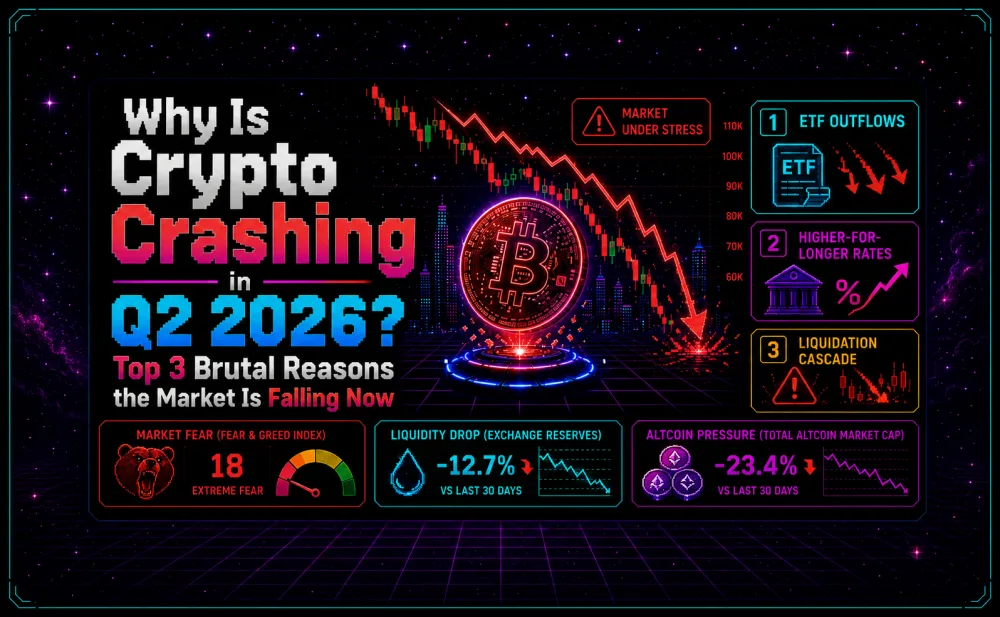
The significant cryptocurrency downturn of mid-2026 can be attributed to a convergence of several economic pressures rather than a single defining event. As money began flowing out of exchange-traded funds (ETFs), available funds diminished, and leveraged positions in futures trading collapsed. This combination transformed a relatively modest dip into a pronounced decline as these factors intertwined, creating a sharper fall in market values.
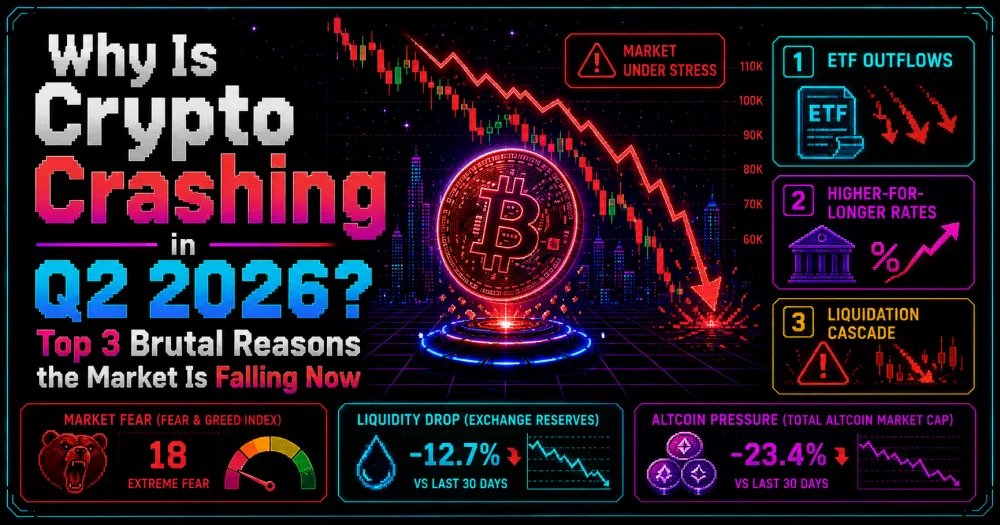
Although Bitcoin remains at its core, the chaos has quickly spread to altcoins, which have been diving even more steeply. As liquidity has disappeared from smaller tokens, traders are left questioning the underlying causes of this sudden downturn in the crypto markets. Several factors play a role in this dramatic shift, particularly diminishing institutional support, adverse global economic conditions, and excessive leverage amplifying downward price movements.
A key factor lies in the order of events. Once ETF demand started to decline and liquidity tightened across global markets, pressure intensified. Vulnerable segments within the market faced harsher repercussions as borrowing started to falter, leading to a chain reaction of selling and price depreciation rather than simple market dips.
Below are the top three reasons behind the current crypto market sell-off:
Why Is Crypto Crashing in Q2 2026? Top 3 Key Reasons for Market Decline
1. ETF Outflows Reverse Institutional Demand
The decline of institutional demand for cryptocurrencies drastically shifted in mid-2026 when appetite for ETFs waned unexpectedly. Prior to this, Bitcoin funds had provided a crucial avenue for investment, effectively drawing in financial resources from traditional avenues and enhancing Bitcoin’s reputation among corporate stakeholders.
With institutional backing diminishing, the influence of ETF transactions has become more pronounced. Market dynamics relied heavily on these funds, as purchasing through ETFs traditionally contributed to rising prices, while heightened redemption requests effectively drove prices down, particularly when outflows persisted over time.
The significance of this downturn today is notable—pressure is not solely the result of individual investors acting on nervousness, but also from significant withdrawals in investment vehicles previously viewed as stabilizers for price increases. As confidence in ETF activity fades, Ethereum’s struggles have further weakened investor sentiment toward crypto as a whole.
2. Federal Reserve’s Extended Tight-Money Policy
Macroeconomic trends significantly impeded the crypto markets as well. In 2026, the Federal Reserve’s decision to maintain elevated interest rates created a ripple effect across digital assets. Initially, there were expectations for a potential reduction in borrowing costs that might have fostered increased investment. Instead, the enduring high rates have led to a more cautious financial environment.
High interest rates inherently dissuade riskier investments like cryptocurrencies, as investors gravitated toward safer, more stable returns. The increased cost of lending further complicates leveraging for investments, exacerbating existing fears. As the market fluctuates and mindsets shift, stability in traditional assets becomes preferable, prompting investors to withdraw from riskier commitments.
Additionally, the stronger U.S. dollar reduces the global appetite for cryptocurrencies. The correlation between a rising dollar and restricted money flow amplifies the downward pressure on speculative investments, such as cryptocurrencies.
3. Leverage Unwinding and Liquidation Cascades
One of the critical mechanisms driving the price decline is the active unwinding of leveraged positions. When market prices fall, forced sell-offs begin as automated mechanisms trigger on highly leveraged long trades. Each decision leads to increasing sell pressure, further driving down asset prices, creating a chain of liquidations that often spirals downwards.
As market participants initially believed Bitcoin prices would hold firm at psychological barriers, miscalculations fueled a false sense of security. As the market subsequently declined, automated selling exacerbated the situation, further compounding the downturn. The lack of buy orders during this period meant that even small sales could dramatically impact prices.
Consequently, Bitcoin’s more stable position compared to smaller cryptocurrencies is a double-edged sword: while it provides some resilience, the rapid decline of altcoins has drawn market resources and attention away from Bitcoin.
Why Are Altcoins Dropping Faster than Bitcoin?
Bitcoin Dominates Amid Market Tensions
In times of market volatility, Bitcoin often outperforms its alternatives, exhibiting milder losses than lesser-known tokens. As pressure mounts, investors tend to divest from altcoins in favor of Bitcoin, along with safer assets. This shift contributes to Bitcoin gaining a greater market share, while altcoins experience sharp declines, often succumbing to liquidity issues.
Institutional Focus on Bitcoin Over Altcoins
Institutional investors tend to favor Bitcoin due to its superior market recognition, liquidity, and clearer regulatory path. When tightening conditions occur, smaller tokens generally falter more quickly, suffering steeper losses as attention shifts away from them. Altcoins such as Ethereum and Solana also struggle as speculative narratives fade, exacerbating their decline without substantial use cases.
Capital Outflows from Small-Cap Tokens
Smaller tokens are more prone to drastic price changes when market conditions fluctuate given their lower trading volumes and heightened sensitivity to sales. These tokens can quickly plummet in value, with significant sell-offs manifesting as larger holders exit the market. As liquidity dries up, even minor sales create sharp declines, leading other holders to panic and sell.
Is This a Bear Market or Just a Correction?

Comparative Analysis with Previous Cycles (2022–2024)
The current market downturn exhibits both familiar and distinct characteristics when compared to crypto contractions in previous cycles, such as those seen between 2022 and 2024. In earlier instances, systemic failures led to rapid losses; however, the ongoing downturn is more prolonged and characterized by a grimmer recalibration rather than outright chaos. Recent attention has centered around new ETFs and their implications for market dynamics.
As the year progresses, ETF movements will play a crucial role in shaping market sentiments alongside central bank policies. The evolution of the crypto space reflects a greater maturity while still grappling with elevated risks and complexities that may redefine how prices are influenced.
Divergence Between On-Chain Signals and Price Actions
The tumultuous market conditions portray an unsettled landscape, as on-chain data may not always echo price actions. Not every long-term holder is rushing to liquidate positions, indicating that panic selling is not yet fully integrated into market psychology. Conversely, the prevailing price trends reveal that any breaches of support levels can induce substantial selling pressure.
Key Support Levels Under Watch
As traders focus on critical support levels, Bitcoin’s performance remains central to market stabilization. A sustained recovery at these thresholds can restore market confidence, yet repeated failures to maintain support can exacerbate bearish sentiment and prompt further selling.
Ultimately, altcoins depend on more than mere technical indicators; liquidity dynamics often dictate price movements. A decline in trading volumes can rapidly impact prices, illustrating how easily sentiment can shift under market strain.
What Could Reverse the Crypto Downtrend in 2026?

1. Potential Shift from the Federal Reserve
A pivotal change could emerge should the Federal Reserve signal a shift in its policy toward looser monetary conditions. Lower inflation rates could foster a more risk-friendly environment, potentially leading to increased inflow in the crypto markets, as investor sentiments become more optimistic.
2. Recovery of ETF Inflows
Another significant catalyst for recovery would be the return of inflows into Bitcoin ETFs. A revival of investment in these funds would not only exert upward pressure on Bitcoin prices but also signal the re-engagement of institutional investors, which could bolster market confidence.
3. Improvement in Global Risk Sentiment
A calming of global financial tensions could also facilitate a reversal of the cryptocurrency downtrend. Positive developments such as stabilizing stock markets and a weakening dollar may lead investors to resume their interest in digital assets, paving the way for cryptocurrencies to experience renewed vitality.
Frequently Asked Questions (FAQ)
What Caused the Crypto Decline in Q2 2026?
The decline in cryptocurrency prices stems from a combination of ETF outflows which decreased institutional interest, alongside a prolonged tight-money stance from the Federal Reserve that constrained market liquidity. This confluence of factors led to a rapid drop in prices as leveraged positions were liquidated.
Do Altcoins Drop Sharply While Bitcoin Holds Steady?
Smaller cryptocurrencies tend to decline more sharply than Bitcoin during periods of market tightening due to lower liquidity and institutional disinterest. As investors shift towards Bitcoin and stable assets, altcoins often face heavier selling pressures.
How Do ETF Outflows Affect Bitcoin?
Ongoing outflows from Bitcoin ETFs negatively impact Bitcoin prices, as they lead to additional sell orders while indicating a lack of interest from institutional investors. Rebounding interest is essential for future price recovery.
How Do Federal Reserve Rates Influence Cryptocurrency?
An increase in interest rates typically diverts investment away from volatile assets like cryptocurrencies to safer options. This distancing can critically reduce market confidence and hinder cryptocurrencies’ ability to maintain price levels.
What Is a Crypto Liquidation Cascade?
A liquidation cascade occurs when a rapid decline in prices triggers the automatic closing of leveraged positions. Each liquidation amplifies selling pressure, creating a loop that drives prices even lower.
Can Crypto Rebound by Late 2026?
A rebound in the crypto market is possible if ETF inflows increase and the Federal Reserve signals a shift to a less aggressive monetary policy. Additionally, improvements in global sentiment could encourage renewed interest in digital assets.
Is This A Bear Market?
Current market behavior suggests a potential shift towards a bear market if Bitcoin fails to establish key support levels amid continued ETF withdrawals. What may appear as a significant pullback could lead to a prolonged downturn.
Should Investors Buy When Prices Drop?
Investing during price declines can be precarious in thinning markets. Monitoring ETF transactions and central bank directives proves vital. Prices must hold firm at established support levels for a smarter re-entry into the market.
