


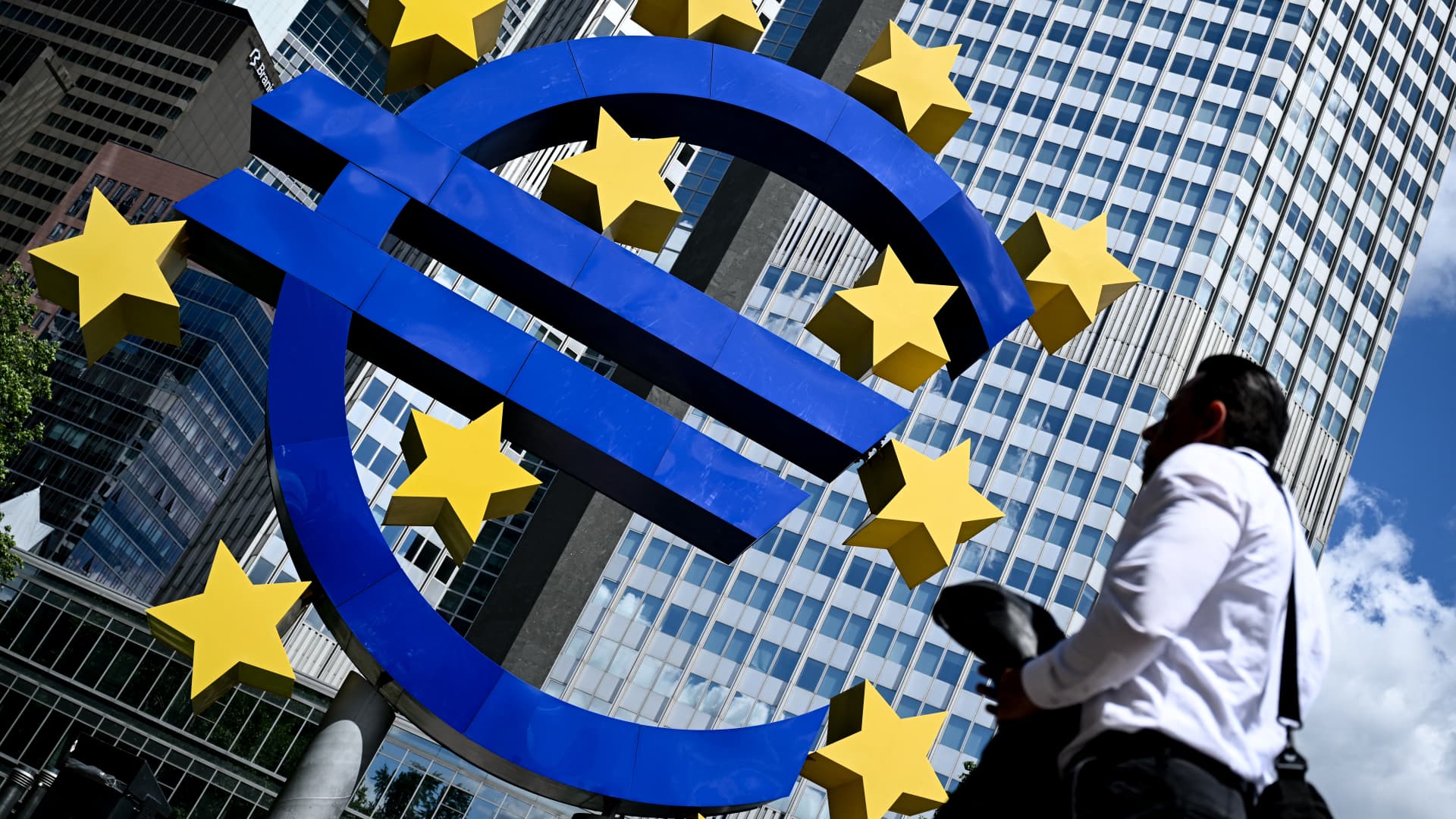
A man walks past the Euro currency sign (‘Euro Sculpture’ by German artist Ottmar Hoerl) in front of the former European Central Bank (ECB) building in Frankfurt am Main, western Germany, on June 9, 2026.
Kirill Kudryavtsev | AFP | Getty Images
The European Central Bank (ECB) maintained its key interest rate at 2.5% during its recent meeting, aligning with market forecasts even as inflation within the euro zone reached its highest level in three years.
This decision followed a 25 basis point increase in September. In its statement, the Governing Council indicated that while rising energy prices present upward risks to the inflation outlook, they equally pose risks to economic growth. Encouragingly, underlying inflation and wages have shown stability thus far.
During a press conference, ECB President Christine Lagarde noted, “At this point in time we are not seeing second round effects in addition to what is already included in the projections” released in September.
Lagarde pointed to significant developments since the last ECB meeting, including higher costs for energy sources—such as oil, fuel, and gas—and an increase in long-term borrowing costs, with a notable rise of about 35 basis points in the average 10-year sovereign yield.
In her remarks, she relayed that the Governing Council had considered a potential increase in rates but ultimately opted for a cautious approach based on existing uncertainties and stable underlying inflation indicators. “The Governing Council unanimously decided that we were well positioned enough at this stage to hold and that a measured approach at this point remained appropriate,” emphasized Lagarde.
Post-announcement, market expectations indicated about a 67% likelihood of a rate hike in December, according to data from LSEG.
Stock Chart Icon
The U.S. dollar strengthened against the euro following the ECB’s decision.
In September, headline inflation in the euro area was recorded at 3.8%, marking the highest rate since 2023. Energy prices significantly contributed to this increase, with energy inflation soaring to 18.8% amid ongoing geopolitical tensions in the Middle East.
The ECB had opted to raise rates in June for the first time since 2023, in response to the surge in energy prices triggered by the conflict between the U.S. and Israel against Iran.
The euro area’s economy showed growth in the third quarter, buoyed by a recovery in the services sector since the onset of the regional conflict. Sectors such as manufacturing, digital services, and exports have benefited from investments in artificial intelligence, while government spending on infrastructure and defense has also supported business activity. However, the persistence of energy price pressures could undermine consumer confidence, particularly as borrowing costs rise, impacting overall growth.
In her address, Lagarde committed to monitoring the rising borrowing costs in France and addressing worrying market fragmentation. She highlighted the significant increases in long-term borrowing costs worldwide, which are influenced by expectations of inflation and interest rates, alongside increased debt issuance by major corporations.
The Path Forward: Potential for Future Rate Hikes
Mark Wall, chief European economist at Deutsche Bank, stated that predicting the future trajectory of the ECB’s monetary policy has become increasingly complicated. He raised concerns about whether the earlier hikes and tightening financial conditions since September are adequate to combat further rises in energy inflation risk. “Probably not,” he affirmed.
Another critical factor he pointed out is the impending departure of Lagarde from her role as ECB president. “We think the institution is bigger than the person, but there’s uncertainty. We expect one more hike to 2.75% in December while Lagarde is still President,” he said, suggesting that this could signal the conclusion of the current rate hike cycle.
Dean Turner, chief euro zone and U.K. economist at UBS Global Wealth Management, characterized the recent decision as a “hawkish pause” rather than the termination of the tightening cycle. He indicated that France’s fiscal challenges should not alter the direction of monetary policy unless broader financial stress arises. “The ECB’s focus remains firmly on ensuring that today’s energy-driven inflation does not develop into a more persistent problem,” he added in his comments.
