


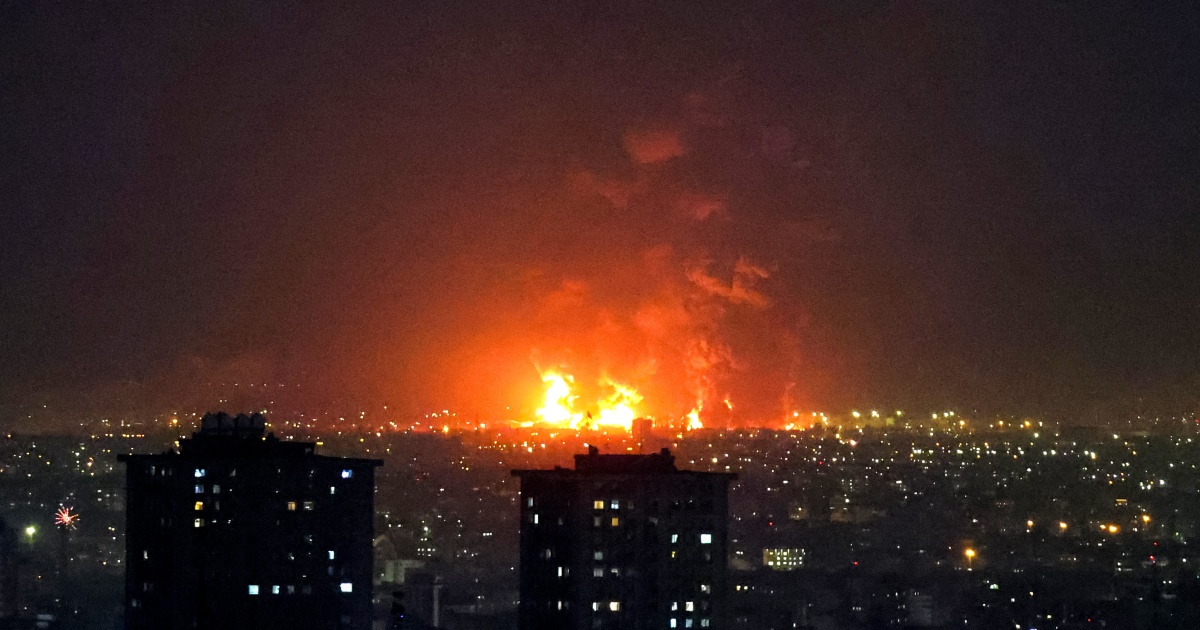
In a twist of wartime irony, the U.S. has moved to ease sanctions on Iranian oil to curb soaring energy prices, a potential boon for Iran as the U.S. scrambles to contain the economic shock of military operations.
Treasury Secretary Scott Bessent said Friday that the easing of sanctions, first imposed after Iran’s 1979 revolution, is “narrowly tailored” and only temporary, “allowing the sale of Iranian crude currently at sea.”
“By temporarily opening up existing supplies to the world, the United States will quickly deliver approximately 140 million barrels of oil to global markets, expand global energy capacity, and help alleviate temporary supply pressures from Iran,” Bessent added.
About 20% of the oil the world consumes every day is transported through the Strait of Hormuz, which runs along part of Iran’s coast. However, since the war began at the end of February, shipping through the strait has stopped.
Retail gasoline prices have risen 93 cents a gallon since the beginning of the year, and U.S. crude oil has soared more than 70% as geopolitical strategy and economic reality collide.
At current prices, Bessent said, the amount of oil the measure would put on the market would be worth more than $14 billion to Tehran.
Experts say his decision highlights a lack of strategic planning and warn that the measures are unlikely to change broader economic pressures.
“The United States is funding a war against itself,” Danny Sitrinowitz, a senior Iran fellow at Israel’s Institute for National Security Studies at Tel Aviv University, told NBC News.
forsubscriber
02:25
Three things Richard Engel is paying attention to regarding the progress of the Iran war
00:0000:00
“What we are seeing is actually a flawed operation, not just in terms of the scale of the operation, but in terms of the strategic preparation of the operation itself,” he said. “Oil prices have become much more important than getting rid of this regime in Iran.”
Moritz Blake, a senior fellow at the Center for Advanced Security and Strategic Integration Research, said the decision to ease sanctions on Iranian oil “points toward an underestimation of how well Iran can resist attack and its impact on the global economy.”
“The risks are underestimated,” he told NBC News.
The United States has already embarked on other efforts to boost supply, including releasing millions of barrels of oil reserves as part of a global effort by International Energy Agency members. Since the beginning of the month, the administration has lifted the Jones Act, eased some shipping regulations, and temporarily lifted sanctions on Russian oil.
Blake said the Iran war has had a “double impact” on Russia’s war against Ukraine.
“On the other hand, drone attacks in Ukraine have decreased because Iranian drones are no longer being transported to Russia,” he said. “At the same time, rising oil prices and the lifting of sanctions will fuel Russia’s war machine with additional funds.”
Headlines about the war weighed on market sentiment Friday, sending stocks plummeting for the worst four-week trading period since April 2025, when the Trump administration’s trade tariffs dominated the news.
Oil prices rose again, with international (Brent) crude trading around $111, ending Friday up 8.3% for the week and 84% for the year.
United Airlines CEO Scott Kirby said in an email to employees Friday that the airline is canceling some flights in preparation for rising oil prices due to the war with Iran.
“Our plans assume oil prices rise to $175 per barrel and do not return to $100 per barrel until the end of 2027,” Kirby wrote. “Honestly, I think there’s a good chance it won’t be that bad,” he said, but added: “I don’t see a lot of downside to preparing for that outcome.”
Kirby wrote that oil prices are expected to result in a short-term reduction in some less profitable flights, such as off-peak and red-eye flights. In his message, he said jet fuel prices had more than doubled in the past three weeks.
“If prices stay at this level, we will be spending $11 billion a year in extra spending on jet fuel alone,” he said. “For reference, we made less than $5 billion in the best year in United history.”
Citrinovic said sanctions relief measures are unlikely to change economic realities.
“Everyone knows that as long as Iran controls the strait, nothing changes in terms of its ability to extract oil,” he said. “You can’t beat geography.”
