


Coinbase’s Quantum Computing Advisory Board has released the first formal assessment of blockchain security, and two names stand out: Algorand and Aptos.
According to an advisory group that brings together expertise from Stanford University, the Ethereum Foundation, and several other institutions, these two chains have made architectural choices that keep them well-positioned to survive the era of quantum computing. The board states that all other proof-of-stake blockchains must begin upgrading immediately.
The details missing from most headlines are what you actually need to be “better prepared.” This is not a certification or safety label.
This is a signal about how these networks were designed from the ground up and what that design philosophy means for the millions of people who hold assets on chains that were not built with quantum resistance in mind.
Discover: Next 1000x Crypto Gems before being listed on Binance
What Coinbase’s quantum warning actually means for Algorand and Aptos
Here is the core issue in plain English. Most blockchains today, including Bitcoin and Ethereum, use a form of mathematics called elliptic curve cryptography to secure transactions. Think of it like a lock that takes a traditional computer billions of years to open.
A sufficiently powerful quantum computer could obtain the same lock in minutes. Google’s March 2026 study suggested that advanced quantum machines could crack Bitcoin and Ethereum encryption in just nine minutes.
Another day, another industry leader recognized Algorand’s post-quantum technology.
Today, @coinbase released a paper detailing post-quantum implementations with blockchain.
Algorand is cited as one of the first and only chains with functional post-quantum security on mainnet. pic.twitter.com/dZQKVChlYJ
— Algorand (@Algorand) April 21, 2026
That is the threat. But it doesn’t affect all chains equally, which is where Algorand and Aptos come in.
Algorand was built with a cryptographic framework that is structurally close to post-quantum standards. Post-Quantum Standards is a scheme that the National Institute of Standards and Technology has spent two decades working on and recently finalized as a recommended migration path for the entire industry. The recently launched Aptos incorporates modern cryptographic primitives from the beginning, rather than inheriting legacy choices made in 2008 or 2015.
Philip Martin, Coinbase’s chief security officer, said bluntly: “Your cryptocurrencies are safe today, but one day quantum computers will be built that can compromise blockchain cryptography. The industry needs to start preparing now, not in an emergency.” This is a framework, not a panic, a structured warning with real deadlines.
Discover: The Best Meme Coins ICOs to Invest in in 2026
Why Algorand and Aptos stand out in the quantum readiness race
Most major blockchains still run on cryptographic assumptions that predate serious quantum computing research. Bitcoin uses an elliptic curve digital signature algorithm, but sending a transaction exposes the public key, making it vulnerable to quantum attacks on any wallet that has ever sent a transaction.
Chaincode Labs estimates that around 6.9 million BTC, worth about $900 billion, is stored in wallets with exposed keys, making them prime targets for future quantum attacks.
The Bitcoin community has proposed a fix. BIP360 is an active proposal, but the implementation timeline is slow and politically debated. Cardano founder Charles Hoskinson has publicly criticized Bitcoin’s quantum proposal, illustrating how divided the industry remains in its response. Ethereum has published a roadmap for its post-quantum layer 1 upgrade, but it is still a roadmap.
Algorand and Aptos aren’t waiting for a community vote to renovate their 15-year-old architecture. Algorand’s consensus mechanism and signature scheme are designed with cryptographic agility in mind. This means that the underlying primitives can be swapped out as standards evolve without having to rebuild the network from scratch.
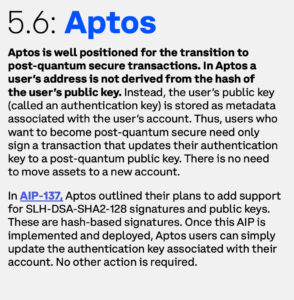
Aptos has adopted the Move programming language and signature infrastructure that maps more accurately to NIST’s post-quantum standards than older systems. This is not a marketing claim, but a meaningful structural benefit.
This comparison is important because quantum threats to Bitcoin include concrete proposals such as the freezing of Satoshi-era wallets and the early output of public keys being made public forever. There is no equivalent governance crisis for chains that incorporate post-quantum considerations into their foundations.
Exclusive to 99Bitcoin readers: Earn $10 USDC when you sign up on Binance
The post Coinbase is Algorand and Aptos Are Better Prepared for the Quantum Threat appeared first on 99Bitcoins.
