


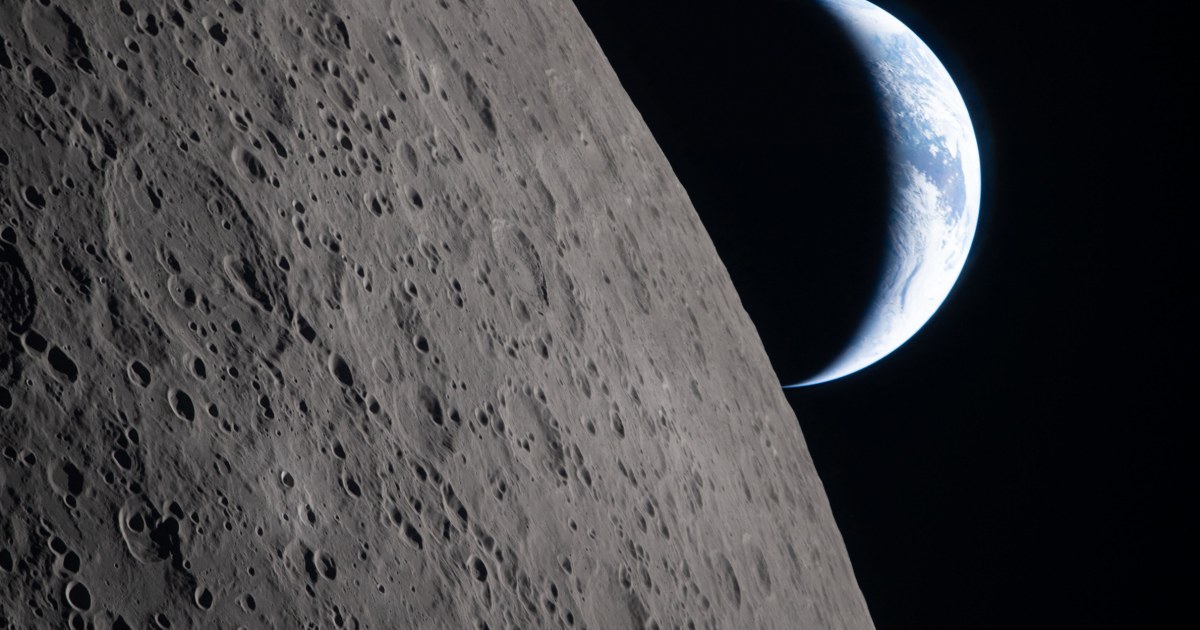
The four astronauts who flew around the moon on NASA’s Artemis II mission are almost on their way home, but one of the most dangerous and nerve-wracking parts of the mission is yet to come.
Subscribe to read this story without ads
Get unlimited access to ad-free articles and exclusive content.

NASA astronauts Reed Wiseman, Christina Koch and Victor Glover and Canadian astronaut Jeremy Hansen are scheduled to return to Earth Friday night after a 10-day stay in space.
Their Orion capsule is scheduled to begin entering the atmosphere around 7:53 p.m. ET, continuing an intense journey expected to last less than 15 minutes. If all goes well, the mission will culminate with a splashdown in the Pacific Ocean off the coast of San Diego at 8:07 p.m. ET.
“There’s a 13-minute period where things have to go right,” Jeff Radigan, NASA’s Artemis II flight director, said at a press conference Thursday.
Reentry is always one of the most dangerous parts of a spaceflight, as the craft can be exposed to temperatures of around 5,000 degrees Fahrenheit as it passes through the atmosphere. But this is especially true for Artemis II. That’s because the Orion spacecraft’s heat shield, a critical layer of bottom thermal protection that protects astronauts from extreme temperatures, has a known flaw in its design.
This mission will be the first time a crew will be in the capsule.
After the 2022 Artemis I mission, an unmanned test flight of the Space Launch System rocket and Orion capsule, NASA discovered unexpected damage to the spacecraft’s heat shield.
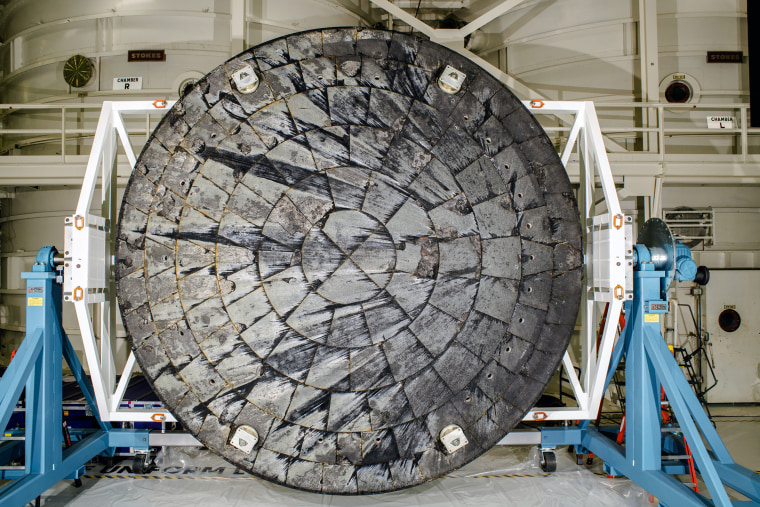
A subsequent investigation by authorities found that some of the material in the heat shield had cracked during atmospheric entry, and that “portions of charred material had peeled off in several places.” Investigation revealed that gas was not venting properly within the outer material of the heat shield, allowing pressure to build up and causing the observed damage.
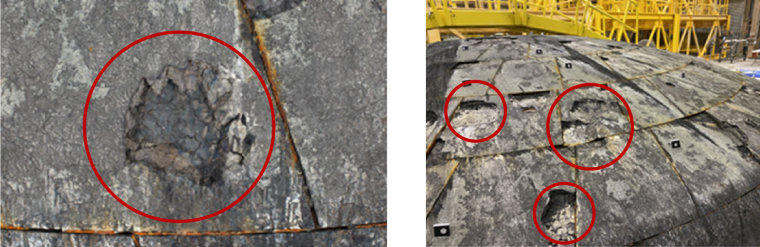
Because of these issues, NASA plans to change the heat shield design for future Artemis flights. The Orion spacecraft used for these missions features a more permeable layer of outer material. However, in the case of Artemis II, by the time NASA learned of the damage sustained on Artemis I, the capsule had already been manufactured and assembled.
So instead of redoing the heat shield, NASA decided to modify the capsule’s reentry path to minimize the risk to astronauts. Normally, the Orion spacecraft is supposed to sink into the atmosphere and rise again like a stone bouncing on water to reduce thermal stress and gravitational acceleration on the capsule before beginning its final descent. But NASA Deputy Administrator Amit Kshatriya said this “skip” would be brief and the capsule would descend faster and at a steeper angle to minimize exposure to the most extreme temperatures.
“All the systems we have demonstrated over the past nine days – life support, navigation, propulsion, communications – all depend on the last few minutes of the flight,” Kshatriya said at a press conference on Thursday.
He added that NASA has “high confidence” in the spacecraft’s heat shield on the revised path.
Still, there are significant risks and four lives are at risk.
Former NASA astronaut Charlie Camarda publicly expressed concerns about the heat shield and said NASA should not have launched the Artemis II mission with the existing design.
“History shows us that accidents happen when organizations think they understand problems they don’t. This problem shows the same pattern that preceded past catastrophes,” he wrote in an open letter to NASA Administrator Jared Isaacman in January.
However, Isaacman said in the same month that he had “full confidence” in Orion’s heat shield.
Wiseman also said he was pleased with the plan.
“If we stick to the new atmospheric entry path that NASA has planned, this heat shield will be safe to fly,” he said at a pre-flight media event in July.
Radigan said the atmospheric reentry program requires the Orion capsule to remain in a very precise orbit. Mission controllers have spent the past day and a half maintaining the Orion spacecraft in its orbit, performing the necessary engine burns to maintain the orbit.
“Don’t do anything that’s impossible,” Radigan says. “You have to hit that angle correctly. Otherwise, atmospheric reentry will not be successful.”

During atmospheric entry, the Orion capsule is expected to reach an estimated maximum speed of nearly 24,000 miles per hour. Astronauts will be exposed to gravitational accelerations equivalent to approximately 3.9 times Earth’s normal gravity.
As the capsule enters the atmosphere, communications blackouts are expected as plasma builds up around the spacecraft and causes interference. Flight director Rick Henfling said at a news conference Wednesday that the outage is expected to last about six minutes.
“At the end of the six-minute blackout, Orion will be at about 150,000 feet, so it will still be descending at a significant rate,” he says.

At an altitude of about 6,000 feet, the capsule deploys three main parachutes that help slow it down to about 20 miles per hour before splashing into the ocean.
The U.S. Navy will support recovery efforts in the Pacific. Once the landing area is determined to be safe, NASA’s plan is to remove Koch from the capsule first, followed by Glover, Hansen, and Wiseman.
Speaking at a press conference on Thursday, Kshatriya praised the crew and said it was time for flight managers, engineers and recovery teams to bring the crew home.
“The crew did their part,” he said. “Now we have to do our thing.”
