


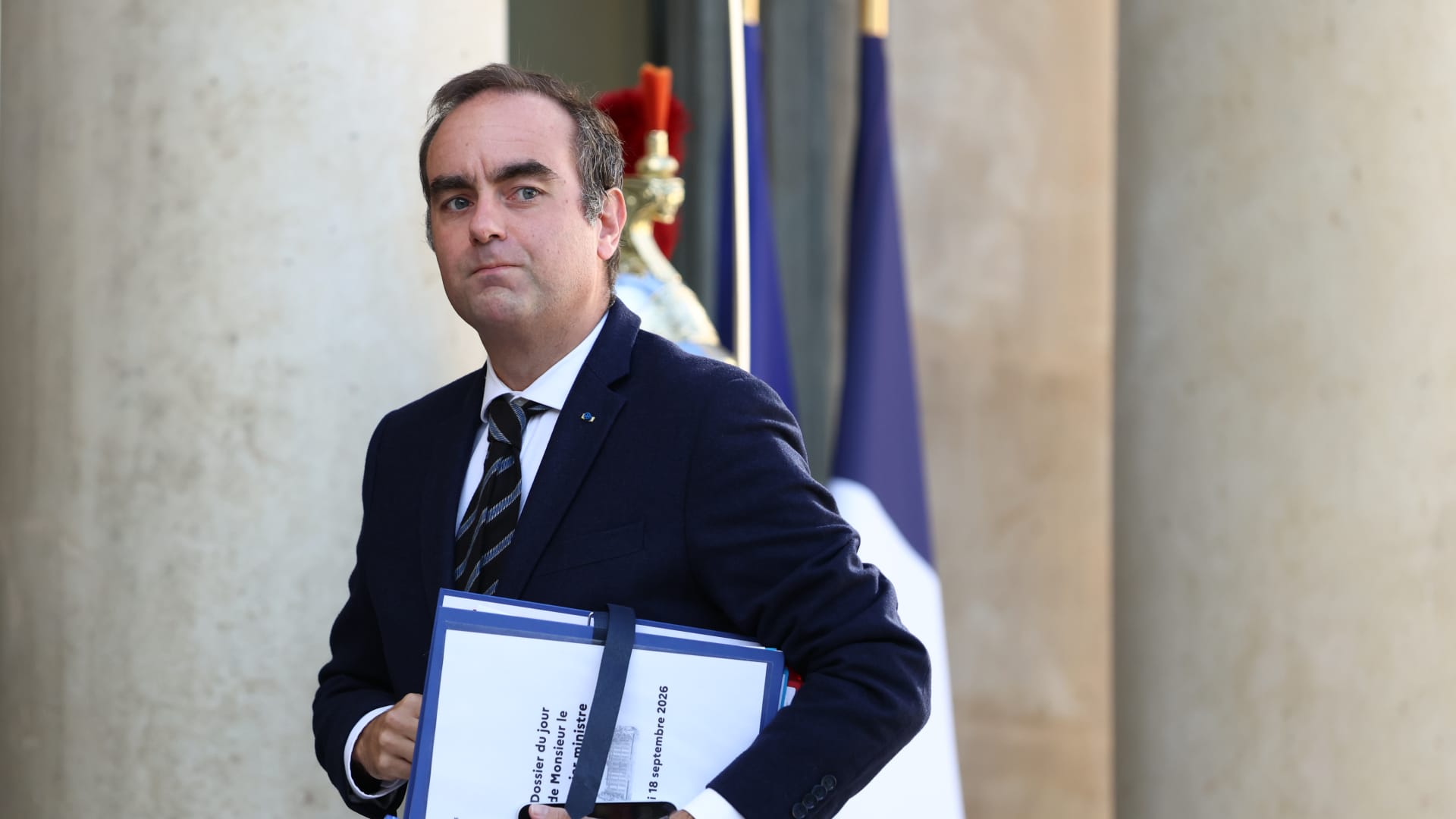
On September 18, 2026, France’s Prime Minister Sébastien Lecornu arrived at the Elysee Palace in Paris amid escalating concerns regarding the country’s financial stability and an impending budget crisis. This year marks a continued trend of increasing risk premiums on French debt, as investors remain wary of political instability that could lead to further governmental upheaval.
The yield on France’s 10-year government bonds, known as OATs (Obligations Assimilables du Trésor), has recently surpassed 4.5% for the first time since 2008. As of Thursday, the yield was recorded at 4.6696%, reflecting a significant uptick in borrowing costs. Notably, this yield now exceeds that of German 10-year bonds by over one percentage point—a situation reminiscent of the euro zone sovereign debt crisis in 2012, increasing concerns among investors.
As one of the countries with the highest government borrowing costs in the G7, France faces an alarming financial landscape. According to the French finance ministry, national debt is projected to reach an unprecedented 119.3% of GDP in 2026, with a further rise to 121.7% by 2027. This trend of escalating debt has only intensified following the turmoil from the July 2024 snap elections, which failed to yield an absolute majority in parliament. Consequently, dissent has erupted within the National Assembly, marked by political factions including the far-right National Rally and the left-wing New Popular Front.
Political instability has led to the ousting of administrations through no-confidence votes in December 2024 and September 2025. In an effort to circumvent parliamentary gridlock, Prime Minister Lecornu utilized constitutional powers to pass the 2026 budget earlier this year. However, as preparations are underway for the 2027 budget, experts warn that the draft may provoke further governmental strife, particularly with contentious measures such as a partial freeze on pensions poised to rally opposition.
‘Time is not in favor’ of French bonds
ING rates strategists Benjamin Schroeder and Michiel Tukker recently noted that the government’s aim to reduce the budget deficit from an anticipated 5.4% to 5% faces significant legislative challenges. The political headwinds are expected to intensify as the country approaches the presidential elections next spring, where extreme political shifts could further complicate governance and budget negotiations.
Consequently, the OAT-Bund spread—reflecting the disparity between French and German borrowing costs—is projected to remain between 100 and 125 basis points in the near future. Concerns persist regarding the European Central Bank’s (ECB) capacity to intervene effectively amid rising inflation pressures, particularly in the context of escalating energy costs and weakening EU unity.
HSBC’s European rates strategist, Chris Attfield, indicated that the current adjustments in the OAT-Bund spreads have exceeded expectations given France’s current debt-to-GDP situation. He emphasized that the ECB’s response would likely be limited to circumstances of extreme market volatility.
In a recent discussion with CNBC, BNP Paribas CFO Lars Machenil underscored the necessity for lawmakers to construct a robust budget while approaching the issue with diligence. “I don’t have a crystal ball, but what I see is that there is a willingness to get this over [the line],” he mentioned, expressing cautious optimism about achieving budgetary consensus prior to impending deadlines.
As France navigates these turbulent financial waters, the road ahead remains fraught with uncertainty, underscoring the critical intersection of economic policy and political stability.
