


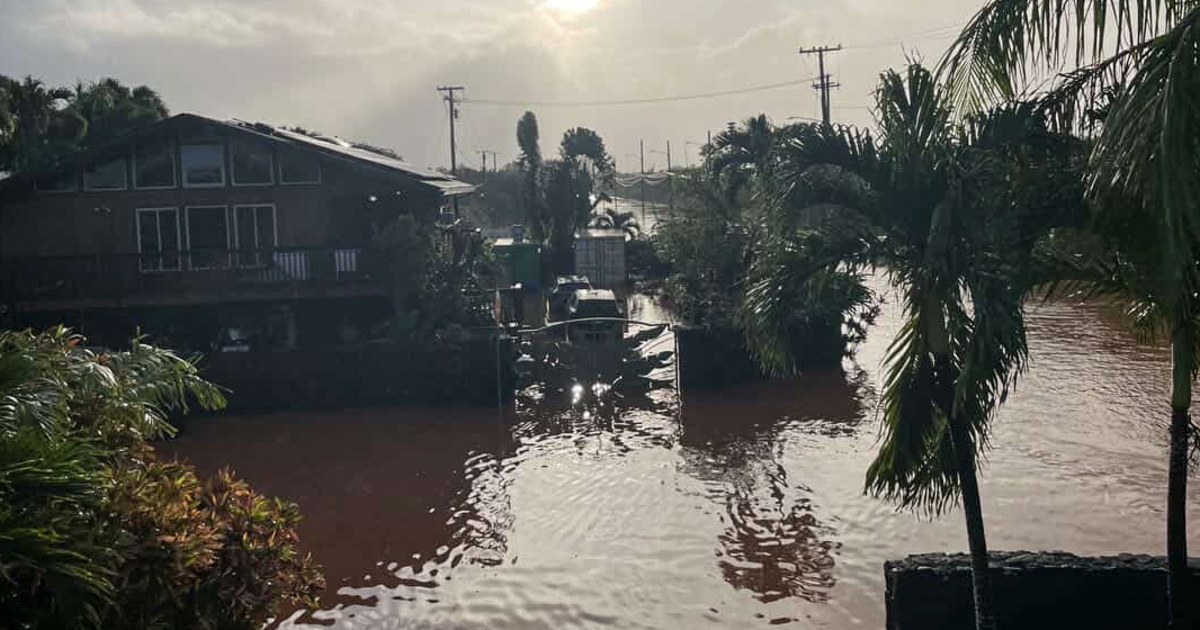
Officials are warning that one of Oahu’s largest dams is in danger of imminent failure after two powerful storms hit Hawaii over the past week.
Water was flowing over the top of Wahiawa Dam on Thursday morning local time. Officials issued evacuation orders for two towns, Waialua and Haleiwa, which were already dealing with localized flooding but could be flooded if the dam bursts.
“There are a little over 4,000 people directly within the dam evacuation area,” said Molly Pierce, a spokeswoman for the Oahu Emergency Management Agency.
Hawaii Governor Josh Green urged residents to follow the guidance of emergency officials.
“If you are in these areas, please evacuate now,” he said in a statement.
The 660-foot-long earthen dam can store up to 9,200 acre-feet of water (about 4,600 Olympic-sized swimming pools). It is equipped with a 183-foot wide spillway.
“It has the potential to fail,” Pearce said of the dam. “Right now, we don’t have a good way to tell if it’s an imminent risk of failure or if it’s just water overflow.”
The dam was built in 1906 and is owned by the Dole Food Company. The area, which holds back irrigation water to form a reservoir called Lake Wilson, was considered in “poor” condition when inspected in 2020, according to the Hawaii Department of Land and Natural Resources. The department said in an email Friday that its flood risk management team is responding to pressing public safety issues and is not available for interviews.
William Goldfield, director of corporate communications for Dole Food Company, said in an email that the company “continues to work closely with authorities and monitor our reservoirs, including Lake Wilson,” with public safety as our top priority.
“The dam continues to operate as designed and there are no signs of damage,” he continued.
The state of Hawaii had been negotiating to acquire the dam from Dole for several years. State records show dam safety officials have been tracking defects in the structure for more than a decade.
“In the event of a major storm, smaller spillways may not be able to pass through the anticipated flooding and could be breached by water overflowing the dam levees,” the state’s chief engineer, Carty Chan, said in a 2024 letter.
The letter states that approximately 2,500 people would be at risk if the dam were to burst.
Honolulu-based NWS meteorologist Stephen Parker said Oahu is expected to remain under a flood watch until Sunday.
“Over the past 12 to 16 hours, we’ve had 8 to 12 inches of rain across northern Oahu,” he said. “It’s hard to find a place that isn’t flooded.”
Nate Serota, a spokesman for the Honolulu Department of Parks and Recreation, said there were multiple reports of flooding on roads in Waialua and Haleiwa, including several cases where authorities sent aerial vehicles to rescue people.
Footage from Oahu shared on social media showed cars submerged in water and nearby residents walking through flooded streets. Mokuleia’s house on the north coast of the island was washed away overnight.
This is the second week of heavy rain in the Hawaiian Islands. More than 5 feet of rain fell in some areas of Maui from March 10th to 16th. The Kona storm is a weather pattern in which winds blow from the south and bring large amounts of precipitation to the leeward areas of the island, which are normally protected from heavy rain.
“The ground was still very wet from last weekend’s system, which didn’t absorb much,” Parker said Friday.
One or two more showers are expected from the current storm, he added. Flow gauges suggested water levels at Wahiawa Dam were dropping by Friday afternoon, but the dam was not out of the woods, Parker said.
“If a large number of doses are taken tonight, that threat will be reactivated,” he says.
Gov. Greene on Friday closed all Hawaii state offices and departments, except for emergency management, and sent employees home.
“With catastrophic flash flooding already impacting parts of Oahu, including evacuation orders on the North Shore and possible dam-related impacts, we are taking this situation extremely seriously,” he said. “Closing state offices will allow families to focus on getting to a safe location.”
This extreme rain coincides with a period of severe weather across the United States. California and the desert Southwest are experiencing a severe heat wave this week. Arizona’s Lake Martinez on Thursday hit 110 degrees Fahrenheit, the highest March temperature ever recorded in the United States. Heavy snow fell across the Midwest earlier this week, sparking the worst wildfires in Nebraska’s history.
