


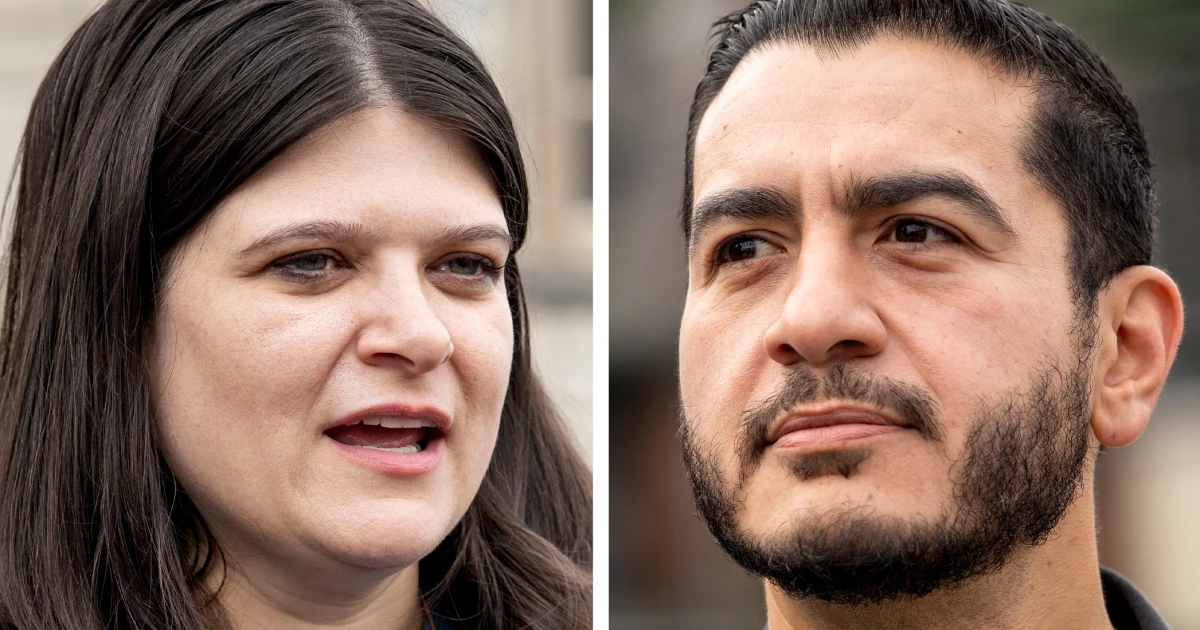
In the lead-up to a scheduled rally in Detroit, tensions have intensified between Senate candidate Abdul El-Sayed and Rep. Haley Stevens (D-Mich.). Just days before the event, both figures released statements that criticized one another amid El-Sayed’s ongoing campaign.
Stevens asserted that El-Sayed, who emerged victorious over her in a contentious Democratic primary earlier this year, should condemn a controversial advertisement from the progressive group Rebellion PAC, which she described as antisemitic. The ad purportedly insinuates that rising grocery prices are linked to Israel’s actions in Gaza, stating that Michigan families cannot afford essentials due to funding being allocated towards “killing Palestinians.”
Stevens emphasized this sentiment in her statement, saying, “This ad tells Michigan families they cannot afford groceries because their money has to be set aside for killing Palestinians, and it blames our close ally Israel for everything Michiganders cannot afford.”
She also demanded El-Sayed apologize for remarks he has made during his campaign that she believes are related to the ad’s narrative, urging him to exclude Israel from his discussions about economic issues in Michigan. “Abdul promises to get money out of politics. He can begin by getting Israel out of his explanation for everything Michigan cannot afford,” Stevens added.
Despite Stevens’ insistence, El-Sayed’s campaign distanced him from the advertisement, clarifying to The New York Times that he is not affiliated with Rebellion PAC.
In a counterstatement, El-Sayed criticized Stevens for what he perceives to be an unnecessary continuation of their primary rivalry, asserting that his campaign is focused on vital issues such as affordability and healthcare. “That focus is why our people-powered campaign defeated a historic $70 million in outside spending from big corporations and AIPAC on behalf of Congresswoman Stevens,” he stated, referencing Stevens’ prior backing from pro-Israel lobbying entities during their primary contest.
This public disagreement marks a shift from their prior reconciliation, where both candidates had agreed to share a stage at the upcoming event in Detroit alongside Rep. Jim Clyburn (D-S.C.). The timing of their conflict comes just four days before voters will decide between El-Sayed and his Republican opponent, Mike Rogers, in a closely watched race characterized as a toss-up by the nonpartisan Cook Political Report.
Uncertainty looms over their planned joint appearance on Sunday, as representatives for both El-Sayed and Stevens declined to comment on the situation or confirm their attendance at the event in light of their recent exchange.
Earlier in the week, during a CNN interview, Stevens expressed her intention to vote for El-Sayed while reiterating her call for him to denounce the controversial ad. This came after her fiancé, Jason Turkish, publicly announced his support for Rogers, leading to questions about Stevens’ position and unity within the Democratic coalition. “Of course, I’m voting for our Democratic nominee for Senate. I’m voting for the Democratic ticket. But I want to encourage this campaign to shut out the hate and to call it out and to make people who are in my coalition feel comfortable about coming to the polls,” she stated.
The exchange between El-Sayed and Stevens has drawn attention from other Michigan Democrats amid broader party efforts to secure a significant Senate seat crucial for congressional control. Michigan state Sen. Mallory McMorrow publicly questioned Stevens’ motives during an appearance on CNN, saying, “First of all, I have no idea what the hell Haley Stevens is doing. This is a moment where we have to recognize the stakes.”
Conversely, Rep. Debbie Dingell, an influential member of Michigan’s delegation, appeared on NBC News’ “Meet the Press NOW” to downplay the tensions, claiming she played a role in facilitating the event with Clyburn, suggesting that others are amplifying the discord unnecessarily. “I think a lot of people are trying to create more controversy here, when the real discussion should be about what’s been happening in Washington and how we’ve got to stand up to what we’ve seen in the last two years,” Dingell remarked.
