


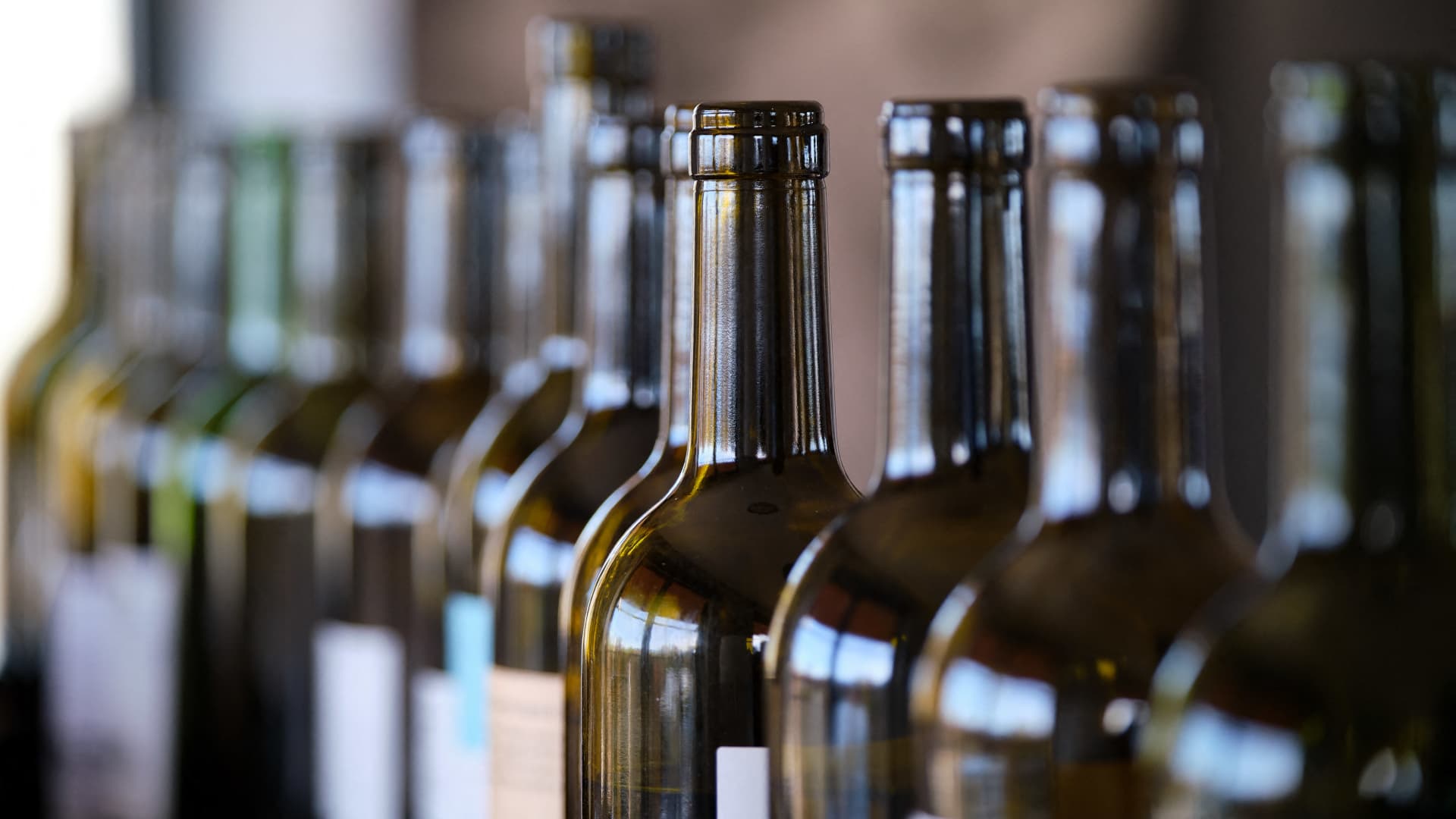
Florent Latour, the CEO of Maison Louis Latour, a leading owner of Grand Cru vineyards in Burgundy, expressed his hopes for a wetter summer as the wine industry grapples with challenging climatic conditions. “We felt we were so close,” Latour shared with CNBC, reflecting on the past season’s struggles. “Just a bit more rain would have produced a fantastic harvest on both counts, but we had to settle for quality, and about half of a harvest.”
This sentiment resonates throughout France, as unprecedented summer heat and severe droughts severely impact the nation’s renowned wine sector. The agriculture ministry of France warns that wine production might plummet to a 70-year low by 2026, signifying a concerning trend of decreased output over the past several years.
Vines torn off in a field, in Roquefort-des-Corbieres, south-western France, on February 3, 2025.
Valentine Chapuis | Afp | Getty Images
Despite a relatively decent 2023 vintage, Jean-Marie Cardebat, who chairs the wines and spirits department at INSEEC Grande École university, noted the overall decline in yields since the start of the decade. “We are realizing that no region in France is safe from heatwaves today,” he indicated. Ironically, the more temperate regions such as the Loire Valley and Champagne are faring worse than the warmer areas of Bordeaux and Languedoc-Roussillon, which are seeing improved harvests.
Cardebat pointed to France’s lack of preparedness for climate change as a significant challenge. He remarked, “Spain is more often affected by heatwaves and global warming; however, it is better prepared,” largely due to its established irrigation systems, which France only permits in exceptional circumstances. Setting up such infrastructure could take significant time in France.
Adapting to Climatic Pressures
The repercussions of climate change are igniting discussions around the rigid regulations governing the French wine industry. Last year, the estate Chateau Lafleur made headlines when it opted to disengage from the official Pomerol and wider Bordeaux designations for its six wines, citing strict appellation rules as an obstacle to necessary adaptations in the face of climate challenges.
Close up image of white wine bottles lined up for a blind tasting of Jurancon wine organized at the Hotel Parc Beaumont in Pau in the department of Pyrenees-Atlantiques in the south of France on December 1, 2025.
Laurent Estreboou | Afp | Getty Images
The Guinaudeau family, owners of Chateau Lafleur, stated that the inflexible regulations regarding irrigation, grape varieties, and planting densities hindered their ability to quickly respond to the evolving climate. They emphasized the need for regulatory flexibility to effectively manage the challenges posed by climate change: “It is a bold decision that enables the entire Lafleur Family … to ensure the perennity of our vineyards and the quality and identity of our wines. In a word: the future.”
Challenges of Harvest Timing
Another consequence of rising temperatures is the earlier harvest season, which has introduced significant logistical complications for winemakers. In 2023, Latour’s estate commenced harvesting on August 14, marking the earliest start to the season in its history. “If you take it per decade, the midpoint of the harvest is three days earlier every decade,” Latour noted, illustrating that it has become a month earlier since the 1930s.
Harvest time at the Maison Louis Latour estate in Burgundy, France.
Maison Louis Latour
Latour explained that the primary hurdle faced during the harvesting process is now related to workforce management: “You have to have the flexibility to get your team in the vineyard at essentially a moment’s notice because your predictions turn out to be wrong.”
Economic Implications
The ongoing climate changes are set to have significant economic ramifications for the French wine sector and the broader economy. Cardebat indicated that the current year’s harvest might result in France dropping to third place in global wine production— a notable decline from its leading position just a decade or so ago. “This shift is symbolic, but also important,” he explained, adding that it represents a substantial potential loss of revenue for France and its wine producers.
According to a government forecast, France’s economic growth is expected to decelerate to 0.5% this year, reflecting the adverse effects of the recent heatwave and drought, which are projected to cost the nation 0.1 percentage points of growth.
Simultaneously, wineries are grappling with escalating operational costs. “Treasuries are currently depleted. The more the climate is disrupted, the less capacity there is to invest,” Cardebat noted, creating a “vicious circle” for the industry.
He also highlighted a troubling rise in business failures within the wine sector, which have reportedly tripled between 2019 and 2025, with forecasts suggesting that 2026 may witness similar turmoil.
In response to these challenges, the French government has proposed a €1 billion ($1.15 billion) emergency aid package aimed at aiding farmers and vineyard owners affected by the extreme weather.
The increasing need for investment could lead to greater consolidation within the sector, as businesses seek to scale up to manage these rising financial burdens more effectively. Latour acknowledged that “quality does require a certain scale at this point in time, because of all this human resources, equipment, and facilities investment,” though he also remarked on the growing appreciation for family-owned operations.
Navigating New Opportunities
Pinot grape sorting at the Maison Louis Latour estate in Burgundy, France.
Maison Louis Latour
As part of a government initiative, approximately 4% of France’s vineyards are set to be uprooted by 2026, where growers will receive €4,000 ($4,590) per hectare for the permanent removal of their vines. This crisis is pushing the country’s wine producers to explore new markets and products rapidly.
Cardebat noted opportunities for innovation within the industry, suggesting entirely new product lines, such as ready-to-drink options. The United States serves as a promising testing ground for these novel offerings, which could help attract consumers with diverse preferences. Furthermore, Cardebat cited South America, Brazil, and India as emerging markets for French wine, aided by new trade agreements.
While Latour acknowledges the ongoing challenges, he remains hopeful for the future of France’s winemaking. He stressed the importance of making high-quality wine accessible while effectively communicating the heritage and nuance of each appellation to new generations. “As long as we’re able to do this … and as long as quality is there and can be appreciated by the consumer, we have, I think, a very attractive future.”
