


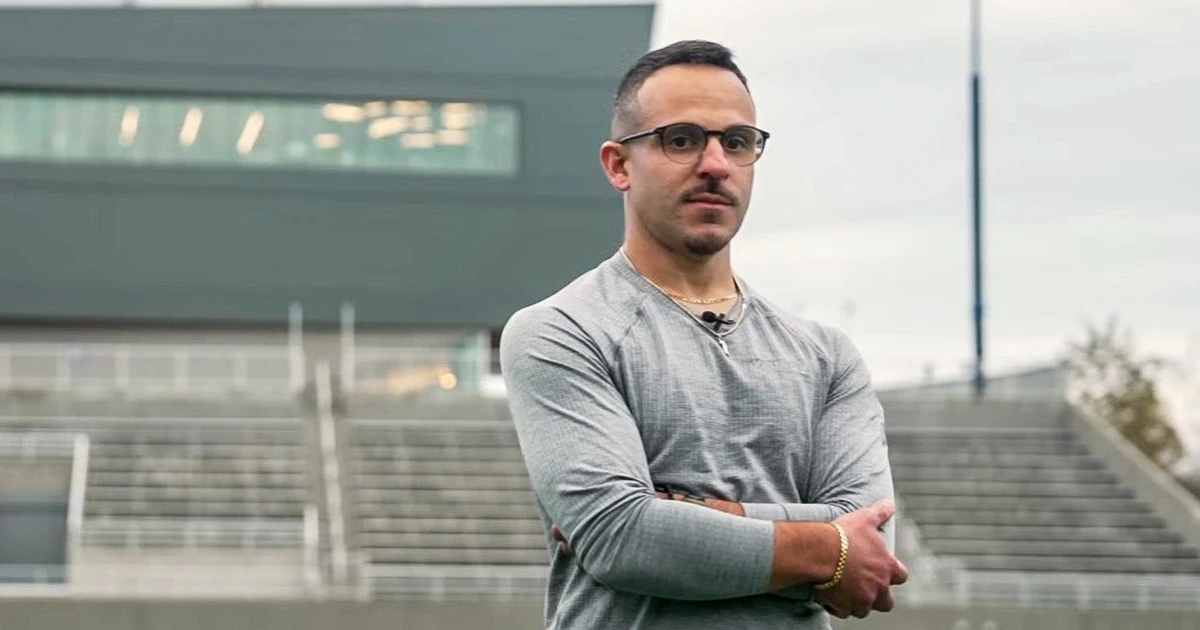
After reaching a major career milestone, Chenzo Funari found himself questioning the very goals he had worked so hard to achieve. “I was kind of at the mountaintop I’d wanted to climb since high school,” he shared in a recent interview with NBC News. “And now that I’m here … is this really what I want my life to be?”
Funari’s transition from an aerospace engineer to a member of an NFL coaching staff is a remarkable journey marked by unexpected turns. With an advanced degree and experience at SpaceX, he made the surprising decision to pivot away from a promising career in aerospace engineering.
Approximately 18 months into his role at SpaceX and before he even turned 30, Funari chose to leave the organization. Many around him questioned his choice. “The question was always like, ‘Are you crazy?’ Or a statement like, ‘What is wrong with you?’” Funari recalled, chuckling at the incredulity of friends and family. However, one voice of encouragement came from his mother, who simply advised him, “YOLO—you only live once.”
Originally from Cleveland, Funari’s early passion for football was hindered by a series of knee injuries during his teenage years, compounded by his 5-foot-5 stature. After leaving SpaceX, he briefly worked at TaylorMade Golf before pursuing a volunteer coaching position at Youngstown State University in Ohio a few months later.
Courtesy Chenzo Funari
Funari’s initial experiences involved nights spent on air mattresses, coupled with a significant degree of uncertainty regarding his future. Nonetheless, he recognized a parallel between creating defensive schemes in football and developing aerospace designs: both processes begin as concepts, advance through design and manufacturing, and culminate in testing. “Something starts as an idea, a concept,” he explained. “Then you design it on the computer, you get it manufactured, built and then you test it.”
Funari drew similarities between aerospace engineering and football. He described it as a comparable journey of taking ideas and turning them into actionable results. “And to me, I view it as the same [with football], what these guys are able to do and the life that they bring to our defense,” he added, alluding to the complexity that many attribute to the sport.
His evolving career has yielded impressive results. Now serving as the assistant defensive backs coach for the Minnesota Vikings, Funari has garnered respect within the organization. Head coach Kevin O’Connell referred to him as “our genius,” highlighting Funari’s unique ability to identify and analyze opposing offenses as a formidable advantage for the team.
“We’re having some conversation, and he will have a pause,” O’Connell noted, humorously interpreting Funari’s thoughtful demeanor. “It’s not that he needs to have a pause because he’s thinking of something. He’s trying to figure out just what layer of his brain he’s going to have to go to, so it can make sense to somebody like me.”
Meanwhile, defensive coordinator Brian Flores, renowned for his innovative blitzing schemes, acknowledged Funari’s analytical contributions. After receiving an extensive research packet from Funari on an opposing quarterback, Flores remarked, “I think some of the information can be overwhelming and hard to really drill it down. But when I got this information from Chenzo, it made a lot of sense. He’s got a football background, as well, and he’s able to tie the whole thing together.”
