


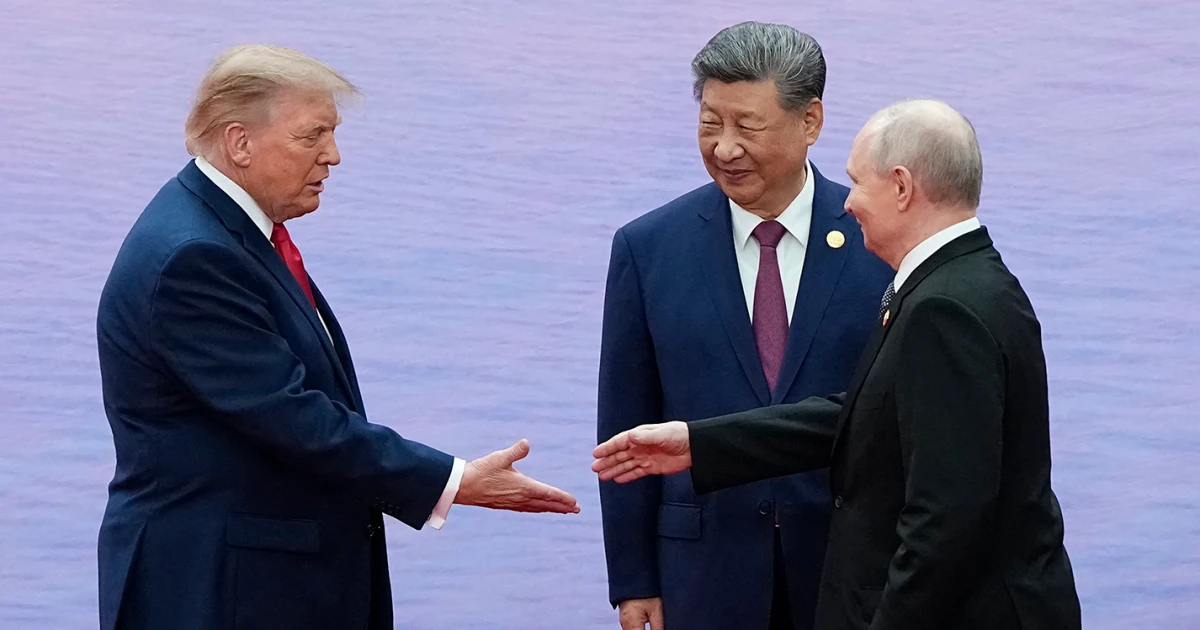
In a significant trilateral meeting on Thursday, President Donald Trump prioritized nuclear nonproliferation on the agenda, alongside Chinese President Xi Jinping and Russian President Vladimir Putin. However, discussions surrounding new commitments to limit their nuclear arsenals appeared to lack enthusiasm from the two foreign leaders.
Since his first term as president, Trump has advocated for China to participate in a nuclear arms control agreement alongside the U.S. and Russia. Yet, he has tempered expectations regarding potential outcomes from their meeting in Shenzhen, China, which coincides with a summit of leaders from the Asia-Pacific region.
The backdrop for the meeting includes Russia’s suspension of participation in the New START treaty—its last remaining nuclear arms control agreement with the U.S.—following its invasion of Ukraine in 2022. While Russia has adhered to the treaty’s limitations for an additional year following its expiration in February, Trump has emphasized the necessity of including China in future agreements.
China has maintained that any nuclear arms control discussions should be confined to the United States and Russia, who collectively account for nearly 90% of the world’s nuclear arsenal, each possessing over 5,000 warheads. Estimates from the Pentagon suggest China currently has about 600 warheads, with projections that this figure could increase to 1,000 by 2030 if current expansion trends continue.
“China is building up its nuclear arsenal to a very significant degree, and it will continue to do so,” stated David Sacks, a senior fellow for Asia studies at the Council on Foreign Relations, highlighting the ongoing buildup.
While the Chinese foreign ministry has not confirmed whether nuclear arms control will be part of the trilateral discussions, spokesperson Mao Ning noted the leaders plan to engage in “an in-depth exchange of views on important issues bearing on global peace.” In a related conversation last week, U.S. Secretary of State Marco Rubio and Chinese Foreign Minister Wang Yi recognized the need for genuine leader-level dialogues aimed at promoting peace and denuclearization; however, the Chinese summary did not reference this topic.
Trump acknowledged the challenges of engaging Russia and China in nuclear disarmament. “So we’re going to talk about denuclearization. Tough subject because it’s very hard for any of us to say we’ll get rid of our nukes, right? But especially since you do have other countries,” he stated, indicating the complexity inherent in the discussions.
As the Asia-Pacific Economic Cooperation summit commenced, both the U.S. and Russia demonstrated military might. The U.S. conducted an unannounced test of an unarmed intercontinental ballistic missile at Vandenberg Space Force Base, while Russia sent two strategic bombers to Vietnam, coinciding with Putin’s visit to China.
Although immediate breakthroughs are unlikely from the summit, experts believe it could help initiate a process conducive to formal negotiations on topics related to nuclear risk reduction and arms control. Daryl Kimball, executive director of the Arms Control Association, stated, “A top priority for all three leaders should be to head off a costly, escalatory nuclear arms race involving the further buildup of nuclear forces and the resumption of nuclear testing by any state.”
Da Wei, director of the Center for International Security and Strategy at Tsinghua University in Beijing, mentioned that the complexities of nuclear arms control might not render it a suitable topic for the trilateral meeting, given the limited time the leaders have together. However, he suggested that a mutual acknowledgment of the untenability of nuclear war could be beneficial.
Rubio has also recognized that establishing a new agreement might require considerable time. “Past agreements, including New START, took years to negotiate and were built upon decades of precedent. They were also between two powers, not three or more,” he reflected in a February Substack post. Nevertheless, he emphasized that pursuing this goal is essential, despite the challenges involved.
