



Charles Hoskinson urged Cardano DReps to support the research funding proposal, warning that failure to do so could undermine its identity as a research-driven blockchain, one of the network’s core value propositions.
Hoskinson said in a livestream from the UK on May 21 that Cardano is in “financial season” and faces a tougher funding environment than last year. He said the ecosystem is seeking about $52 million in funding this year, down from about $98 million last year, due to budget cuts that have already affected engineers and community teams.
“A lot of people have had to make great sacrifices,” Hoskinson said. “Good people have had to leave. Engineers have also been let go. Our community team is eliminating familiar and new faces alike.”
But the proposal that aroused his deepest concerns was research. Hoskinson said he has seen a “disturbing trend” of some DReps voting against funding Cardano research groups, despite Cardano’s explanation of Cardano’s fundamental role in the network’s development.
Hoskinson defends Cardano’s research core
Hoskinson framed the debate as something bigger than a budget debate. In his view, Cardano’s long-term research program is the “spine and backbone” of the ecosystem and the main reason the project can differentiate itself from other major blockchains.
“The spine and backbone of what makes Cardano Cardano has always been and always will be the fact that we are a science coin,” he said. “We are a research coin. Over the past decade, hundreds of millions of dollars and countless researchers have been involved in creating the world’s largest research group in cryptocurrencies.”
He cited Cardano’s efforts in proof-of-stake research, enhanced UTXOs, Plutus, sidechains, and Bitcoin-related DeFi research as examples of the group’s work. He also argued that the network’s academic connections, which span institutions such as Stanford University, the University of Edinburgh, and the University of Wyoming, cannot be easily replaced.
Hoskinson said critics of the proposal argue that research funding should be split up to allow ecosystems to “choose” which areas and people remain. He rejected this framework on the grounds that it would force decisions that the ecosystem is incapable of making without harming the entire research operation.
“So I asked DReps: Which scientists would you like us to fire?” he said, before naming several researchers involved in the development of Cardano’s technology. “And if not humans, then probably institutions. Which institutions would you like to close? And which research questions do you feel are unnecessary because you are well qualified?”
Warning about talent absconding
A key part of Hoskinson’s argument was that if the project showed that Cardano researchers’ work was no longer valued, they could be co-opted by better-funded rival ecosystems. He said other blockchains with large financial assets are also likely to interest the same cryptographers, programming language experts and distributed systems researchers.
“If you treat these people like a commodity, they’re going to leave,” Hoskinson said. “They will defer to other ecosystems that have more capital, have more stability and certainty, and will pay more.”
He warned that the losses would not be easily recouped. He argued that academic and technical talent depends on long-term stability, and once researchers move to other ecosystems, Cardano may not be able to retrieve them. “We can’t get this back. This is a one-way door. If you lose your best people, we can’t get them back. We have no right to say sorry.”
Hoskinson also linked this issue to market perception. He asked what the investment case for Cardano would be over the next 3-5 years if the ecosystem is no longer willing to support research. Without that tier, Cardano would need to focus more on metrics such as monthly active users, TVL, and transaction volume, he suggested.
The livestream ended as a direct appeal to DReps who have not yet voted and to those who voted against the proposal. Hoskinson called for reconsideration, saying research funding is not a discretionary item, but part of Cardano’s long-term competitive position.
“You can’t walk without a spine,” he said. “Vote for science. Vote for IOG’s research proposal. This is a fundamental proposal that we need and we cannot afford to lose.”
At the time of writing, ADA was trading at $0.2499.
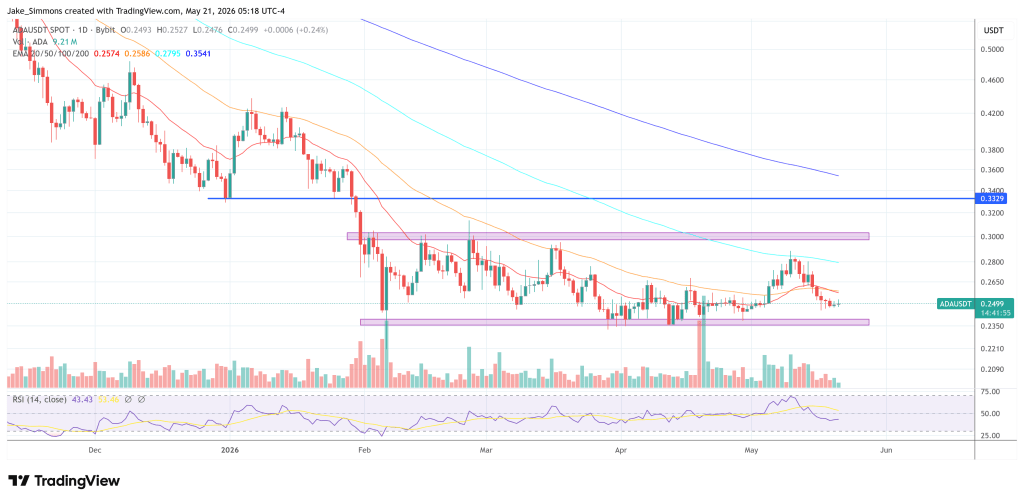
Featured image created with DALL.E, chart on TradingView.com

bitcoinist’s editorial process focuses on providing thoroughly researched, accurate, and unbiased content. We adhere to strict sourcing standards, and each page is carefully reviewed by our team of top technology experts and experienced editors. This process ensures the integrity, relevance, and value of your content to your readers.
