


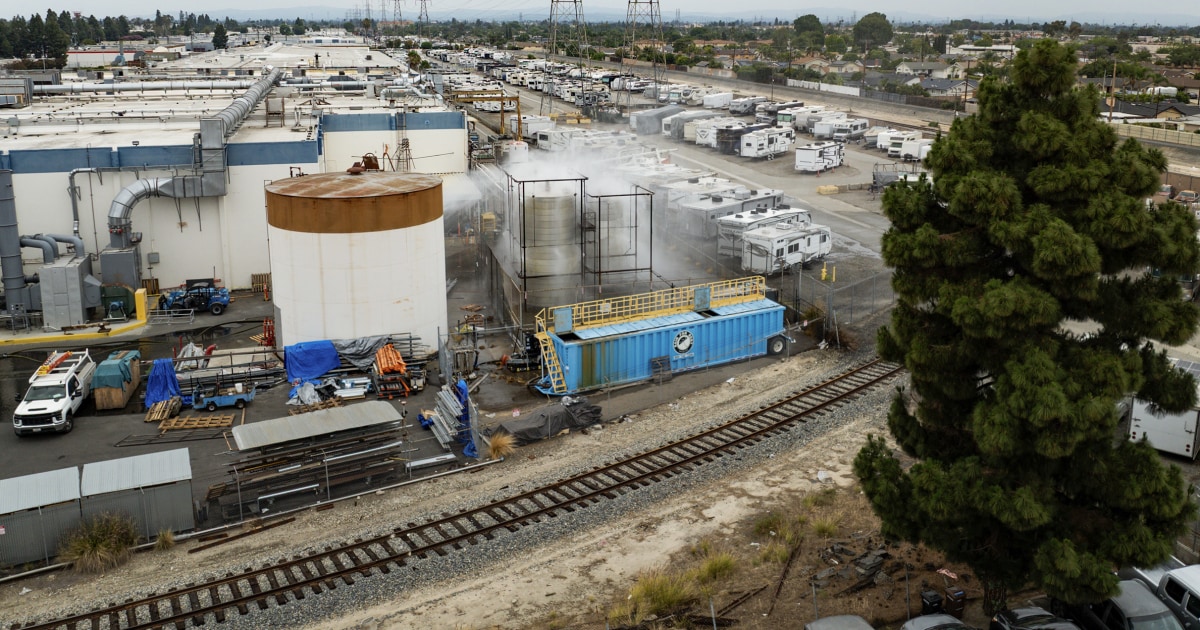
The remaining 16,000 residents of the Southern California city were allowed to return home on Tuesday, days after the threat of a catastrophic chemical tank explosion raised concerns about an environmental disaster.
Subscribe to read this story without ads
Get unlimited access to ad-free articles and exclusive content.

The crisis at GKN Aerospace Corp.’s 7,000-gallon tank of the toxic and flammable chemical methyl methacrylate in Garden Grove, first discovered Thursday, prompted the evacuation of tens of thousands of people.
By Tuesday night, there was no longer any explosion risk, chemical leak or fire risk, and there was no danger to the public, according to the Orange County Fire Department.
“All evacuation orders related to the Garden Grove hazardous materials incident have been lifted,” the agency said in a statement.
At the peak of the emergency, about 60,000 people were forced from their homes in Garden Grove and nearby cities. Most evacuation orders were lifted on Monday, but about 16,000 people remain told to stay home because a slight risk of fire or explosion remains.
At a community meeting Tuesday, some residents questioned why dangerous chemicals were being allowed at the facility in Garden Grove, a city of about 171,000 people 35 miles southeast of Los Angeles.
Mayor Stephanie Klopfenstein said investigations will be conducted at the city, state and federal levels.
“Our community has a right to know what happened, why it happened and whether any laws or regulations were violated,” she said.
At 3:22 p.m. Thursday, firefighters responded to a 911 call regarding leak activity at GKN Aerospace and found a pressure valve at the top of one of the three tanks releasing steam, Orange County Incident Commander Craig Covey announced at the meeting.
He said there was a problem with a valve in the refrigeration system that was supposed to keep the tank at 50 degrees Fahrenheit, causing it to overheat.
“That tank was ready to explode,” Covey said.
He said the company’s sprinklers were activated to try to cool the tank, and the fire department poured 1,250 gallons of water into the tank with a hose.
“These cooling measures were successful and relieved the pressure,” Covey said.
Covey said gauges showed temperatures in the tank reached at least 100 degrees over the weekend. According to the Fire Department, the temperature in the main tank remained at 92 degrees on Tuesday.
Cracks in the tank also helped relieve pressure, allowing the crew to take more proactive measures. Had the worst feared boiling liquid expanding vapor explosion (BLEVE) occurred, it would have been a disaster, officials said.
A GKN spokesperson said early Tuesday that they are “continuing to work 24 hours a day” with the Orange County Fire Department, the Department of Environmental Protection and others.
“We apologize for the continued disruption this incident has caused. We continue to prioritize the safety of our neighbors and community,” a spokesperson said in a statement.
