


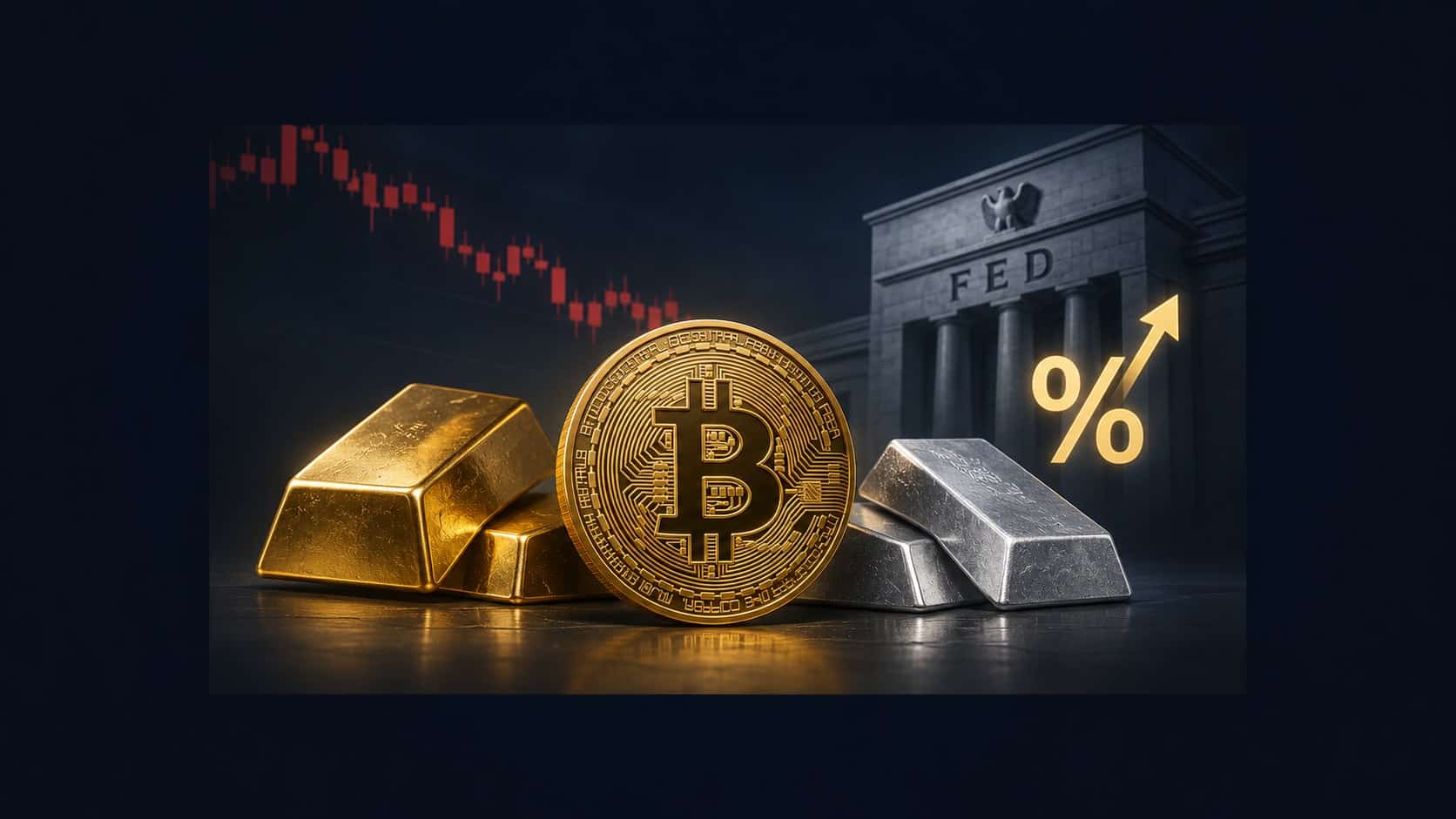
Gold (XAU) witnessed a decline of 2.5%, settling at approximately $3,770 per ounce on Wednesday, November 18. This downturn came as traders anticipated a potential interest rate hike by the Federal Reserve in December. Silver experienced a sharper fall of 3.3%, priced at $45.70. Both precious metals are now trading at their lowest levels since September 2025. Meanwhile, Bitcoin remained relatively stable around $64,600, yet it has shown a more substantial decline compared to gold and silver since positive outlooks emerged.
Gold falls below $3,800 to 14-month low as Fed’s hawkish outlook and strong dollar weigh on bullion – FX
— First Squawk (@FirstSquawk) November 18, 2026
Analyzing the market movements since November 5, when the sentiment shifted due to a robust October employment report, gold has fallen 8.4%, Bitcoin by 15%, and silver by 12.5%. Concurrently, the US dollar index increased by 2.2%, and the 10-year US Treasury yield rose from 4.84% to 5.10%. Higher interest rates impact non-yielding assets, causing gold, silver, and Bitcoin to reflect a downward trend. The upcoming Federal Open Market Committee meeting on December 8-9 will therefore be pivotal.
Declines in Precious Metals
Gold briefly peaked around $5,320 per ounce on COMEX futures in late January but has since plummeted by 29%. Silver has seen an even more significant 60% drop since its January high of $115. On November 18, gold prices reached $3,832, continuing their downward trajectory due to expectations surrounding Federal Reserve policy.
Rate Hike Predictions and Market Impact
The market anticipates another Federal Reserve rate hike. As of November 5, the probability of a December increase was estimated at 67%. Following a strong employment report on November 6, which revealed a surge of 165,000 new jobs—far exceeding forecasts—sentiment shifted further. Subsequent data indicated unexpected inflationary pressures prompting comments from Fed officials, leading to heightened expectations of a rate increase. By November 18, the CME FedWatch tool recorded a 95.4% likelihood of a quarter-point hike.
This anticipated quarter-point increase would adjust the Fed’s target range to 4.00-4.25%, marking the second such adjustment in 2026. Fed Director Christopher Waller also suggested that a potential half-point increase should be considered.
Central Bank Buying vs. Market Forces
Notably, central banks continued to purchase gold, acquiring 675 tonnes in the first three quarters of the year. However, this demand has been insufficient to counterbalance the impacts of a strengthened dollar and rising yields.
Bitcoin’s Correlation with Precious Metals
While Bitcoin is often referred to as “digital gold,” its recent performance has not mirrored that of traditional safe-haven assets during market selloffs. A review of daily trading data from October 29 to November 18 shows that gold declined in 9 of the 15 sessions analyzed, while Bitcoin fell on 7 of those days. Notably, even on days when gold prices increased, Bitcoin often did not follow suit, demonstrating a lack of safe-haven characteristics during times of market stress. Bitcoin’s correlation with stock indices is also noteworthy, aligning more closely with the S&P 500 (0.66) than with silver (0.54) or gold (0.36).
Current sentiment in the crypto market remains pessimistic, as reflected by the Crypto Fear & Greed Index, which stands at 11, indicating “extreme fear.” This may lead to further selling pressure in the absence of positive catalysts.
Looking Forward: The December Fed Decision
The likelihood of a quarter-point rate hike in December remains high. However, any unexpected action—such as a larger hike or a pause—could significantly impact market sentiment. A half-point hike prediction has been suggested by some, including Fed official Christopher Waller, yet markets currently expect the increase to be modest.
Bitcoin Price Dynamics
As of now, Bitcoin’s price is around $64,590 on Binance, representing a 48% drop from its record high in October 2025. On the daily trading chart, it sits below both its 50-day and 200-day exponential moving averages of $75,780 and $75,760 respectively, indicating a bearish trend. Key resistance is identified at $65,500—a critical psychological level previously tested multiple times—while support lies at $62,300.
Market analysts suggest that Bitcoin may fluctuate between these two levels leading up to the December 9 Fed decision, heavily influenced by external factors such as interest rates and the performance of the dollar.
Currently, gold, silver, and Bitcoin are closely monitored as reflections of investor sentiment toward Federal Reserve policies, and until the forthcoming meeting, their price movements are likely to continue in correlation with U.S. Treasury yields and the strength of the dollar.
Disclaimer: Coinspeaker is committed to providing fair and transparent reporting. The information presented herein is intended for informational purposes only and not as financial advice. Given the volatile nature of market conditions, it is recommended that readers conduct their own research and consult with a financial professional prior to making investment decisions.
Daniel Frances is a technical writer and Web3 educator specializing in macroeconomics and DeFi mechanisms. A crypto native since 2017, Daniel leverages his background in on-chain analytics to provide evidence-based reports and detailed guides. He holds certifications from The Blockchain Council and is dedicated to delivering reliable information that cuts through market hype and highlights the tangible utility of blockchain technologies.
