


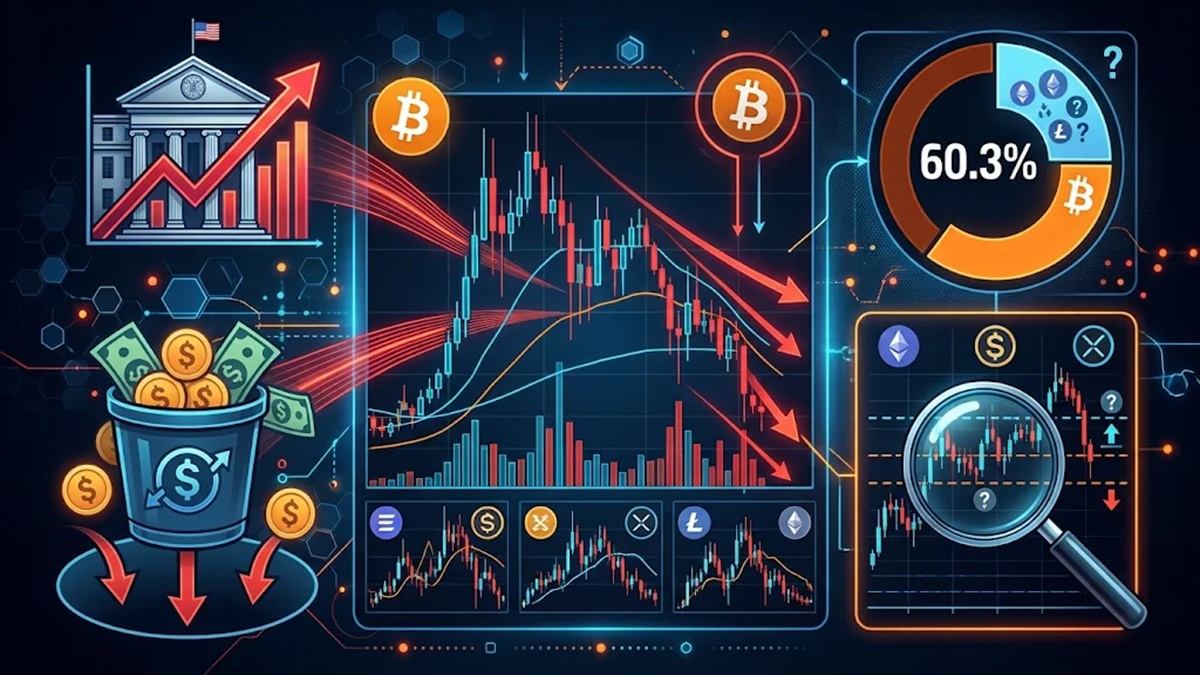
The cryptocurrency landscape is currently marked by increased volatility, influenced significantly by movements in traditional financial markets, decisions on monetary policy, and shifts in capital distribution within digital assets. Although Bitcoin has managed to bounce back temporarily from recent downturns, ongoing technical assessments and trends in institutional investments indicate a tougher road ahead. Notably, crypto analyst and YouTuber Josh cautions that these short-term surges do not necessarily indicate a transformation in market trends, warning that altcoins may struggle further if Bitcoin continues to expand its market dominance.
The Impact of Wall Street and Inflation on Bitcoin
Conventional financial markets play a critical role in shaping the behavior of digital assets. Recent trading sessions have shown that declines in U.S. technology stocks have heightened selling pressure on Bitcoin, further validating its status as a risk-sensitive asset. A recent market analysis from Bitwise reveals that during the significant drop on November 5, when the S&P 500 fell by 4.4%, Bitcoin’s correlation with major U.S. stock indices reached around 0.8. This data illustrates how fluctuations on Wall Street can have a rapid or pronounced impact on cryptocurrency valuation.
While a subsequent recovery in stock markets has provided some temporary relief, substantial economic hurdles remain. The U.S. Bureau of Labor Statistics (BLS) reported on November 10 that month-over-month headline inflation increased by 0.4%, surpassing an anticipated rise of 0.3%, coupled with a 0.3% uptick in core inflation, which excludes volatile food and energy prices. This news has reignited concerns regarding enduring inflation and its potential ramifications on Federal Reserve policies.
In this context, Bitcoin faces challenges as sustained higher interest rates may diminish the attractiveness of more speculative investments. Josh emphasizes that the recent stock market recovery should be interpreted as a transient phase, not a definitive sign of underlying structural improvement. The ongoing anxieties regarding inflation and forthcoming Federal Reserve measures may continue to limit the liquidity available for higher-risk investments.
Bitcoin’s Critical Support Levels and Market Dominance
From a technical standpoint, the price range between $74,000 and $76,000 is crucial for Bitcoin’s stability. Josh specifically notes that $75,000 is a key support threshold, while the level at $76,400 is significant for potential recovery if buying activity increases. A persistent drop below this lower support could lead to further declines, contingent on trade volume and buyer engagement.
Institutional investment trends are also signaling caution. Data from November 5 indicated that U.S. spot Bitcoin ETFs experienced net outflows of approximately $430.2 million. This was followed by further withdrawals totaling around $411.9 million on November 6, with continued selling pressure resulting in additional outflows over the following days. Cumulatively, outflows exceeded $1.1 billion during this period. This trend reflects a decline in institutional participation, contributing to Bitcoin’s struggles to regain higher price levels.
One of the most telling indicators of the overall cryptocurrency ecosystem is Bitcoin’s market dominance. As reported by TokenPost on November 10, Bitcoin dominance climbed to 60.3%, a modest increase from 60% the previous week. In contrast, the Altcoin Season Index decreased to 38 points, down from 47, indicating a limited performance among alternative cryptocurrencies compared to Bitcoin. Typically, readings of 75 or higher suggest an altcoin season.
This divergence is significant, revealing that a limited number of major altcoins are outpacing Bitcoin. Furthermore, Ethereum’s proportion of total market capitalization dropped from 10.6% to 10.3%. If Bitcoin dominance crosses and stabilizes above 61%, Josh warns, altcoins may face intensified pressure, regardless of Bitcoin’s ability to maintain its price.
Altcoin Market Pressures: Ethereum, XRP, and Solana
Several major altcoins are grappling with distinct challenges, each significantly influenced by Bitcoin’s performance. For instance, Ethereum has been trading around the critical $2,000 mark but is losing ground against Bitcoin, as identified by Josh, who notes that persistent bearish divergences cast doubts on the likelihood of a sustainable upward trend.
XRP, on the other hand, is showing signs of weakness, with critical support levels located between $1.00 and $1.05. Its performance is further hindered by diminishing momentum against Bitcoin. As the Relative Strength Index (RSI) approaches oversold conditions, the potential for selling pressure remains high but does not immediately indicate a rebound. Whether a recovery occurs will depend on the emergence of sufficient buying interest to alter the asset’s price trajectory.
Lastly, Josh highlights the 81.50-83 range for Solana as a significant support area. While this level has previously demonstrated resilience, any uptick in Bitcoin’s dominance may complicate recovery efforts for Solana. A breach of this support zone could lead to further declines and compel investors to reevaluate their medium-term bullish positions.
Final Thoughts: Navigating a Delicate Market Landscape
The convergence of ongoing inflation concerns, significant spot ETF outflows, and Bitcoin dominance nearing 61% underscores a precarious environment for investors, particularly those heavily weighted in altcoins. Despite these factors, it is essential to recognize that they do not definitively predict a market downturn and do not exclude the possibility of a broader recovery.
As Josh contemplates the future landscape, it becomes apparent that merely halting Bitcoin’s decline is insufficient to confirm a revival in the overall cryptocurrency market. It will be critical to observe whether altcoins regain market share and attract renewed capital investment. Ultimately, the trajectory of recovery in this ecosystem hinges not only on Bitcoin’s performance but also on the ability of alternative cryptocurrencies to share in any potential upward momentum.
Disclaimer: This article is intended solely for informational purposes and should not be construed as investment advice. Always conduct your own research prior to making any investment in the cryptocurrency sector.
