


In today’s Bitcoin news, BTC USD price rises +30% from February lows to over $80,000. Two macro forces have just collided, and prices could either skyrocket or fall sharply in the coming weeks.
The Fed’s next interest rate decision and the growing US debt crisis are converging with a legislative push that could permanently change the way digital assets are held and regulated in the US.
The central question now is not whether Bitcoin will work. it is. The question is which of these two “earthquakes” will hit your portfolio first, and whether your portfolio is positioned for either outcome.
24 hours 7 days 30 days 1 year Always
Today’s Bitcoin News: The Fed, the Debt Ceiling, and Why Bitcoin Is Stuck in the Middle
Think of the Federal Reserve’s interest rate policy as a gravity dial that influences financial assets. When interest rates are high, funds are concentrated in high-yield products such as government bonds, making it difficult for Bitcoin, which has no yield, to attract investment. This movement has weighed on the cryptocurrency market since late 2024.
But with interest payments on U.S. debt exceeding $1 trillion a year and Treasury yields rising, the dollar’s stability is at risk. In this environment, the narrative of Bitcoin as “digital gold” is gaining momentum. Incoming Federal Reserve Chairman Kevin Warsh recently highlighted the shift in sentiment towards Bitcoin by proposing to allocate 5% of the US Treasury’s $28 trillion portfolio to BTC as an inflation hedge.
Konstantinos Chrysikos of Kudotrade noted that improved Middle East negotiations have lowered US bond yields, easing pressure on Bitcoin. It is important to understand how the Fed’s interest rate decisions will impact Bitcoin, as a single pivot could cause a rise or a capitulation, depending on the accompanying inflation data.
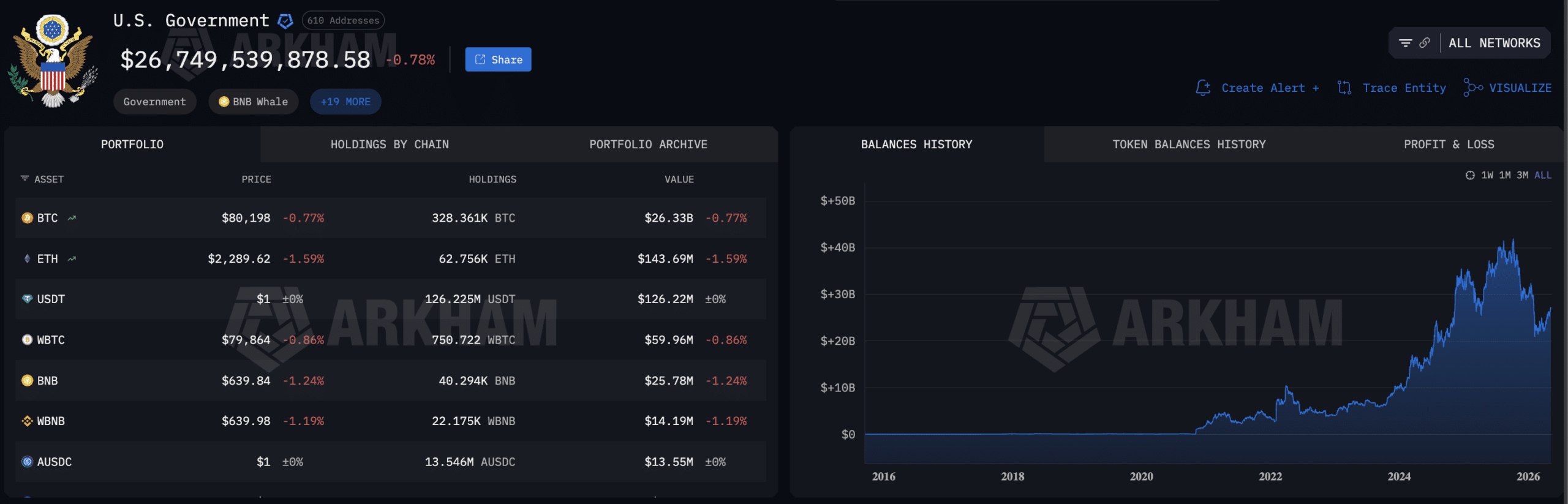
(Source: Arkham)
Bitcoin as digital gold: Structural issues are becoming harder to ignore
The digital gold argument was once purely rhetorical. It’s starting to look structural. The US government already holds 200,000 BTC (worth about $16.2 billion) from criminal and civil asset forfeiture proceedings, and White House Cryptocurrency Advisor Patrick Witt promised to release an update on US Bitcoin reserves “in the coming weeks.”
Two separate bills, Sen. Cynthia Lummis’s Bitcoin Act and Rep. Nick Begich’s American Reserve Modernization Act, both propose that the United States buy 1 million bitcoins over five years. Polymarket currently estimates the Clarity Act has a 70% chance of passing this year, up from just 40% last month. This is a meaningful shift in institutional investor expectations, not individual speculation.
A valid counterargument is that Bitcoin remains correlated with stocks that are under severe macro stress. Both March 2020 and late 2022 showed that. Volatility in the cryptocurrency market does not disappear just because macro conditions are favorable.
In today’s ETF-related Bitcoin news, structural bidding is changing. Sovereign-level accumulation, ETF inflows absorbing liquid supplies, and a legal framework formalizing US government demand represent sources of demand that did not exist in previous cycles.
Bitwise CIO Matt Hogan called the current surge in legislation a “once-in-a-decade catalyst” and predicted that if the Clarity Act passes, BTC could reach $150,000 by the end of the year. What remains to be seen is whether the Senate Banking Committee’s rate increase, scheduled for May 20, and whether the July 4 deadline, which Patrick Witt described as a “great birthday present for America,” actually holds.
Discover: Next 1000x Crypto Gems before being listed on Binance
Bitcoin price: 3 scenarios from here
$BTC is currently below the $80,000 level.
The next important support zone is $78,000 to $79,000 and should hold until further rebound.
Losing this zone means BTC will undergo a deeper correction. pic.twitter.com/rFqJQQWjGE
— Ted (@TedPillows) May 8, 2026
Bullish case: The Transparency Act will pass the Senate by June 15th, and the White House will announce a formal expansion plan for US Bitcoin reserves. Amid softening inflation data, the Fed signaled a path to rate cuts at its May FOMC meeting. Bitcoin decisively broke above $85,200, triggering dealer hedging flows in the options market. Target range: $95,000 to $110,000 by Q3 2026. Base case: Legislation progresses as planned, but there are no major surprises. The Fed has kept interest rates on hold at a neutral tone. Bitcoin remains stable between $78,200 and $88,500, rising further due to continued accumulation by institutional investors and ETF inflows. The $16 trillion price prediction for 2030 remains a talking point and not a short-term factor. Bearish/Invalid Case: Inflation data will accelerate again in May, forcing the Fed to signal another rate hike. Treasury yields soared towards 5% and cracks appeared in the digital gold narrative as Bitcoin correlated with stocks in a risk-off decline. If Bitcoin loses the $75,100 level on heavy volume, the entire post-February recovery structure will be called into question. Delaying legislation beyond July 4 would remove the most obvious short-term catalyst.
Discover: Top Cryptocurrency Presales to Watch Now
Follow 99Bitcoins on Twitter for the latest market updates and subscribe on YouTube for daily expert market analysis.
The post Bitcoin News Today: What the Fed’s Next Move Means for Your Portfolio appeared first on 99Bitcoins.
