


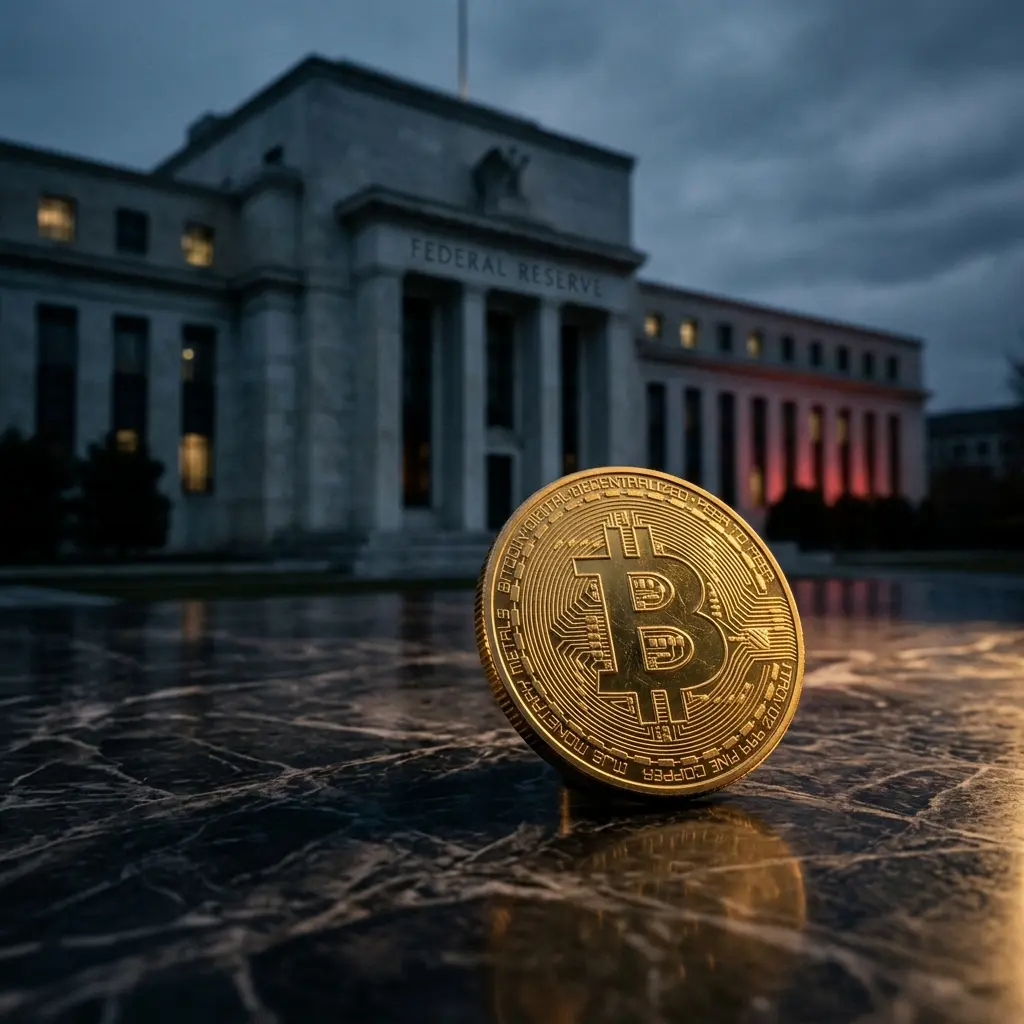
In today’s Bitcoin news, the Federal Reserve left the federal funds rate unchanged at 3.5% to 3.75% on Wednesday in what is almost certainly Jerome Powell’s last meeting as chairman, with the FOMC voting 8-4, revealing that the committee is more divided than the headline of the hold would suggest.
Bitcoin was trading around $76,000 in New York by late Wednesday, down from an early trade of $77,000 and extending its decline by about 40% from its all-time high of around $126,000 in October 2025.
The analytical question is no longer whether a pause will delay the bull market by a quarter. The question is whether the $250,000 Bitcoin price prediction, monetary easing, crypto regulatory clarity, and three simultaneous tailwinds that were supposed to boost momentum in the AI sector have stalled long enough for this hypothesis to structurally fail this cycle.
JUST IN: Fed leaves interest rates unchanged at 3.75% from 3.50%, vote the most divisive FOMC decision since October 1992 🇺🇸
Voting result: 8 to 4 in favor of keeping interest rates unchanged.
Opposition went in the opposite direction.
– Mr Milan opposed in favor of a 0.25% rate cut.
– Hammack,… pic.twitter.com/shAPgoNFUf— WOLF (@WOLF_Financial) April 29, 2026
Explore: The Best Meme Coins to Buy in 2026
Today’s Bitcoin News: Fed Pause, Inflation Calculation, Liquidity Transmission Channel
The mechanism by which FOMC decisions are reflected in Bitcoin’s price trajectory works as follows. Holding interest rates in an environment of persistently high inflation compresses risk appetite by preserving the real opportunity cost of overall dollar-denominated assets and unlocks the increased liquidity that speculative positions in high-beta assets require to attract marginal capital.
The 2022 episode established an empirical template in which the 65% collapse in Bitcoin prices unfolded in direct response to the Federal Reserve’s most aggressive tightening cycle in 40 years, as duration-sensitive risk assets were simultaneously repriced.
Wednesday’s hold wasn’t tightening, but it wasn’t the easing factored into the $250,000 theory. The committee cited “the situation in the Middle East” as a significant source of uncertainty, which is a code word for oil supply shocks, and does exactly what oil supply shocks do for central bank selectivity.
Source: Tradingview
In the Strait of Hormuz, where about 20% of offshore oil flows, Brent crude prices have been pegged at more than $110 per barrel for much of April, disrupting shipping. This week, the U.S. national average gasoline price reached $4.22 per gallon, an increase of 6.2% in one month.
Jerry Tempelman, a former senior analyst at the New York Fed and now vice president of economic and fixed income research at Mutual of America Capital Management, characterized the turmoil as one that could lead to “prolonged pricing stress through the market,” concluding that a rate cut in 2026 is unlikely absent severe energy or labor market shocks.
Data from CME Fedwatch supports that decision, with traders holding interest rates unchanged through December. The composition of the FOMC’s dissenting opinion is helpful, but not yet conclusive. Governor Stephen Millan advocated for an immediate rate cut, but three others opposed easing the language, resulting in a vote that showed true disagreement rather than the committee moving consistently in either direction. That ambiguity itself is a headwind, with markets valuing certainty rather than internal debate.
Discovered: The next cryptocurrency will explode in 2026
Next
Disclaimer: Coinspeaker is committed to providing fair and transparent reporting. This article is intended to provide accurate and timely information but should not be taken as financial or investment advice. Market conditions can change rapidly, so we recommend that you verify the information yourself and consult a professional before making any decisions based on this content.

Daniel Frances is a technical writer and Web3 educator specializing in macroeconomics and DeFi mechanisms. A crypto native since 2017, Daniel leverages his background in on-chain analytics to write evidence-based reports and detailed guides. He holds certifications from The Blockchain Council and is dedicated to providing “information acquisition” that breaks through the market hype and finds real-world blockchain utility.
