


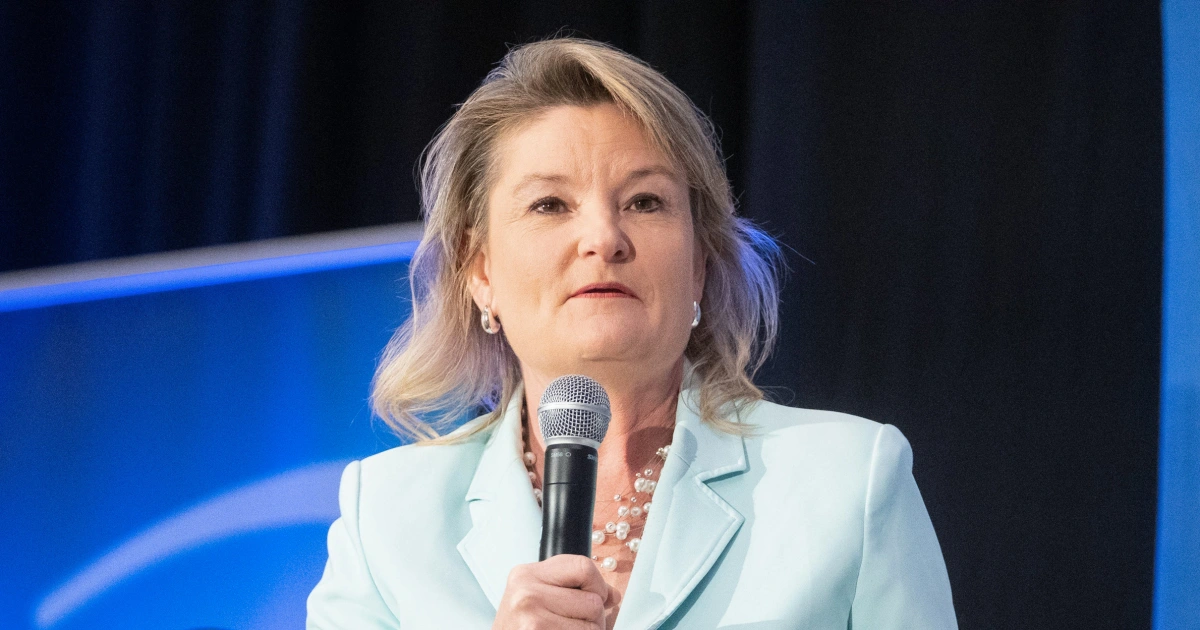
Cindy Holscher, the Democratic state senator, has been projected to win the governorship of Kansas, according to NBC News. This victory is significant as it allows the Democratic Party to maintain control of the governorship in a predominantly Republican state.
Holscher’s election comes after defeating Ty Masterson, the Republican state Senate President and a supporter of former President Donald Trump. She succeeds Laura Kelly, a two-term Democratic governor.
In a state where registered Republicans outnumber registered Democrats nearly 2 to 1, Holscher’s success stands out, especially as Trump has secured Kansas by substantial margins in the last three presidential elections. However, polls indicated a competitive race, largely fueled by electorate dissatisfaction with Trump, particularly in relation to economic issues. The increased focus on Kansas, especially amid a tightly contested Senate race, also contributed to Democratic momentum.
Holscher’s win was achieved despite her Republican opponent enjoying a significant financial advantage in advertising during the campaign, with ad-tracking company AdImpact reporting a nearly 3-to-1 ratio of Republican spending over Democrats.
Throughout her campaign, Holscher successfully associated Masterson with Trump while emphasizing her willingness to collaborate with the current administration where beneficial. “I think that’s a concern that [Masterson] has the ear of the administration,” Holscher noted to local news station KMBC, expressing apprehensions about Masterson’s influence on policies that affect Kansas farmers and ranchers.
Despite being endorsed by Trump, Masterson sought to distance himself from the former president, attempting to appear more moderate in his campaign. Nevertheless, Trump’s presence loomed large, especially as he campaigned alongside Masterson just days before the election, a move that correlated with Masterson’s challenge in securing voter support as Trump’s approval ratings decreased in the state.
Additionally, Holscher’s campaign focused on her firm stance against new data center constructions, advocating for a moratorium to protect community interests. “This field of Kansas sunflowers is under threat because big tech wants to build a data center,” Holscher declared, promising to implement precautions to shield local economies.
In contrast, Masterson supported a law providing tax exemptions for data centers. He opposed Holscher’s proposed moratorium, while a pro-data center super PAC emerged to bolster his campaign as the election neared.
Holscher’s path to victory was also shaped by her primary experience, which was marked by tensions within the Democratic Party. Former Governor Kelly, who has retained high approval ratings, initially supported Holscher’s primary opponent, state Senator Ethan Corson, raising concerns about Holscher’s leadership capabilities. However, following the primary, Kelly shifted her endorsement to Holscher, uniting the party behind her more progressive campaign.
In summary, Holscher’s gubernatorial win in Kansas represents a notable shift in the political landscape, reflecting both the changing attitudes of Kansas voters and the strategic campaigning of a determined Democratic candidate.
