


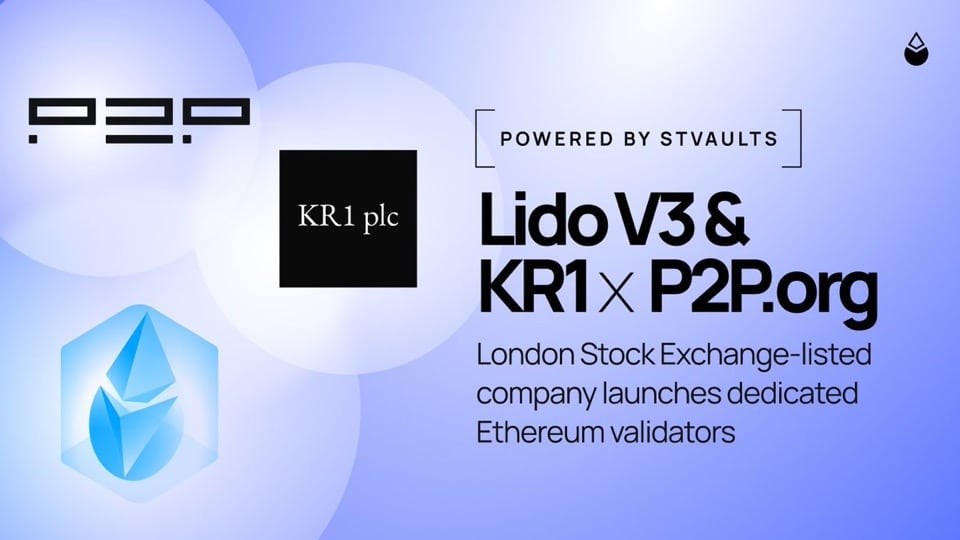
The Ethereum ecosystem is witnessing a significant development as KR1, listed on the London Stock Exchange, has initiated the launch of 10 dedicated Ethereum validators on October 15, 2026. This strategic move aligns with the company’s ambition to maximize the utility of its holdings of 6,200 ETH through a staking model aimed at generating revenue from both staking rewards and infrastructure operations.
To facilitate this process, the initial validators have been integrated into a specialized Lido stVault, managed in collaboration with the validator operator P2P.org. While KR1’s immediate plans include the launch of these 10 validators, there are intentions to expand this capacity to over 100 in the future. However, the full realization of this plan is contingent upon the Ethereum validator entry queue, which must be navigated for the scaling process.
A central concern arises regarding KR1’s ability to convert increased control over its staking operations into substantial revenue while facing potential delays in queue entry and the associated operational costs. The company has emphasized a desire for clearer attribution of income compared to traditional passive ETH holdings.
RNS: Launch of a dedicated Ethereum validator
KR1 plc today announced that it has launched its own dedicated Ethereum validator on @LidoFinance stVaults in collaboration with @P2Pvalidator.
This allows for a broader operational strategy and strengthens KR1 as the only strategy. pic.twitter.com/1mGHW2iC6e
— KR1 plc (@KR1plc) October 15, 2026
As KR1 embarks on this new venture, understanding the functionality of Lido stVault is essential. An Ethereum validator functions as a computer that verifies transactions and secures the network, earning rewards from staking and network fees in the process. Unlike traditional staking through shared pools, KR1’s validators are positioned within a dedicated Lido stVault, offering the company control over various operational aspects, including validator fees, deposit management, and the minting of stETH, which provides liquidity during the staking process.
The announcement of KR1’s launch reveals a notable gap between its current validator deployment and its long-term objectives. While the company currently operates 10 validators, the ambition to eventually surpass 100 and stake a majority of its ETH holdings reflects a broader vision defined in its October 2025 prospectus. At present, specific details regarding expected fees, operational costs, or projected income remain unspecified, limiting investors’ ability to evaluate the economic implications of this initiative.
As the staking landscape evolves, KR1’s expansion strategy highlights the complexities of running validator operations, which necessitate high uptime and can incur penalties for downtime. These operational demands signal that scaling up involves more than merely increasing validator numbers; it also requires careful management of associated risks.
KR1’s strategy aims to establish a significant infrastructure revenue stream through its substantial ETH holdings. Amir Kahouri, Ethereum Senior Product Manager at P2P.org, noted that the dedicated validator structure not only enhances operational accountability but also avoids the pooling of funds, which could obscure financial insights. This setup is hailed as a unique offering, positioning KR1 as the first publicly traded company to establish its own branded validator within Lido stVaults.
P2P.org, having secured assets exceeding $10 billion and collaborating with around 190 institutional clients across more than 40 proof-of-stake networks, lends additional credibility to KR1’s endeavors. Despite these promising figures, independent verification of performance metrics remains crucial for assessing operational effectiveness.
While KR1 has begun to implement its operating model, the timeline for scaling operations and the resulting financial benefits remain uncertain. Future updates, specifically regarding growth beyond the initial 10 validators, realized fees, and retained earnings, will be critical for investors monitoring the company’s path in this evolving sector.
To stay informed on the latest developments in the Ethereum space, follow reliable crypto news platforms and subscribe to updates for expert market analysis.
