



XRP Ripple CTO David Schwartz stood in front of a packed venue at XRPLasVegas 2026 on May 1st and made remarks that made some in the XRP community uncomfortable. “Repeat the CLARITY Act now, even if it’s not perfect.”
The XRP token is currently trading around $1.38, up modestly by +0.4% over the past 24 hours, a deceptively benign number considering the regulatory storm swirling around it. The real question is not whether this bill is flawed. Apparently so. The question is whether the incomplete legislation finally on the books will be more beneficial to XRP than two more years of legal ambiguity.
XRP Army Alert: David Schwartz Drops Retail Bomb in Las Vegas:

“We intend to move into retail at some point.”
David frankly acknowledged Ripple’s master plan:
Today’s enterprise paves the way for tomorrow’s retail – just as the internet began… pic.twitter.com/83bVSwyocv
— Archie
(@Archie_XRPL) May 1, 2026


The detail missing from most headlines is the strategic logic behind Schwartz’s endorsement. This does not mean that Ripple is waving a white flag against malicious legislation. It’s a calculated bet that market stability and protection for individual investors are worth more at this point than holding out for the legislation to be completed.
Schwartz, who has spent years watching the SEC treat enforcement as a substitute for actual rulemaking, argues that any concrete framework will overcome the vacuum that has quietly punished XRP holders with each lawsuit.
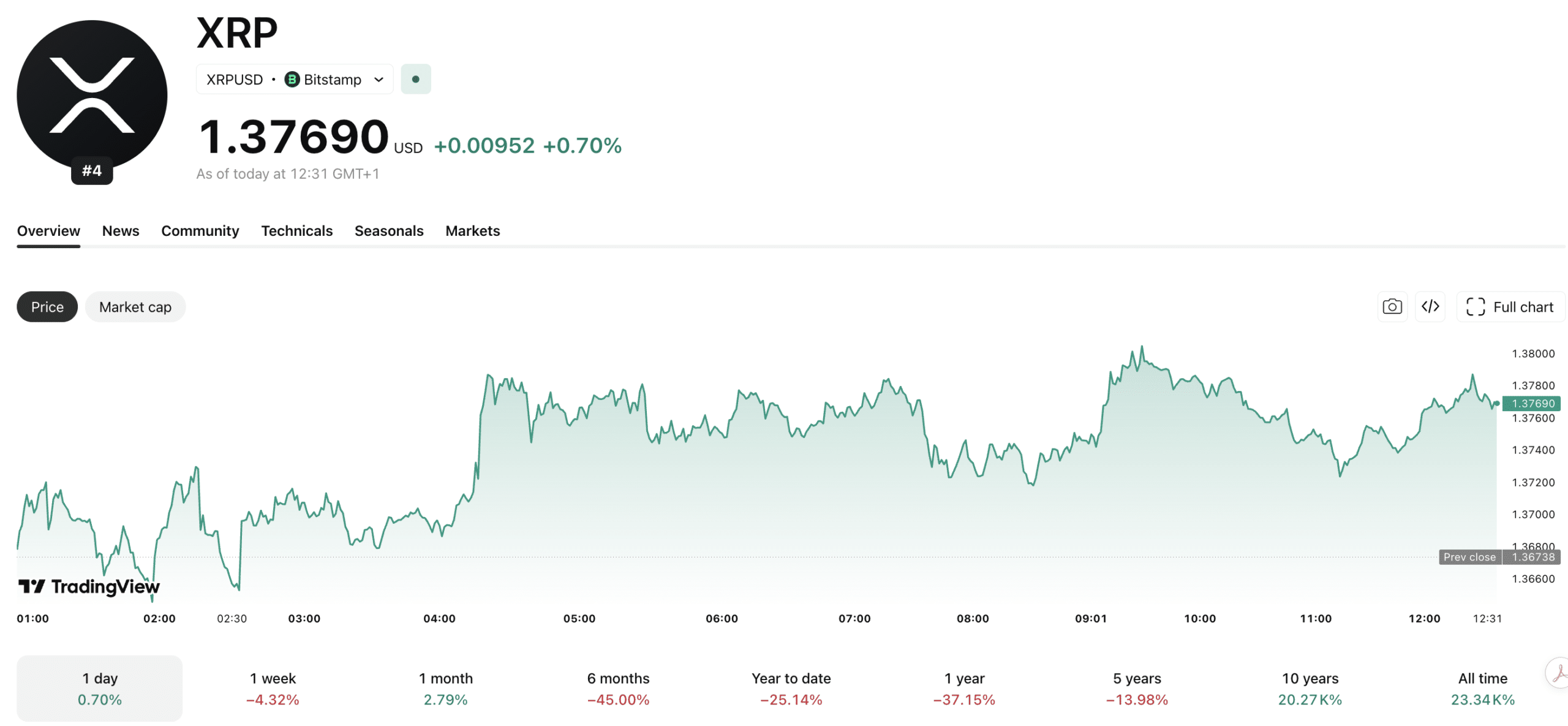
(Source: TradingView)
What the CLARITY Act Actually Does and What Critics Get Misunderstood About It
Think of the CLARITY Act like a building code for cryptocurrencies. Now, developers and companies building financial products in cities with no zoning laws will sound free until the authorities come along and tear down what they’ve built.
The law aims to assign oversight of spot cryptocurrency markets to the CFTC, define what constitutes a decentralized protocol, and establish clear liability rules for developers. For stablecoin issuers in particular, it stipulates who can issue stablecoins and how they must be backed by reserves.
But the criticism is true. One sticking point is the bill’s limits on stablecoin yields. The current draft only allows for activity-based compensation and gives the SEC, CFTC, and Treasury 12 months to iron out the finer points.
DeFi proponents warn that these yield limits could spark innovation in a sector that Schwartz himself acknowledged is stuck at around $150 billion due to limited real-world utility. Ripple’s broader technology roadmap makes it clear that the company is thinking far beyond stablecoins, but the bill, as written, still leaves key questions unanswered for more than a year.
Schwartz made this clear at the conference: “I think the strategy is to get as much as possible as quickly as possible.” He compared the law’s potential to the early Internet era, which unlocked all the capabilities that followed despite imperfect infrastructure. “The passage of the Transparency Act is the starting gun,” he said, suggesting that institutional investors are on the sidelines for just this kind of green light.
Could XRP Ripple rise further if the CLARITY Act passes?
XRP challenges the market with $3.6 million in ETF inflows
The $BTC and $ETH ETFs suffered net outflows of over $200 million, while the Spot@Ripple product recorded inflows of approximately $3.59 million on April 29th. @Bitwise’s $XRP ETF leads the pack of 5 with assets under management of over $312… pic.twitter.com/aZjtMUbJD1
— BSCN (@BSCNews) April 30, 2026
After a strong showing earlier this year, XRP Ripple has remained in a consolidating range, with ETF inflows reaching a 2026 high in April, indicating institutional interest is already growing ahead of any legislative action.
24 hours 7 days 30 days 1 year Always
The technical situation reflects that tension. Buyers are present but have not yet committed to the breakout.
Bullish Case: The CLARITY Act will be passed in substantive form in Q2-Q3 of 2026. Regulatory certainty frees up institutional capital that Schwartz said is sitting on the sidelines. XRP breaks through the $1.40 resistance and targets the $1.50 to $1.60 range as the legal risk premium compresses. Base case: The bill passes in a watered down form with further amendments, or it moves out of committee but stalls before a floor vote. XRP Ripple is stable between $1.30 and $1.40, with moderate institutional inflow, but no major revaluation until there is complete clarity. The bearish case: Post-adjournment negotiations collapse, bipartisan momentum stalls, or the bill sparks a new turf war between the SEC and CFTC. As regulatory uncertainty comes to the fore once again, execution risk will reset the price of XRP to the $1.15-$1.20 range.
Ripple CEO Brad Garlinghouse had estimated the bill had an 80% chance of passing, citing bipartisan committee language and White House support, but that timeline stretched past the April recess. Look to committee votes and amendments in May and June 2026 for the clearest near-term signals.
Read more: The best crypto presales right now
For more cryptocurrency news and analysis, follow 99Bitcoins on X, YouTube, and Telegram.
The post XRP Ripple CTO backs “incomplete” crypto bill: why it matters for XRP appeared first on 99Bitcoins.
