


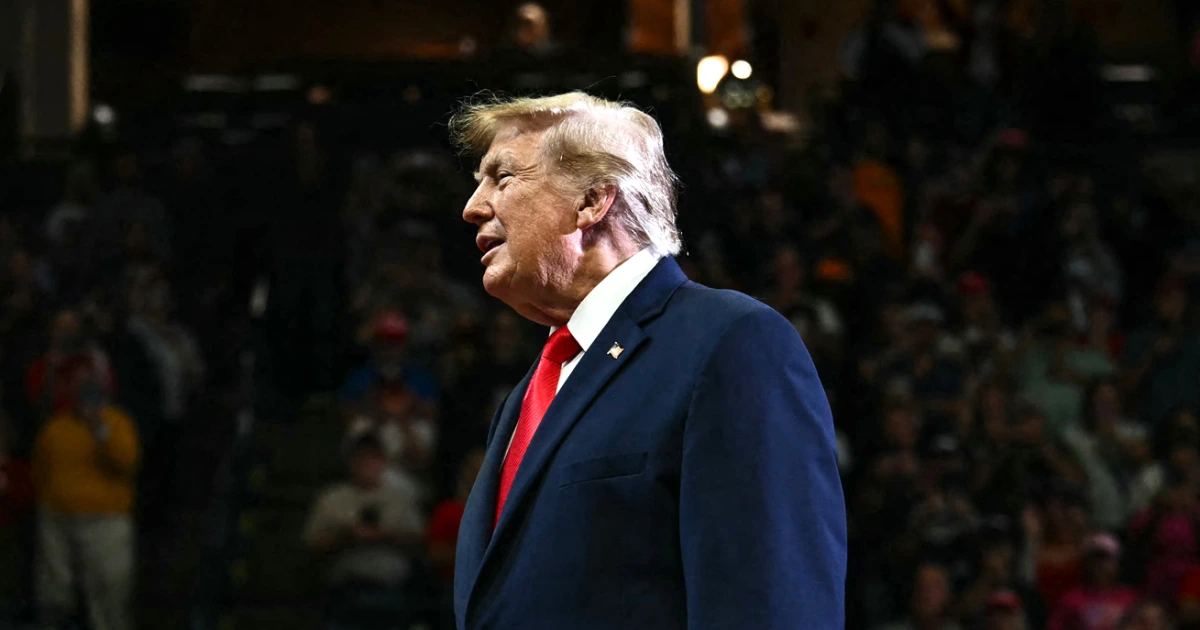
During a recent rally in Youngstown, Ohio, President Donald Trump sparked controversy as he targeted Congresswoman Ilhan Omar, a Democrat from Minnesota, and Abdul El-Sayed, the Democratic nominee for the Senate in Michigan. The event took place amid growing political tensions, where chants of “deport” echoed from the crowd.
In his remarks, Trump labeled Omar a “disaster,” making her criticism of U.S. laws a focal point of his attacks. This occurs shortly after her Washington, D.C., residence was the subject of a search by federal agents, according to sources familiar with the investigation. The Justice Department indicated that the search was part of an ongoing federal criminal inquiry, though they did not confirm any direct link to Omar.
“She comes in from a country without laws, without police, without military,” Trump stated, referencing Somalia, where Omar was born. He added that she had no authority to speak about the U.S. Constitution given her origins, which he characterized in stark terms.
The rally further escalated as Trump discussed incidents of crime tied to Somali nationals in Minnesota, referencing an FBI-intercepted plot involving a shooting at the Mall of America. At this point, audience members began chanting “deport,” reflecting the charged atmosphere and Trump’s rhetoric.
Omar, who immigrated to the United States as a child from Somalia, responded to Trump’s remarks on X (formerly Twitter), stating, “For 10 years, Trump has targeted me with baseless lies and smear campaigns. This is just the latest escalation in his campaign of political intimidation.”
Trump denied any involvement in the search of Omar’s home when questioned by reporters. His attacks did not stop with Omar; he also launched a vehement critique of El-Sayed, describing him as a “jihadist.” This inflammatory comment came as he transitioned from discussing Omar to El-Sayed, asserting that individuals like them “do not belong in America” and calling for their expulsion.
El-Sayed, born in Michigan to Egyptian immigrants, has faced attempts to conflate his name and faith with extremism. In response to Trump’s comments about him, he remarked, “They point to my name and they point to my faith, trying to distract us from the challenges that we have.” El-Sayed emphasized that his ethnic and religious identity should not be scapegoated for national issues.
Trump’s rhetoric reflects a broader trend of heightened scrutiny toward Muslims and immigrants. This is not without precedent; following El-Sayed’s primary win, Trump had previously warned that the U.S. was at risk of becoming a “jihadist-run country.” Alongside this, Republican Senator John Kennedy of Louisiana accused El-Sayed of sympathizing with Osama bin Laden.
At the rally, Trump also touched on other topics, reminiscing about earlier visits to the Mahoning Valley, a region that has shifted politically from Democratic to Republican in recent years. Highlighting his previous comments regarding Haitian immigrants in Springfield, Ohio, Trump reiterated controversial statements made during a presidential debate.
The increasingly charged language surrounding this political climate raises significant discussions about immigration, identity politics, and the narratives constructed around public figures. As the election cycle progresses, such rhetoric is likely to influence voter sentiment and campaign strategies.
