


During the “XRP in a Minute” segment at XRP Las Vegas, Ripple CEO Brad Garlinghouse positioned the XRP Ledger as a specialized payments infrastructure that can settle transactions in 3-5 seconds for just a fraction of a penny.
He highlighted that it has processed over 4 billion transactions since 2012 and its potential as a foundational layer of the Internet of Value. Garlinghouse highlighted the technical architecture of the ledger, which traces its origins to the original Bitcoin developers, as a competitive advantage for XRP over Ethereum and Bitcoin.
This approach aims to shift the audience for XRP from retail investors to institutional investors such as financial managers and banks. By positioning XRP as a payments infrastructure rather than an investment, Ripple seeks to engage mainstream financial services and expand beyond niche crypto payments.
XRP USD was trading at $1.38, down -3.2% on the day, as the market-wide cooldown widened following Garlinghouse’s comments, wiping out more than $100 billion in crypto market capitalization.
$XRP/USDT 4-hour analysis
XRP has been riding an uptrend line since late March and is currently testing its support after a rejection from the $1.48 to $1.50 resistance zone
Main levels to note:
– Support: Trendline $1.38
– Resistance: $1.48–$1.50🟢 Maintain the trend line → towards $1.48 or higher… pic.twitter.com/ZrdGxcXgYe
— Ixant Radha | Cryptera (@theCryptera) May 18, 2026
Ripple Architecture and the Internet of Value: How Garlinghouse’s payments-focused design philosophy works in practice
The XRP Ledger (XRPL) uses the Byzantine Fault Tolerant algorithm and Unique Node List to reach consensus every 3-5 seconds without mining.
This design eliminates the energy overhead of Bitcoin’s proof-of-work and Ethereum’s complexity, resulting in instant finality instead of the 10 minutes it takes for Bitcoin or the 12-15 seconds it takes for Ethereum before the rollup.
XRPL can process approximately 1,500 transactions per second, far exceeding Bitcoin’s 7 TPS and Ethereum’s capacity, while maintaining minimal transaction fees of approximately $0.0002. It is designed specifically for payments and liquidity flows, featuring financial primitives such as decentralized exchanges and payment channels, rather than a general-purpose platform like Ethereum.
Additionally, Ripple complies with the ISO 20022 standard, making XRP interoperable with existing banking systems. This focus on specialization distinguishes XRPL’s architecture from that of Ethereum.
(Source DefiLlama)
Discover: The Best Meme Coins to Buy in 2026
Payments vs. Smart Contracts: Garlinghouse’s Ripple Architecture Discussion Reveals the Institutional Position of XRP
The competitive logic in Garlinghouse’s argument highlights Ripple’s focus on XRP’s payments-specific design, which sets it apart from Ethereum’s programmable payments and DeFi capabilities.
Ripple positions its architecture as more suitable for correspondent banking and cross-border payments, arguing that it needs to fragment institutional use cases.
Ripple’s growing institutional traction, exemplified by the cross-border live redemption of tokenized US Treasuries on the XRP ledger in May 2026 involving JPMorgan, Mastercard, and Ondo Finance, lends credibility to this stance. This transaction demonstrated operational viability and elevated architectural discussions to procurement considerations.
Additionally, a July 2023 ruling by Judge Annalisa Torres clarified that XRP sales on public exchanges do not constitute investment contracts, providing regulatory clarity that Garlinghouse claims is essential to the institution.
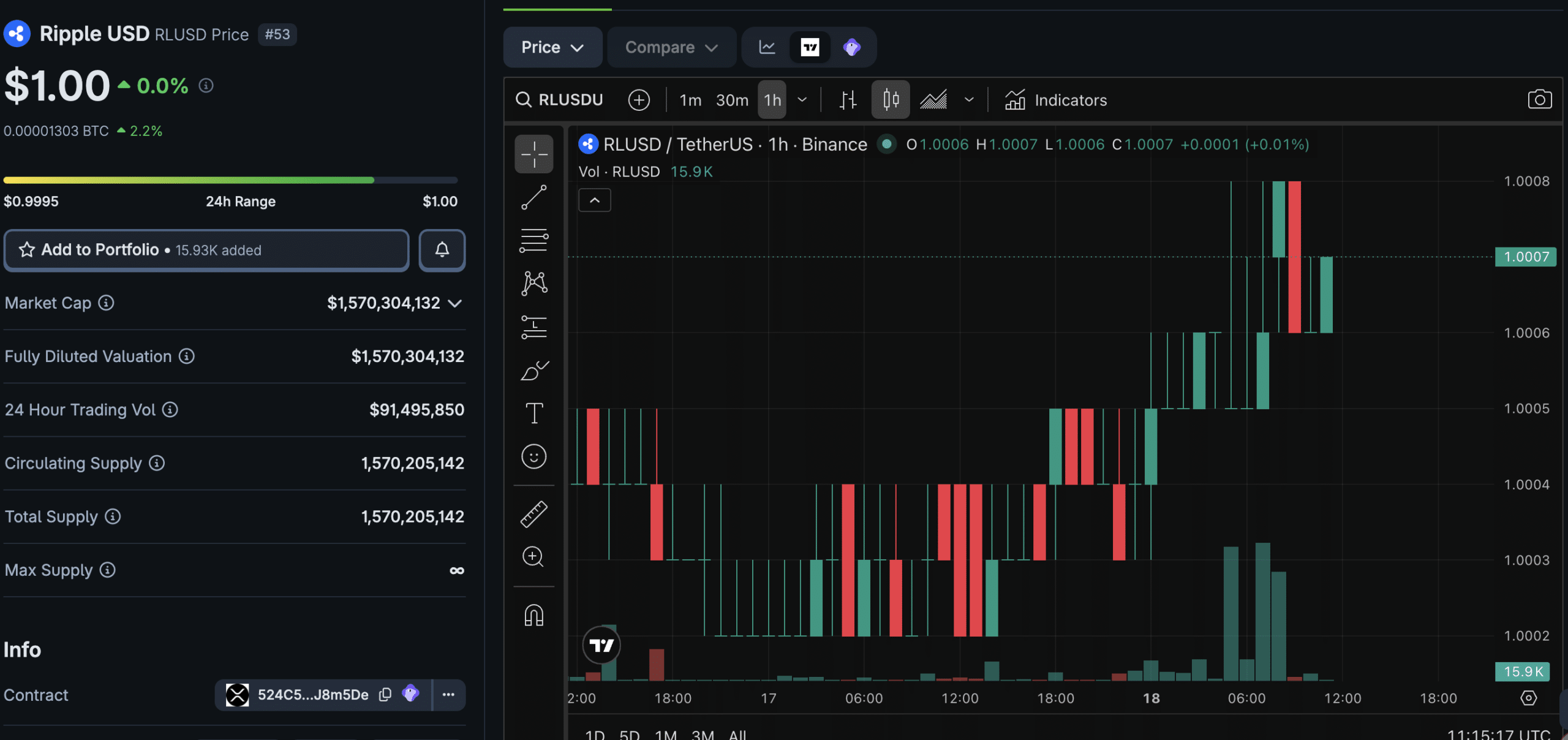
Combined with Ripple’s acquisition efforts and the approval of the RLUSD stablecoin, this represents a strategic push to position XRP as a compliance-friendly option for institutional adoption.
(Source: CoinGecko)
Internet of Value Infrastructure: What a payments-first architecture means for XRP’s role in institutional payments
Garlinghouse’s perspective highlights the changing way institutional investors view cross-border payments. While SWIFT’s correspondent banking model relies on pre-funded Nostro and Vostro accounts and ties up capital, Ripple’s on-demand liquidity (ODL) uses XRP as a real-time liquidity bridge, eliminating the need for pre-funding. XRP acts as a temporary bridge currency, focusing on transaction throughput over price appreciation.
RLUSD is a fiat-pegged stablecoin that supports stable settlement of value in transactions with XRP processing bridge and fee capabilities that support a risk-averse compliance framework. Ripple’s roadmap includes hooks and EVM-compatible sidechains to expand functionality while focusing on payments.
However, the link between Ripple’s infrastructure and XRP demand is mainly latent. Most transactions on RippleNet utilize the RLUSD and fiat channels, and ODL has not yet generated significant XRP demand. ODL scaling data over the next 12-18 months will reveal this.
Key metrics to look at include ODL corridor volumes, especially in corridors where eliminating up-front funding yields significant savings. Garlinghouse’s claims could be vindicated if XRP’s role in institutional workflows expands. If RLUSD and fiat channels prevail and ODL trading volumes remain low, the gap between Ripple’s story and XRP’s practicality will remain a significant issue.
Explore: The next crypto currency to explode in Q2
Next
Disclaimer: Coinspeaker is committed to providing fair and transparent reporting. This article is intended to provide accurate and timely information but should not be taken as financial or investment advice. Market conditions can change rapidly, so we recommend that you verify the information yourself and consult a professional before making any decisions based on this content.

Daniel Frances is a technical writer and Web3 educator specializing in macroeconomics and DeFi mechanisms. A crypto native since 2017, Daniel leverages his background in on-chain analytics to write evidence-based reports and detailed guides. He holds certifications from The Blockchain Council and is dedicated to providing “information acquisition” that breaks through the market hype and finds real-world blockchain utility.
