



Bitcoin trades in a market that is becoming increasingly difficult to define.
At the time of writing, Bitcoin is hovering around $64,000, down almost 50% from its cycle peak. Although this is a much shallower drawdown than previous cycles, the bull market did not reach the same heights this time.
The 2025 rally was driven by exchange-traded fund (ETF) inflows, post-halving momentum, and new institutional demand, pushing the market to an all-time high of over $126,000 in October 2025.
Since then, the trend has been inexorably downward, but analysts are divided on what that decline means.
According to Standard Chartered and other bullish institutional desks, Bitcoin may have already hit the bottom of the cycle last month, with structural demand from ETFs and treasury companies and improving long-term capital flows reducing the likelihood of further severe outflows.
Other analysts are taking a more cautious approach, believing that Bitcoin is likely in the final stages of a bear market, but has not yet reached a firm bottom.
Bitcoin’s 4-year cycle. Source: Galaxy
For example, Galaxy Research argued in June that traditional cycle signals were not fully reset and could not eliminate the risk of further pain.
Interestingly, analysts are no longer just divided on price targets, but on what a “cycle bottom” actually means in a market that is being shaped by changes in ETFs, macro liquidity, and global capital flows.
Some analysts still expect further downside
Among the most cautious is Russell Thomson, chief investment officer at asset management firm Hilbert Capital.
Thomson told Cointelegraph that he believes Bitcoin continues to be in a downcycle and is likely to break below recent lows before forming a durable foundation. He said the current structure is still dominated by global macro conditions and liquidity rather than crypto-specific signals.
RELATED: $60.4K Becomes ‘Most Important Area’: 5 Things to Know in Bitcoin This Week
Thomson expects Bitcoin to first revisit the summer 2024 lows in the $56,000 to $52,000 range before losses could extend further to $40,000 to $45,000, an area he associates with an earlier consolidation phase in the market structure in early 2024.
Timing-wise, he sees Bitcoin’s broader cyclical rhythm still largely in place, with a low potentially forming around October 2026, but stressed that a shift in macro policy could move it forward.
“With the Fed cutting rates or passing the (CLARITY Act), it’s possible we could bottom sooner than that,” he said.
He argued that institutional investors are not insulating Bitcoin from macro cycles, but are instead becoming more sensitive to global liquidity conditions, making Bitcoin behave more like a “high-beta macro instrument” than a “decoupled crypto-native asset.”
This view is echoed by Citibank analysts, who lowered their 12-month price target for Bitcoin from $112,000 to $82,000 on July 1, highlighting how Bitcoin’s increasing integration into traditional financial markets is strengthening its correlation with risk assets and macro liquidity conditions, rather than reducing volatility.
The bear market is ending, but the bottom has not yet been confirmed.
More positive, but still cautious, is Andre Dragos, head of research (Europe) at Bitwise.
Dragos told Cointelegraph that the current environment resembles a “late-stage bear market,” arguing that multiple indicators are already pointing to exhaustion.
He noted that sentiment has deteriorated to levels last seen after the FTX collapse in 2022, a period typically accompanied by seller fatigue.
Dragosz also doesn’t think a cycle low has been confirmed. “I don’t think we’ve seen the final bottom yet, but we’re probably very close,” he said, stressing that there is no single indicator that can reliably identify the bottom of the cycle.
Related article: $1.9 million worth of dormant Bitcoin tied to New York lawsuit for the first time in nearly 15 years
He also highlighted structural changes in the market, noting that increased participation by ETFs and institutional investors is increasing off-chain trading and reducing the reliability of some historical cycle indicators.
Despite these uncertainties, he said downside risks look increasingly limited at current levels, adding that Bitcoin could start outperforming artificial intelligence stocks in the coming months once macro conditions stabilize.
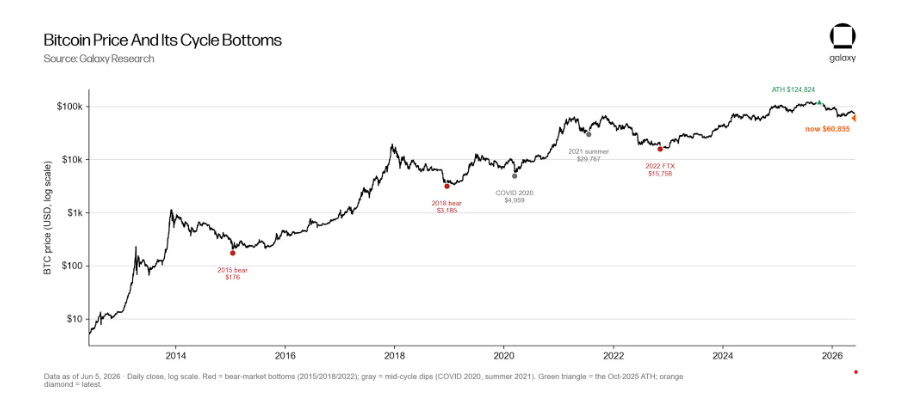
Bitcoin price and its cycle bottom. Source: Galaxy
He noted that in Galaxy’s base case, the company could fall to between $40,000 and $46,000, depending on how liquidity and macro conditions develop.
“When will Bitcoin hit the bottom?” Might be the wrong question.
A more structural interpretation comes from Dean Chen, an analyst at Bitunix Exchange.
Chen told Cointelegraph that while Bitcoin is still in a downward trend, its decline is increasingly defined by global liquidity competition rather than internal crypto market structure.
“Bitcoin has entered a relatively stable valuation range, supported by the structural capital base built after the approval of the US Spot Bitcoin ETF in 2024, but I believe it is still in a down cycle,” Chen said.
While ETFs are generating more sustained institutional bids, Chen argued that Bitcoin is now in direct competition with other major global capital narratives, particularly artificial intelligence and stock markets, for marginal liquidity.
Related: Tim Draper says Arkham Bitcoin wallet attribution was ‘wrong’
“The bigger challenge is not Bitcoin itself, but the competition for global liquidity,” he said. “Capital continues to flow towards AI infrastructure, equity and other high-growth opportunities.”
In his view, this will change the entire way we understand cycle analysis.
“The wrong question to ask is, ‘When will Bitcoin bottom?'” Chen said. “The more important question is: When will cryptocurrencies again become the most attractive destination for global risk capital?”
He noted that derivatives markets are now playing a significantly larger role in price discovery than in previous cycles, with funding rates and open interest increasingly subject to short-term volatility.
That means Bitcoin may not form a sharp V-shaped bottom at all, and instead may spend a long period of time building structural foundations, he said.
Bitcoin Cycle Not Similar to Previous Cycles
Beyond price targets, what emerges from these competing views is a deeper disagreement over even how Bitcoin’s cycle structure should be defined.
Thompson believes that Bitcoin is still firmly in a macro-driven bearish cycle and the liquidity situation has not completely changed yet.
Dragos sees it as a late-stage bear market that is already showing signs of exhaustion, even if confirmation is still pending.
Chen argues that Bitcoin is now in direct competition with global capital allocation themes such as AI and equities, making the traditional bottom call framework increasingly incomplete.
In this cycle, the debate seems to be not only about where Bitcoin will bottom, but also whether the bottom is even fleeting at all.
magazine: Veteran trader Peter Brandt says Bitcoin will not reach $1 million by 2030.
