


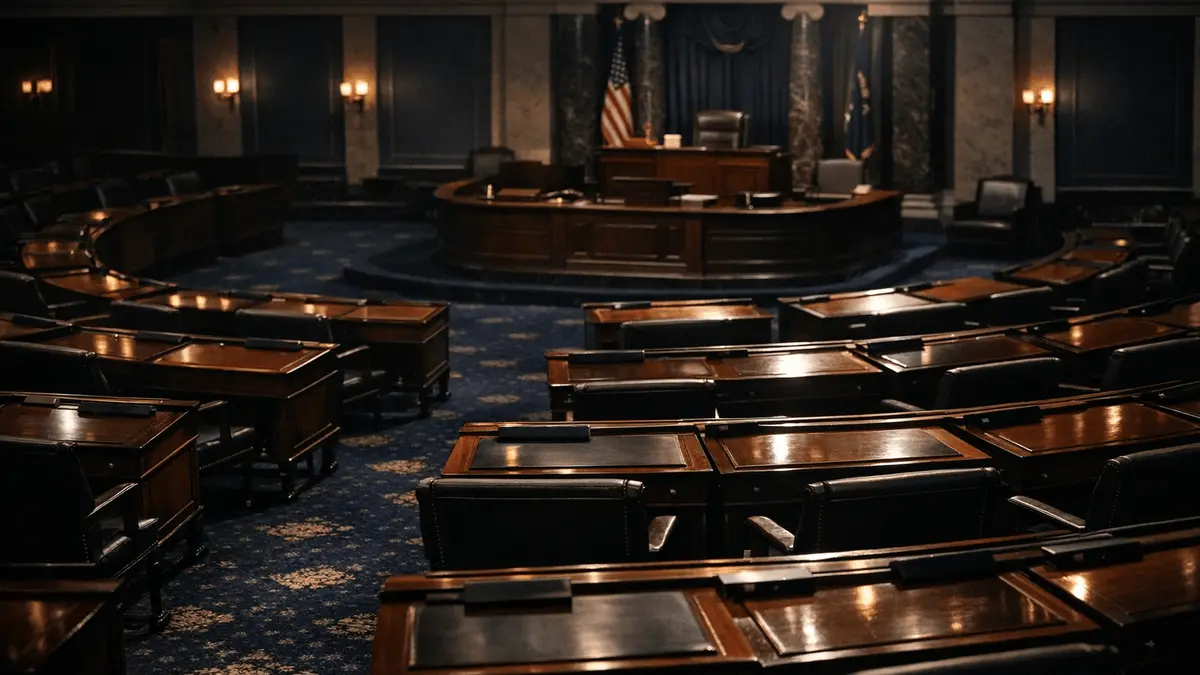
A closed-door ethics meeting between Kirsten Gillibrand, Sen. Ruben Gallego (D-AZ), Sen. Bernie Moreno (R-OH), and Sen. Cynthia Lummis (R-WY), which also included White House Cryptocurrency Council Executive Director Patrick Witt, was called off without an agreement Tuesday after Republicans and the White House rescinded a provision that would have allowed state attorneys general to sue the Department of Justice. President Trump’s interest in virtual currency business. At the same time, the White House Crypto Council on Wednesday convened representatives from the National Sheriff’s Association, Fraternal Order of Police, and National District Attorneys Association to address law enforcement objections to Section 604 of the CLARITY Act, the Blockchain Regulatory Certainty Act, leaving the market structure bill facing two outstanding hurdles with 31 days left in the Senate session and a 60-vote threshold before the August recess. Not yet cleared.
🚨🗞️New: Transparency law faces ethics challenges as White House seeks law enforcement assistance
Democrats walked out of Tuesday’s meeting frustrated after Republicans withdrew key elements of the interim ethics agreement. Talks expected to continue Thursday ➕ WH convenes law enforcement agencies. https://t.co/YaKxuTKL09
— Eleanor Terrett (@EleanorTerrett) June 10, 2026
This is more than just a schedule delay for the virtual currency regulation bill that has already passed the House and Senate Banking Committees. This is a structural diagnosis of a coalition whose two weakest pressure points, President Trump’s Democratic demands for ethical guardrails to deal with crypto disputes and law enforcement concerns over on-chain enforcement powers, are now failing simultaneously rather than sequentially, and which is critically dangerous on a compressed calendar.
If both disputes are not resolved before adjournment, the effective window for passage in 2026 could be permanently closed, and previous statements from the bill’s sponsors suggest it is unlikely to be revisited before 2030.
Discover: The Best Meme Coins to Buy in 2026
CLARITY Act News: Ethics Code Breakdown, How the Republican Walkback Works, and What the AG Enforcement Clause Really Means
Tuesday’s meeting was the first closed-door ethics meeting since the bipartisan group agreed to a tentative framework in May, after the Senate Banking Committee voted 15-9 to move forward with the bill.
This mechanism works as follows. The provisions being negotiated would authorize state attorneys general to file civil lawsuits against the Department of Justice if federal authorities fail to enforce ethics rules that prohibit senior executive branch officials from deriving financial benefits from digital asset legislation that federal authorities are simultaneously developing, in direct response to documented financial exposures created by the Trump family’s crypto ventures, which have generated an estimated $2.3 billion in assets across their holdings, including World Liberty Financial and related token issuance.
The perceived context of this $2.3 billion figure requires caution. This represents a widely cited estimate compiled based on public information and market valuations, rather than a formally audited amount.
During Tuesday’s session, Republicans and Witt proposed a narrower alternative to the attorney general that would withdraw support for state law enforcement agencies and limit enforcement powers, but Democrats rejected it as functionally circular given that the attorney general serves at the pleasure of the president. Republicans also proposed impeachment as a remedy for presidential ethics violations, but Democrats similarly rejected this proposal.
Notable developments in ongoing Transparency Act negotiations: Senate Republicans have reportedly withdrawn a proposed enforcement mechanism that would have allowed state attorneys general to pursue @TheJusticeDept for ethics violations.
As bipartisan talks continue… https://t.co/dW4LBYXAUY
— Adrian Wall (@AdrianWall8395) June 10, 2026
We suspect that the White House rescinded the state law enforcement provision, reflecting a determination that any provision that creates a litigation pathway through state-level Democratic attorneys general, no matter how narrowly written in the statute, structurally implies unlimited political liability.
This collapse is directly related to the commission’s earlier ethical battles. In the May 14 rate hike, the Van Hollen Amendment, which would have prohibited the president, vice president, and members of Congress from issuing or promoting digital products while in office, failed on a party-line vote of 13-11, with Republicans arguing that the provision was outside the Banking Committee’s jurisdiction and should be resolved on the floor.
This defeat left the ethics issue formally unresolved at the committee stage, with post-markup private negotiations becoming the designated venue for resolution. So their collapse doesn’t just delay the bill. Faults that were not actually closed are reopened.
The two Democrats who gave the bill a nominal bipartisan lead in committee votes, Sen. Gallego and Sen. Angela Alsobrooks (D-Md.), both indicated that their support in the chamber remains dependent on strong ethics guardrails, and Tuesday’s defeat makes that condition harder, rather than easier, to meet. The details of President Trump’s crypto income and the specific integrity gap created by the current provisions of the CLARITY Act illustrate why Democrats’ insistence on enforceable guardrails is unlikely to be resolved by timeline pressure alone.
Explore: The next crypto currency to explode in Q2
Next
Disclaimer: Coinspeaker is committed to providing fair and transparent reporting. This article is intended to provide accurate and timely information but should not be taken as financial or investment advice. Market conditions can change rapidly, so we recommend that you verify the information yourself and consult a professional before making any decisions based on this content.
Daniel Frances is a technical writer and Web3 educator specializing in macroeconomics and DeFi mechanisms. A crypto native since 2017, Daniel leverages his background in on-chain analytics to write evidence-based reports and detailed guides. He holds certifications from The Blockchain Council and is dedicated to providing “information acquisition” that breaks through the market hype and finds real-world blockchain utility.
