


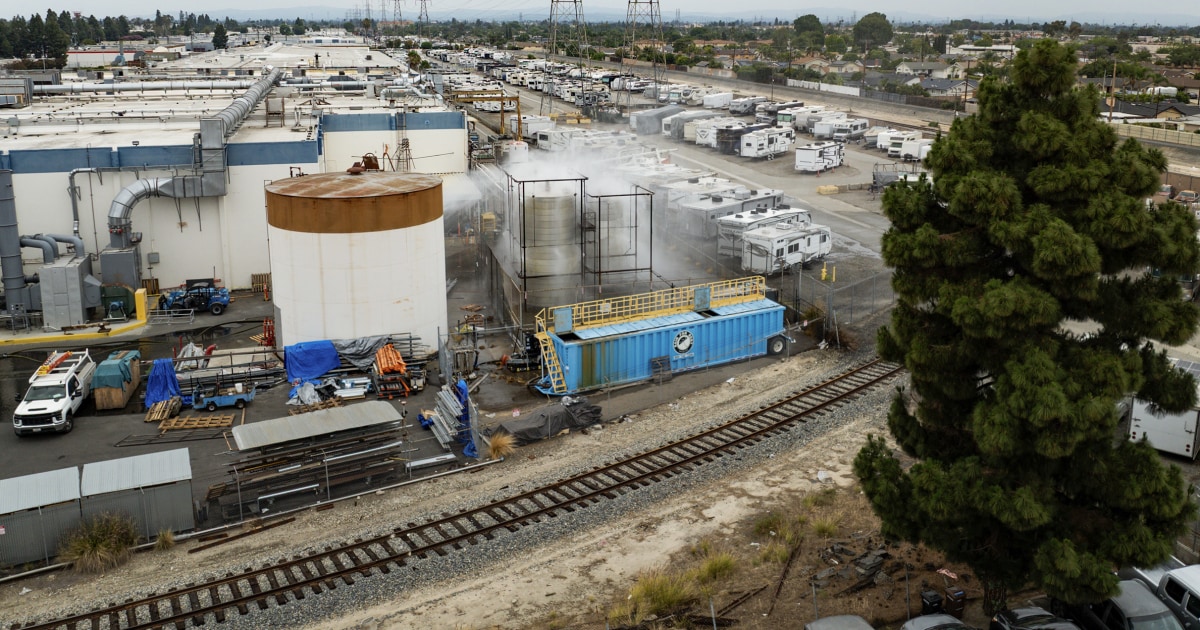
A “catastrophic” explosion at a chemical tank in a city near Los Angeles was averted by Monday, but the risk remains and about 16,000 people are under evacuation orders, officials said.
Subscribe to read this story without ads
Get unlimited access to ad-free articles and exclusive content.

Liquid in a 7,000-gallon methyl methacrylate tank at the Garden Grove facility began overheating Thursday after a problem with a valve in the refrigeration system led to tense days for first responders and experts trying to avoid an explosion.
Officials said Monday that the biggest risk, a potential boiling liquid expanding vapor explosion (BLEVE), had been averted.
“The most catastrophic, worst-case scenario has been mitigated and resolved,” Orange County Interim Fire Chief TJ McGovern said at a news conference Monday night.
“It’s not over yet. I want to emphasize that again. It’s not over yet. We still have work to do,” he said.
Mr McGovern said firefighters “still have to mitigate concerns of fire, very small explosions and even the possibility of a spill”.
Evacuation orders in the northern Orange County city, about 55 miles southeast of Los Angeles and about four miles from Disneyland in Anaheim, were reduced from about 60,000 people to 16,000 on Monday.
The incident began Thursday at the GKN Aerospace facility, where Orange County Fire officials reported a “vapor release.” Further investigation revealed elevated temperatures in the tank of methyl methacrylate, a toxic chemical used in the manufacture of resins and plastics, officials said.
Orange County Fire Chief Craig Covey said Monday that a valve, part of a circulating cooling system designed to keep the tank at 50 degrees, failed, causing the tank to overheat.
“One of the valves in that system froze, so it couldn’t circulate,” he said. “And because of that failure, the tank went into a heating process because it wasn’t continuing to cool down.”
Covey said the BLEVE and spill at the site could have been one of the worst chemical accidents in state history.
At one point, the thermometer hit a high of 100 degrees Fahrenheit. By Monday, temperatures had dropped to 93 degrees, Covey said.
Covey said millions of gallons of water are being poured into the tanks to lower the temperature inside them, and deluge sprinklers are also reducing the risk of fire.
He said a crack in the tank released enough pressure on Monday without causing a leak, allowing further offensive measures. That night, Covey said, crews were able to strip insulation and other materials from the sides of the tank, allowing water to cool the contents more quickly.
Covey said GKN is responding. “They were completely on par with us on the ground,” he said, who hired contractors to assist with the incident.
No one was injured, Covey said.
As the development progressed, authorities reduced the size of the evacuation zone, allowing most of the 60,000 people temporarily evacuated to return home.
Covey said evacuation orders for the remaining 16,000 people will remain in place until Monday night and will be reassessed on Tuesday.
Officials said at a news conference that there was no contamination from the incident or response efforts.
Chris Myers, the Environmental Protection Agency’s federal field coordinator, said Monday night that air monitoring from 20,000 instruments in the area “detected no exceedances” during the entire incident.
Garden Grove Police Chief Amir El Farah asked for patience from people and city residents who were told to leave their homes. He called on people to follow existing evacuation orders.
“Please understand that we are doing this for your safety,” he said.
