


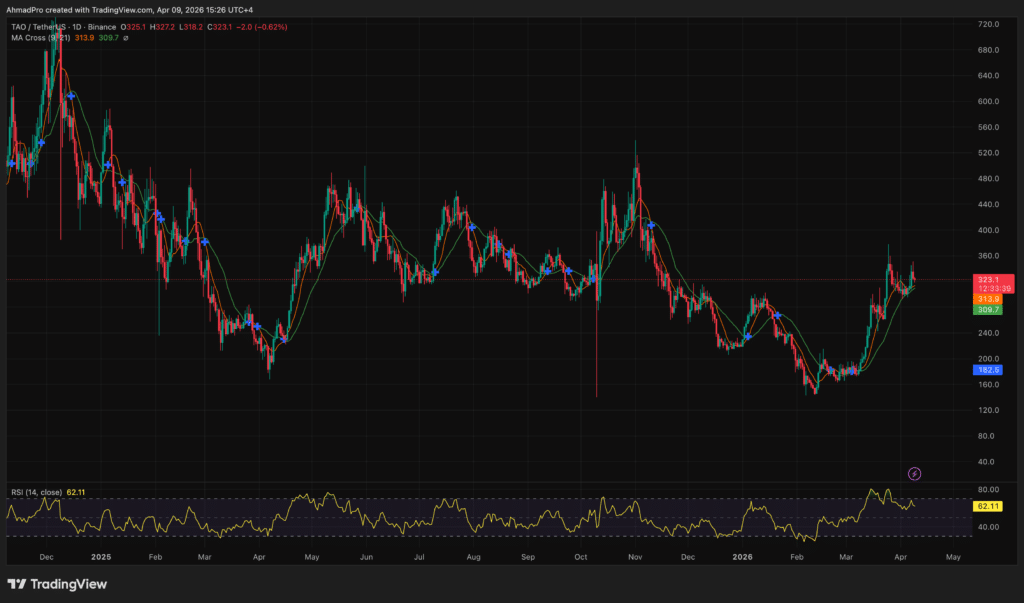
Bittensor’s TAO crypto is trading at $334 after the success of Covenant-72B. Covenant-72B is a 72.7 billion parameter model trained on over 70 anonymous distributed nodes without requiring a single data center or a nine-figure budget.
The 90% increase in TAO recorded through March 2026 is not a narrative trade. This is a direct market response to a technological milestone that decentralized AI has been chasing for years.
But this milestone requires a precise framework. Covenant-72B proves that permissionless networks can orchestrate model training at scale. This does not eliminate hardware physics that still favors centralized clusters for frontier pre-training.
The more commercially pressing story, and the one worth noting in terms of TAO pricing, is happening on the inference side, where Subnet 64 is already underperforming centralized cloud providers on cost.
24 hours 7 days 30 days 1 year Always
Discover: Next 1000x Crypto Gems before being listed on Binance
The physics of distributed training and pre-training: What Covenant-72B has proven in practice
Training a 72B model typically requires a tightly coupled cluster of high-end GPUs connected with InfiniBand. This hardware costs tens of millions of dollars and requires sub-millisecond latency between nodes.
Conventional wisdom held that commodity internet connectivity could not bridge that gap. Covenant-72B directly challenges this using SparseLoCo, a technique that combines sparsification, 2-bit quantization, and error feedback, reducing inter-node communication by more than 146 times compared to previous distributed executions.
Results: Bittensor’s Templar subnet was trained on 1.1 trillion tokens across 70+ peers with blockchain-based validation via the Gauntlet system. The system used loss evaluation and OpenSkill rankings to award TAO to high-quality nodes and penalize poorly performing nodes.
Bit tensor SN3 :: @tplr_ai // @covenant_ai 72B
"If intelligence is the most powerful thing, decentralized training is humanity’s last dance. It’s the same thing we’ve been fighting for for years."
"That’s what the internet tried to do. That’s what Bitcoin tried to do – how do we get it back… pic.twitter.com/mzza4y0zpb
— Openτensor Foundation (@opentensor) March 28, 2026
The base model achieved a score of 67.1 on MMLU zero shots, outperforming both LLaMA-2-70B (65.6) and LLM360 K2 (65.5). A Chat variant, Covenant-72B-Chat, led its peer group in the instructions-following benchmark. All weights and code are released under the Apache license and are permission-free and ready for use.
The unpleasant truth is that pre-training on the frontier (think running at GPT-5 scale) still requires co-located hardware for which no corresponding distributed network currently exists. The physics of VRAM synchronization and bandwidth at that scale are still not solved by SparseLoCo. What Covenant-72B proved is perhaps more important in the short term. It means that a permissionless network of anonymous contributors can produce models that rival the output of multibillion-dollar corporate research labs. This changes the conversation from “Will decentralized AI work?” “How quickly will it improve?”
The answer to the second question is where speculative economics comes into play. Inference is modular and hardware is heterogeneous, so InfiniBand is not required to process queries. The cost advantage of subnet 64 over centralized cloud is not a roadmap item and is already commercially available.
Discovered: 10+ Cryptocurrencies to Grow 100x in 2026
Can TAO Crypto sustain $334 and target $379 price?
The TAO cryptocurrency is currently trading at $334, up about 90% from its March lows, with 24-hour volume sitting at 244,000, a sustained accumulation rather than a single-session spike.
The RSI (Relative Strength Index, a momentum indicator ranging from 0 to 100 with values above 70 indicating overbought conditions) is rising, but has not yet flashed the extreme values that preceded previous corrections.
The structural anchor is the 200-day EMA (exponential moving average, a trend-smoothing indicator that weights recent prices more heavily) at $275. This level flipped from resistance to support during the March rally and has been retested every time since. A close above $275 on a weekly basis is the macro floor. Bulls need that level to hold before they can claim that the broader trend has changed character.
The immediate target is last week’s intraday high of $379. A clean break above volume levels comparable to March’s surge would pave the way for the next significant resistance cluster.
TAO is tied pretty closely to Bitcoin here, and if BTC continues to perform well above $85,000 and TAO is able to move above $379 in actual volume, momentum will return from there and a move towards the $420-$450 zone will begin. This is especially true when developer activity actually increases around the time of a new release, driving new demand.
But for now, things seem to be calming down after the initial hype, and the price will likely hover between $300 and $379 until the market resets. As long as the $275 EMA holds, the structure is still intact and this looks like just a re-accumulation and not weakness.
That risk would materialize if the broader market changed direction. This is because if Bitcoin loses its strength and TAO falls below the $275 level at the close of the higher timeframe, the entire setup will collapse and open the door to an even deeper decline towards the low $200s.
244K volume is not a ghost rally. However, at current prices, TAO price prediction requires BTC stability as much as it requires Bittensor-specific catalysts.
Discover: The Best Meme Coins ICOs to Invest in in 2026
How Bittensor Trained a 72 Billion Parameter AI Model Without a Data Center — Is TAO Crypto About to Reach $379? The post appeared first on 99Bitcoins.
