


Asked about the presence of the wreckage, Kremlin spokesman Dmitry Peskov said it was “a matter for our military.” He called Zelensky’s dismissal of the attack and the allegations raised in Western media “completely insane.”
Peskov said Russia’s diplomatic position “will become tougher” as a result of the attack. “Our military knows when and how to respond,” he added.
The speaker of Russia’s lower house of parliament, Vyacheslav Volodin, also vowed that “there will be no forgiveness” for Zelensky. The story received enthusiastic coverage and made headlines on national television channels’ news programs.
President Putin has made no secret of his determination to go to war if his tough demands are not met in an agreement.
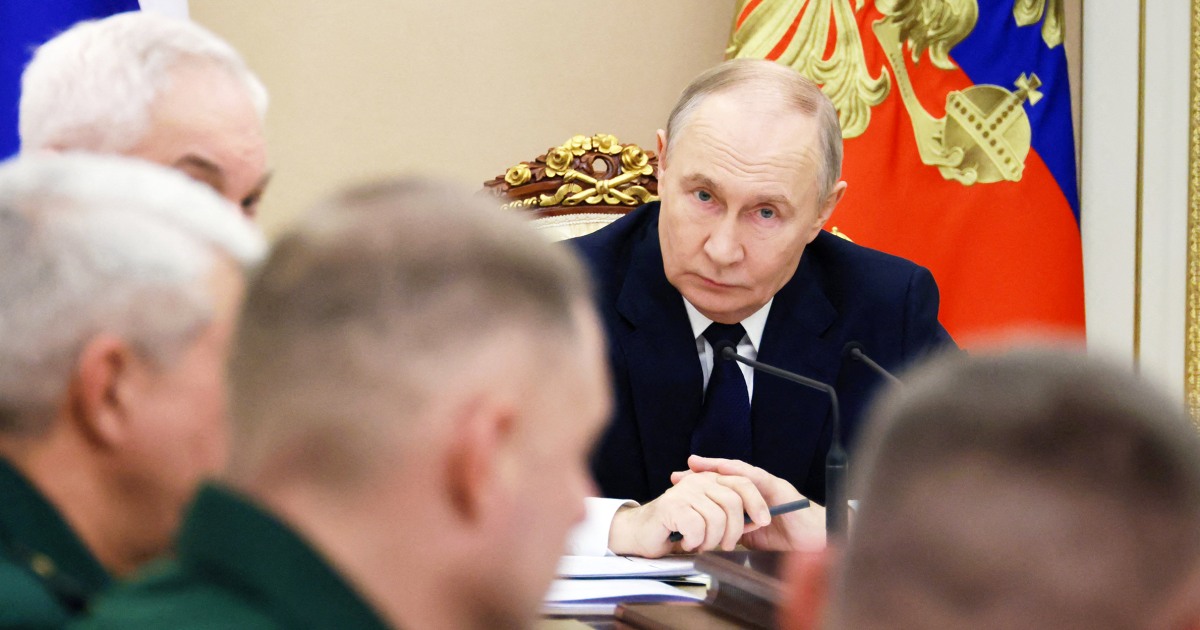
The Kremlin has declined to comment on the Russian leader’s whereabouts during the alleged attack. Hours earlier, he appeared on the latest video conference with battlefield commanders, apparently aimed at telling domestic and international audiences that Russia has the upper hand in the war and that if it fails to come to the negotiating table, it intends to seize territory it wants by force.
President Zelenskiy is working on his own messaging campaign, and Sunday’s meeting with President Trump in Florida is seen as a success for Ukraine, despite the lack of a clear breakthrough.
Matthew Ford, an associate professor of war studies at the Swedish National Defense Academy in Stockholm, said Russia’s sudden accusations should be seen as “perfectly timed drama.”
Ford said Putin is trying to provide the Trump administration with “sufficient protection” to press ahead with its hard-line demands while avoiding the U.S. siding with Ukraine.
What does it mean for Ukraine?
President Trump said he learned about the alleged attack directly from President Putin and was “very angry.”
“I don’t like it,” Trump told reporters when asked if he thought the alleged attack would affect his efforts to broker peace. Asked if there was evidence of an attack, Trump said, “We’ll see.”
Ukraine claims there is nothing.
“Almost a day has passed and Russia still has not provided any plausible evidence,” Foreign Minister Andriy Sibikha said. “And they don’t, because there’s no one there. Those attacks aren’t happening.”
President Trump’s response hits a nerve at a particularly sensitive time for Ukraine.
President Zelenskiy on Monday touted his success in securing long-term security from the United States that is legally binding and will help prevent future Russian attacks. He said Trump offered Ukraine security guarantees for at least 15 years, but Kiev wanted guarantees for up to 50 years.
But later, when asked whether he would send U.S. troops to Ukraine, Zelensky told reporters on WhatsApp that it was for Trump to decide. “We want this,” he said. “That would be a strong element of safety assurance.”
This is not an abstract issue for Ukraine, whose cities are subject to near-daily Russian shelling, resulting in civilian deaths and damage despite ongoing negotiations.
Svyatoslav Yurash, a Ukrainian lawmaker and military officer, said Trump’s quick reiteration of Russia’s claims underscores the need to understand exactly what kind of security Kyiv has and how it will work.
To Yurash and others, the Kremlin’s claims appeared to be just another “false flag” operation, raising concerns that the parties enforcing the agreement could repeat the strategy of breaking the ceasefire unchecked in the future.
“We had already made a declaration when we gave up the world’s third-largest nuclear arsenal,” Yuras said, referring to the failure of the 1994 Budapest Memorandum, which the United States co-signed to protect the homeland from Russian aggression. “We need more than a neat piece of paper,” Yurash added.
Phillips O’Brien, professor of strategic studies at the University of St. Andrews in Scotland, agrees.
“Ukrainians have no confidence in the U.S. government’s treaty commitments,” he said. “They already had them, but they were pointless.”

Darina Meyer and Reuters contributed.
