


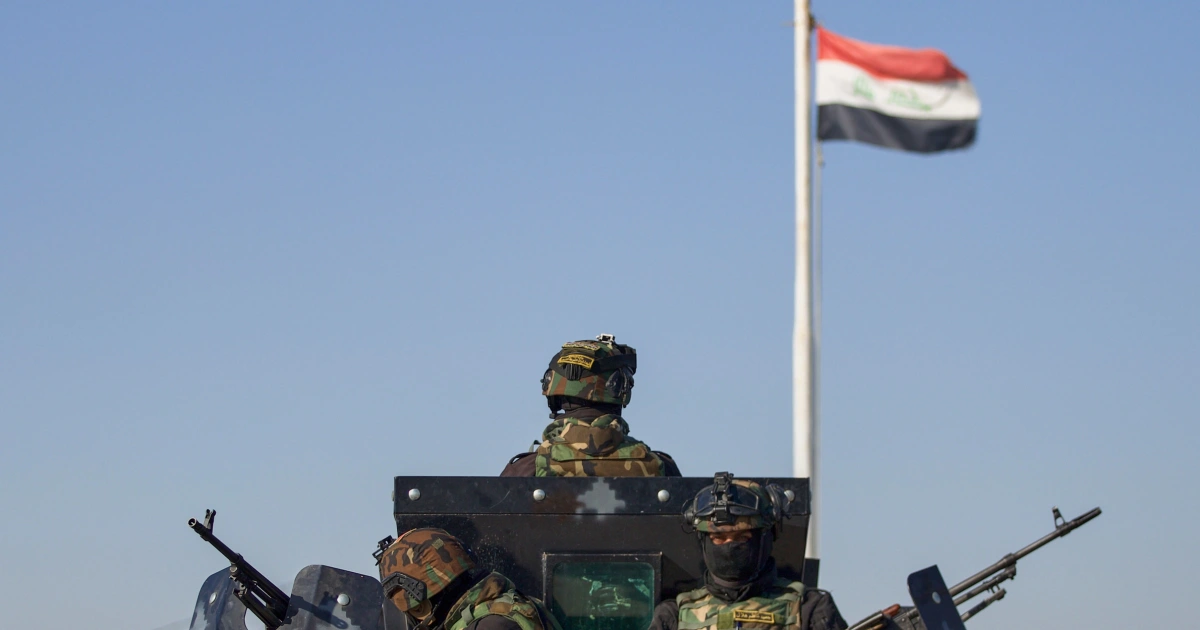
In a significant move to enforce state authority and curtail militia power, Iraqi security forces were deployed in Jurf al-Sakhar on Friday. This town, long known as a stronghold for the armed group Kataib Hezbollah, is at the center of a delicate agreement aimed at reducing the influence of Iran’s major Shi’ite militia ally in Iraq while avoiding direct confrontation.
Prime Minister Ali al-Zaidi has given the order for security forces to intervene in Jurf al-Sakhar, following accusations that Kataib Hezbollah is involved in a state oil smuggling operation valued at hundreds of millions of dollars. The Iraqi government’s crackdown has raised concerns of potential violent backlash from the militia, which has consistently denied involvement in any illicit activities.
Kataib Hezbollah, identified as a terrorist organization by the United States, has been accused of engaging in smuggling operations. This escalation in accusations coincides with the group’s claims of conducting attacks against US forces in the region, especially amid the ongoing tensions due to the US-Israeli conflict with Iran.
As part of the deployment, a convoy of vehicles bearing Iraqi flags entered Jurf al-Sakhar, marking the beginning of a new security presence in the area. Officials announced at a press conference that government forces would offer protection to the town, responding to local residents’ call for security assurance.
Prime Minister Zaidi addressed his troops, emphasizing Iraq’s sovereignty: “From Jurf al-Sakhar, we begin asserting state authority across all of Iraq, confronting corruption and weapons beyond state control,” he declared. He reinforced the message that no arms would exist outside state control, and that actions would align strictly with the national government.
Implementation of Security Measures
The agreement reached between Shi’ite political leaders will see the establishment of a new security headquarters in Jurf al-Sakhar on Saturday to monitor the transition of authority. The Iraqi energy police have already begun securing the oil pipeline routes in the area.
“Today is a historic moment in which the Iraqi Armed Forces prove that they are the nation’s shield and the guardian ensuring security stability for the Iraqi people,” stated Sabah al-Numan, spokesperson for the commander-in-chief of the Iraqi armed forces, during the press briefing.
The situation remains sensitive, with reports indicating the recent visit of Esmail Qaani, the commander of Iran’s Revolutionary Guards’ Quds Force, to Baghdad. This visit aims to alleviate tensions with Kataib Hezbollah and potentially de-escalate the ongoing crisis.
Government Actions and Reactions
In light of the investigation centered on Jurf al-Sakhar, nine high-ranking officials from security and oil sectors have been dismissed. There is a heightened concern that conflict with Iran-backed militias could have dire consequences, recalling a previous incident where a prior crackdown led to a drone attack on a former prime minister’s residence.
US Pressure on Iraqi Leadership
US President Donald Trump has exerted pressure on Prime Minister Zaidi to take decisive action against these militias, which have attacked US facilities and allied values in the region. Kataib Hezbollah, along with other militia groups directly loyal to Iran, has shown resistance to disarming, thus complicating efforts for state authority.
Since its formation in the wake of the 2003 US-led invasion, Kataib Hezbollah has become a powerful entity in the Islamic Resistance in Iraq, managing a range of operations from military strategies to political activities. Their forte in conducting lethal attacks against military targets during conflicts underscores their military influence.
Iran’s Influence in Iraq
The Iranian foothold in Iraq has significantly expanded since the fall of Saddam Hussein. Their influence is evident through strong affiliations with Kurdish and Shi’ite militias and political factions, with security assessments indicating that these groups possess a variety of sophisticated armaments.
Additionally, Kataib Hezbollah maintains political operatives under its affiliated faction, Huquq, which has representation in the Iraqi parliament. Reports suggest the organization also engages in various business activities, diversifying their income beyond militancy, although they publicly reject such claims.
Despite being integrated into Iraq’s Popular Mobilization Forces (PMF), a recognized government security body, Kataib Hezbollah operates with significant autonomy, reflecting the complex relationship between state institutions and these pro-Iran militias.
