


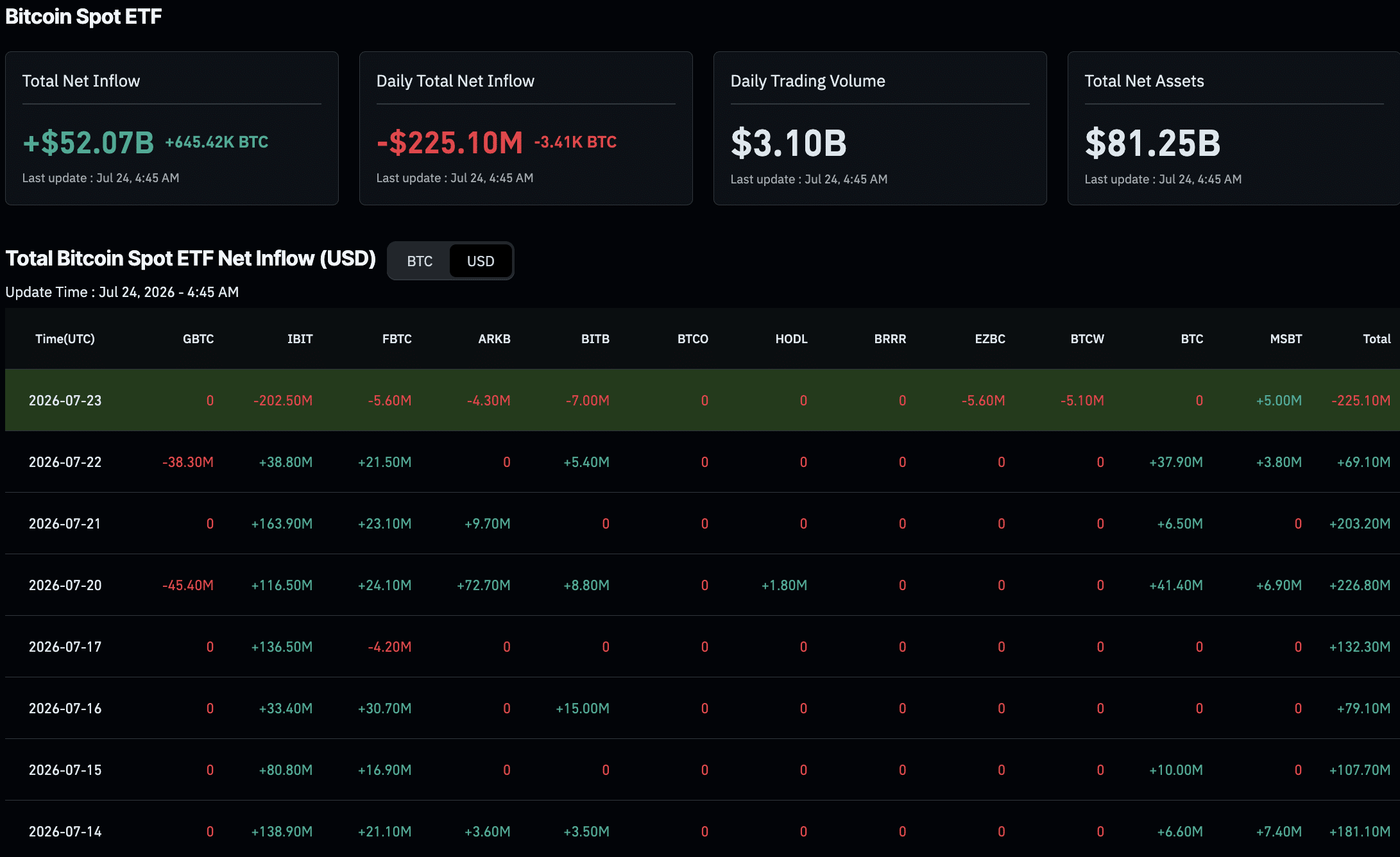
In today’s Bitcoin news, the US Spot BTC ETF fund posted nearly $1 billion in net inflows for seven consecutive sessions ending July 22, 2026, its longest positive run in 11 weeks, with BlackRock IBIT taking in $319.16 million of the $499.05 million added this week alone.
However, that winning streak has already come to an end, as yesterday’s session ended with an outflow of -$225 million, even as Bitcoin remained solid above $65,000 despite ETF selling pressure.
According to 247 Wall St, Bitcoin rose above $66,000 during the two strongest consecutive sessions on July 20th and July 21st. The impetus was news that President Trump had agreed to the ethics rules that underpin the CLARITY Act.
This bipartisan digital asset bill would establish clearer regulatory boundaries for cryptocurrency markets and appeared to unleash a wave of institutional demand.
Bitcoin ETF News: 7-day inflows disappear with -$225 million outflows
(Source: Coinglass)
The last outflow date was July 13, when investors withdrew $424.66 million, the largest single-day withdrawal of the month. Since then, the funds have been returned every session, but not uniformly.
According to CoinGlass data, flows reached $181.08 million on July 14, fell to $107.8 million on July 15, $79.15 million on July 16, and recovered to $132.3 million on July 17.
Two major sessions arrived with the CLARITY Act heading. On July 20th, $226.92 million was recorded, and on July 21st, $203.14 million was added as Bitcoin price crossed $66,000.
By July 22, daily inflows had retreated to $68.99 million, the weakest session of the entire streak. This slowing pattern was telling, as yesterday saw outflows of $225 million, resulting in an end to a seven-day streak.
The last time institutional demand for Bitcoin through ETF vehicles sustained this type of multi-day consistency was in early October 2025, when Bitcoin was trading near its all-time high of around $126,000.
Why IBIT continues to win despite not being the cheapest option
BREAKING: Bitcoin ETFs saw over $900 million in inflows last week, the largest weekly inflow since early May.
This represents a sharp acceleration from the previous week’s inflows of +$197 million.
$IBIT, the largest Bitcoin ETF, led the surge, raising +$193 million last week… pic.twitter.com/tr8lo363oX
— Kobeissi Letter (@KobeissiLetter) July 22, 2026
The pricing structure alone cannot explain IBIT’s superiority. Fidelity FBTC charges no management fees and has $11.38 billion in total assets under management, while IBIT leads with $48.86 billion in total assets under management. Over 10 years, IBIT’s 0.25% annual fee adds up significantly for long-term investors.
247 Wall St. attributes IBIT’s success to distribution advantages. BlackRock’s products are well-known to pension administrators and registered advisors, who can purchase IBIT in a seamless experience with minimal compliance hurdles, making fees less important.
Trading volume also highlights this concentration, with IBIT accounting for nearly 79% of the $1.11 billion in total trading volume across all 13 Spot Bitcoin ETFs as of July 22. IBIT holds 3.70% of all Bitcoin, while 12 other ETFs collectively hold only 2.38%. This indicates significant activity by IBIT institutions during this period.
Discover: Next 1000x Crypto Gems before being listed on Binance
Bitcoin ETF News: Grayscale GBTC, Fund Still Dragging Through Complexity
In other Bitcoin ETF news, Grayscale GBTC, the Grayscale Bitcoin Trust that converted from a closed-end fund to a spot ETF, remains the biggest structural headwind to the ETF complex’s net position. Since converting to ETF format, GBTC has reduced cumulative outflows by $27.42 billion. On July 22 alone, an additional $38.3 million was drained from the fund.
The fundamental reason is the price difference. Grayscale charges 1.50% per year. IBIT’s fee is 0.25%. For an investor who holds $100,000 for five years, that 1.25 percentage point gap would result in an additional fee of approximately $6,500, before considering performance differences.
The cumulative effect is that GBTC’s outflows are overwhelming the real demand seen at IBIT and, to a lesser extent, other competitors.
Since inception, total net inflows across the 13 Bitcoin ETF funds have been $51.85 billion, which is what remains after GBTC minus $27.42 billion. Without GBTC’s impact, the headline numbers for the ETF complex would look pretty strong.
$BTC — If you somehow deviate and get back 65.5K in 4HR TF, you’ll see 70K immediately.
Otherwise, the chop continues until 64K.
Despite SPY’s weakness yesterday, I am optimistic about the upside move due to Orange Coin’s relative strength.
More than $70,000 BTC will be programmed in the next few rounds… pic.twitter.com/Ug9eGaGPUX
— Friedrich
(@FriedrichBtc) July 24, 2026
Trade BTC with ByBit and participate in 99Bitcoin’s exclusive $1000 USDT airdrop
The Catalyst of the CLARITY Act and What It Actually Moved
The CLARITY Act (Digital Asset Market Transparency Act) was stalled due to ethics-related disputes. Reports on July 20 that President Trump had agreed to ethics rules spurred significant capital flows into the market.
Clarity in regulations could reduce compliance risks and allow institutional investors, such as pension funds and insurance companies, more freedom to own Bitcoin ETFs.
Inflow days of $226.92 million and $203.14 million on July 20th and 21st indicate that institutions were expecting this change, but yesterday’s large outflows capped the bullish momentum built with seven consecutive days of inflows.
However, if processing delays occur again, momentum could continue to turn red, as seen in the $68.99 million decline in inflows on July 22 and subsequent outflows yesterday, both of which lack fresh regulatory support.
Explore: The Best Cryptocurrency Presales with Asymmetric Upsides in the Current Market
The article 7 Consecutive Bitcoin ETF Inflow Days Recovers Just 15% of June’s Losses was first published on 99Bitcoins.
