


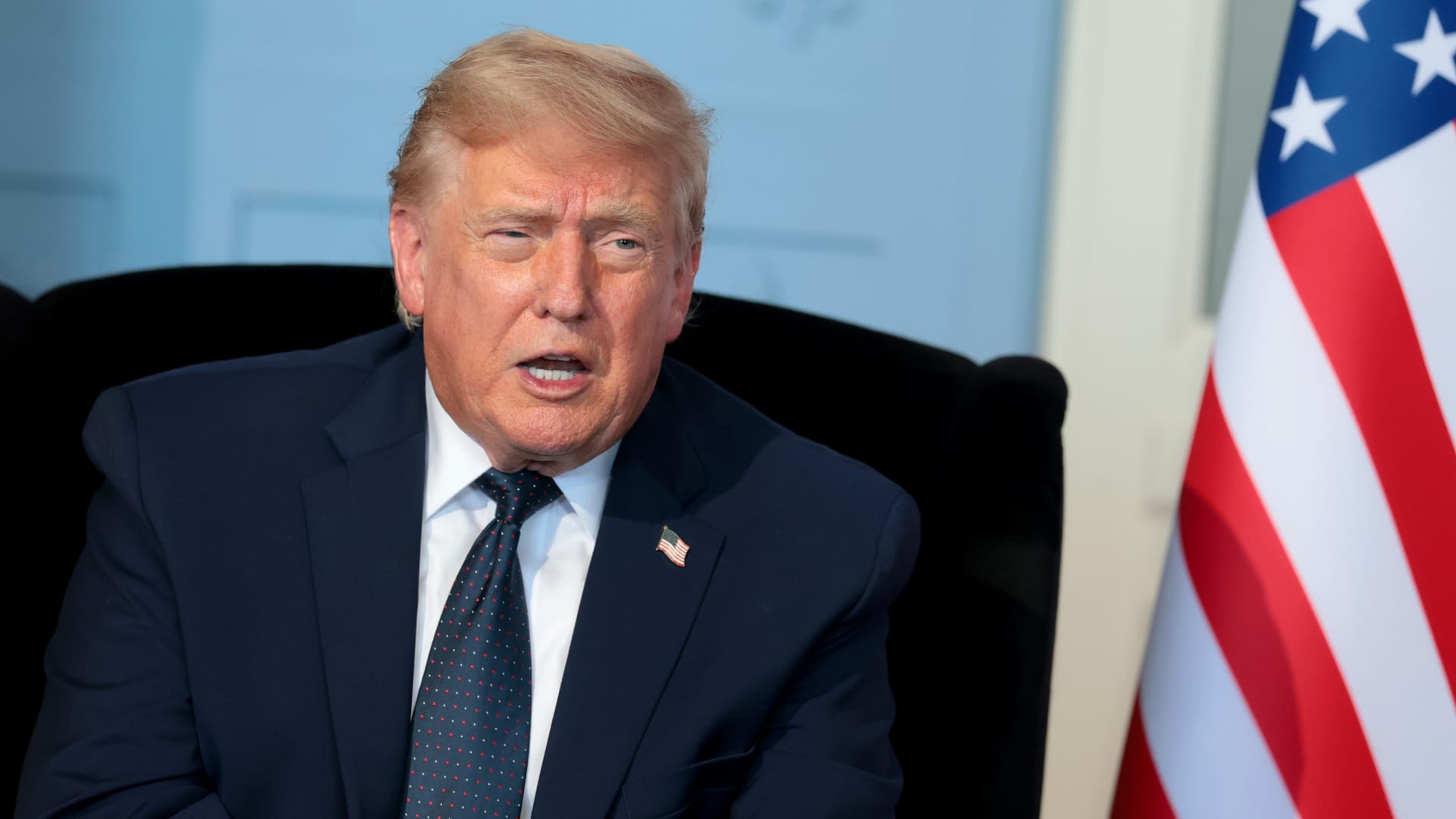
U.S. President Donald Trump meets with French President Emmanuel Macron for bilateral talks at the Hotel Royal Evian in Evian-les-Bains, France, June 15.
Anna Moneymaker | Getty Images
US President Donald Trump insisted in an interview with Axios that he has unlimited power and that the deal with Iran amounted to “unconditional surrender” by Iran.
The United States and Iran signed a deal on Thursday after a three-and-a-half month conflict that has blocked the Strait of Hormuz and disrupted global energy markets. President Trump said in an interview Thursday evening in the United States that he had negotiated the deal to prevent the conflict from triggering a global economic recession.
The memorandum includes a 60-day negotiation period to reach a final agreement, the reopening of the vital Strait of Hormuz, and a framework for nuclear negotiations. Several key details remain unresolved and will be addressed in future negotiations.
Asked what he learned from the war about the limits of his power, Trump said, “We haven’t learned that lesson yet. We know there are limits, but there are no limits.”
Shipping activity through the Strait of Hormuz began to pick up after the agreement entered into force, with cargo ships and oil tankers resuming passage through the narrow artery.
At least 18 crossings were recorded between June 17 and 18, the highest number in any comparable period since the conflict began, according to maritime information firm Windward.
U.S. Central Command announced Thursday that U.S. forces have lifted all blockades on maritime traffic in and out of Iran’s coastal areas.
“All U.S. military blockade enforcement efforts have ceased,” Centcom said in a social media post, adding that the U.S. Navy will remain in general waters to ensure all aspects of the agreement are adhered to.
U.S. Vice President Vance canceled a planned trip to Switzerland to begin 60 days of negotiations with Iranian officials on Friday, citing logistical reasons, a White House spokesperson said.
“Plans for further technical consultations have not yet been finalized, and the U.S. delegation is ready to depart at the first opportunity. However, the logistics of these negotiations were by no means simple or predictable,” the spokesperson said.
The deal has drawn criticism from lawmakers who say the terms of the interim agreement fall short of the president’s goals at the start of the war and that Trump was not tough enough on Iran.
Senate Majority Leader Chuck Schumer of New York told reporters that Trump’s negotiations were “very unsuccessful” and that the U.S. situation is worse than it was before the war began.
“This will be considered one of America’s greatest disasters, and that’s because Trump started this war,” Schumer said.
Sen. Peter Welch (D-Vermont) said Iran maintains influence through its control of the Strait of Hormuz, and said the conflict had failed to achieve key objectives such as regime change and halting Iran’s missile and nuclear programs. Welch estimated the cost of the war to be an estimated $100 billion and called the outcome a “failure.”
President Trump on Thursday pushed back against mounting criticism, saying anyone who thinks he is soft on Iran is either “jealous, a bad person or a stupid person.”
During an interview with Axios, Trump again fumed that he should have pushed harder, asking how much more effective it would have been to continue shelling for weeks more with the Strait closed.
“This is the kind of thing that could cause a global depression,” he said.
