


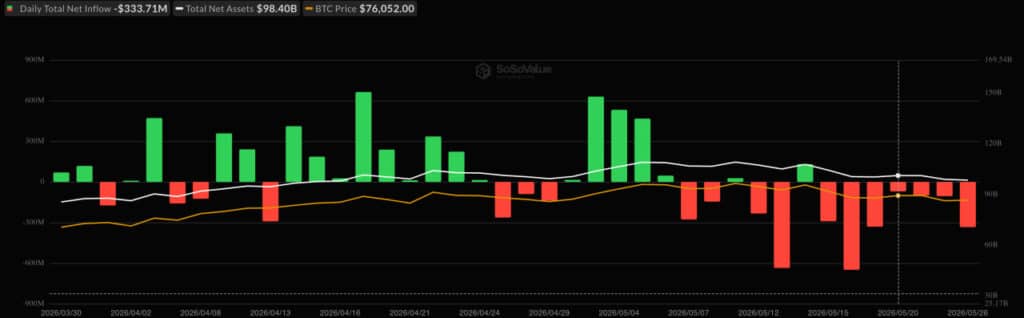
Bitcoin ETF News: On May 26, 2026, BlackRock IBIT, the world’s largest spot Bitcoin ETF, recorded $1.3 billion in outflows in one day, extending its selling streak to seven consecutive days and marking the fund’s worst outflow event since its inception in January 2024.
Bitcoin fell under pressure during the same period, with the effects of Bitcoin price being felt across the broader crypto market as sentiment turned cautious.
The central tension this article unpacks is: If BlackRock’s IBIT is supposed to represent institutional confidence in Bitcoin, then why is the largest institutional Bitcoin product on the planet selling for seven straight days? And does it actually mean what the headline suggests?
$1.3 Billion IBIT Dark Pool Dump Rocks Bitcoin Market
A massive $1.29 billion dark pool block trade hit BlackRock’s $IBIT this morning, marking what traders are calling one of the largest institutional Bitcoin ETF trades ever recorded.
Reportedly, the deal was a back-and-forth… pic.twitter.com/jmZtwKRLT8
— Bitcoin News (@BitcoinNewsCom) May 26, 2026
Discover: The Best Meme Coins ICOs to Invest in in 2026
Bitcoin ETF News: What the $1.3 Billion Number Really Says
Think of Spot Bitcoin ETFs like a coat check at a concert. When you enter the store, you hand over your coat (money) and receive a ticket (ETF shares). The coat inspection staff takes all the coats and stores them in one huge room (they buy Bitcoin).
When you want your coat back, a staff member pulls it out of the room and hands it to you, but when thousands of people want coats at once, staff have to retrieve a lot of coats quickly. That search is the headline: Sell Bitcoin.
I confirmed. A trade of 29 million shares of $IBIT ($1.3 billion) was executed at 10:30 a.m. this morning. This screen displays all of today’s IBIT trades by size, and you can see that one of them is different from the others. MKT absorbed well as the price remained unchanged today. https://t.co/Otew0DWa3F pic.twitter.com/jZcoKez74K
— Eric Balchunas (@EricBalchunas) May 26, 2026
Simply put, if an investor sells IBIT shares, the authorized participant must redeem those shares by selling the underlying Bitcoin. The Fund is not making directional bets, it is simply honoring withdrawal requests.
The selling pressure seen in the market is a mechanical result of investor redemptions and does not mean that BlackRock has abandoned its belief in Bitcoin.
Context is very important here. IBIT accumulated approximately $19.5 billion in assets under management at its peak. This built on months of consistent inflows that helped push Bitcoin toward record highs. While the $1.3 billion in one-day outflows was a record for the fund, it represented a fraction of its cumulative base, and many said the ETF absorbed significant sales.
As commentators explain what Bitcoin ETF outflows mean for retail investors, the mechanisms behind these redemptions are far less alarming than the dollar numbers alone suggest.
Institutional Sales Explained: Tactical or Structured Exit?
The most likely explanation for the current wave of Bitcoin ETF outflows is tactical repositioning rather than a conviction crisis. Large asset managers and hedge funds frequently use Spot Bitcoin ETFs for short-term exposure, basis trades, or as a risk management tool within a diversified portfolio.
When macro conditions change, a strong dollar, better-than-expected inflation numbers, or the Federal Reserve signals tightening policy, these players quickly and cleanly de-risk through ETF redemptions.
When the wave of IBIT outflows occurred in late 2025, with daily redemptions reaching around $523 million, market observers quoted by Reuters explained that the selloff reflected “macro risk-off sentiment and profit-taking” rather than a collapse in institutional demand for Bitcoin itself.
Bloomberg ETF analyst Eric Balchunas has consistently noted that record volumes and large outflows tend to be clustered around spikes in volatility, suggesting rebalancing or capitulation rather than a permanent exodus from the asset class.
This seven-day selling streak also fits into a documented pattern. As discussed in our previous analysis of the $635 million ETF outflow event, IBIT selloffs have historically preceded stabilization and new inflows, not permanent trend reversals.
The broader Spot Bitcoin ETF complex had its longest streak of net outflows since its inception from November 2025 to January 2026, shedding approximately $6.18 billion, but institutional participation did not disappear. In this context, institutional selling looks more like a seasonal storm than a structural change in the weather.
Discover: Next 1000x Crypto Gems before being listed on Binance
The post Bitcoin ETF News: BlackRock’s Bitcoin ETF has its worst day ever: Should beginners panic? The post appeared first on 99Bitcoins.
