



JPMorgan Chase & Co. filed with the U.S. Securities and Exchange Commission (SEC) on May 12 for a second tokenized money market fund on Ethereum, proposing a digital token linked to a portfolio of U.S. Treasuries and overnight cash forwarding contracts that investors can hold in digital wallets or deploy as on-chain collateral.
The filing estimates that the total market value of tokenized real-world assets (RWA) tracked by rwa.xyz is approximately $32 billion, and notes that competitors, including BlackRock, are moving forward with comparable institutional offerings under the recently enacted GENIUS Act.
(Source RWA.xyz)
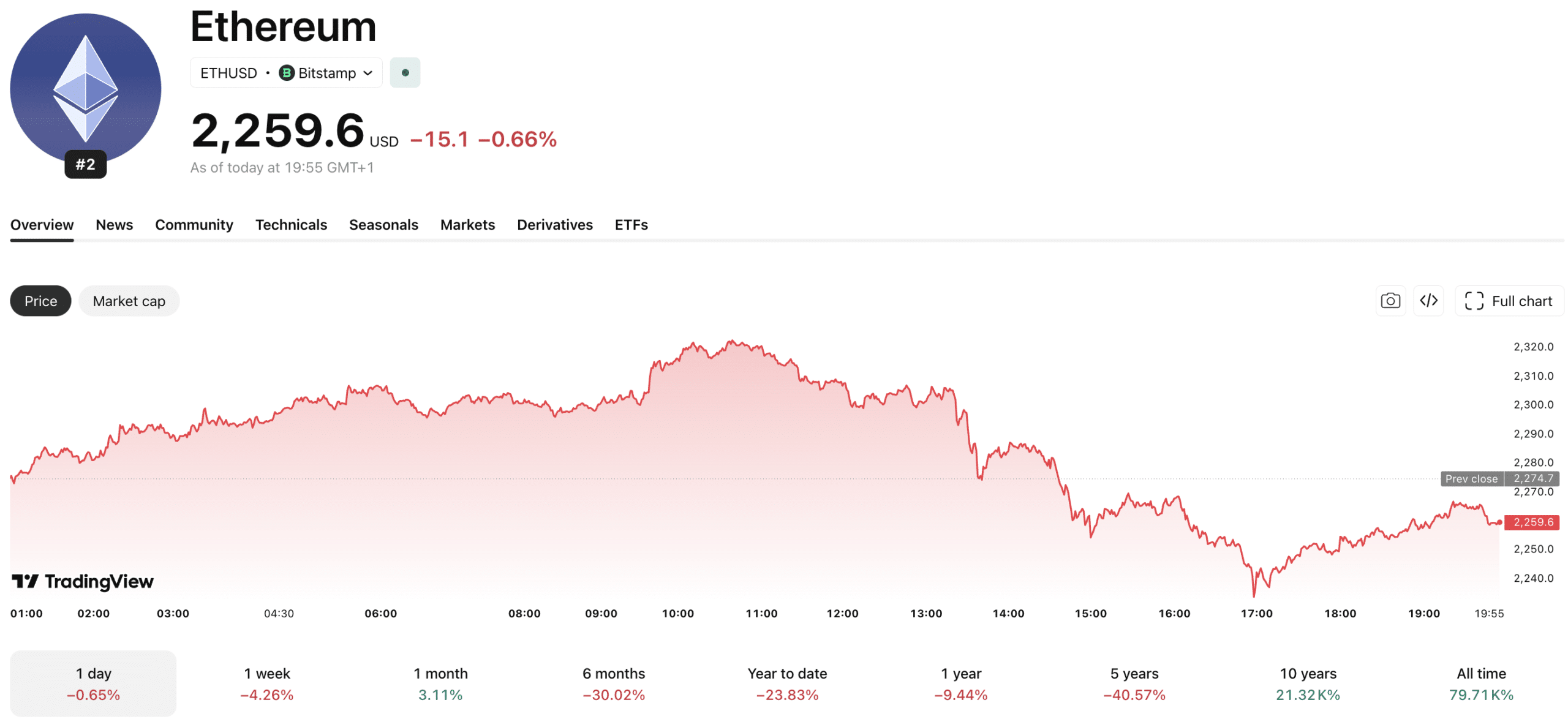
This is not just a new product launch. JPMorgan has indicated that the pilot phase of institutional tokenization has ended, and that Ethereum’s public infrastructure, rather than banks’ own permissioned networks, will be expanded in the next phase of on-chain finance.
I suspect they will choose Ethereum mainnet over JP
Morgan’s private Kinexys Digital Assets infrastructure for client-facing products reflects a deliberate recognition that institutional liquidity is not stored in a segregated bank-led network.
(Source: TradingView)
JP Morgan’s JLTXX filing: How the second tokenized treasury fund will work in practice
This mechanism works as follows. The new fund, structured as a token class stock under JPMorgan Trust IV and designated JLTXX, has filed for an effective date of May 13, 2026, has underlying assets limited to U.S. Treasury securities maturing within 93 days, and will maintain at least 99.5% cash or government assets in accordance with SEC Rule 2a-7.
Rather than the T+1 or T+2 cycle of traditional money market funds, trades settle in minutes, but legal control of the assets remains with the traditional custodian. Blockchain balances reflect held assets on a one-to-one basis, and in the event of a dispute, traditional transfer records take precedence.
While MONY, the bank’s first tokenized fund, requires a minimum investment of $1 from accredited investors, including institutions with assets of $25 million or more, and targets broad institutional yield, JLTXX is explicitly structured to serve as a reserve asset for stablecoin issuers operating under the GENIUS legal framework.
Permitted Ethereum addresses handle compliance at the protocol level, allowing funds to operate on public blockchains while maintaining the access controls necessary for regulated institutional products. Subscriptions and redemptions can use stablecoins in addition to cash, increasing adoption options for financial managers who already own digital assets.
The product will be routed through Kinexys Digital Assets, JPMorgan’s blockchain-based asset platform. Kinexys Digital Assets previously executed a $50 million tokenized commercial paper transaction on Solana and issued JPMD deposit tokens on Base. A trajectory of public chain pilots, now converging into a live, SEC-registered product on Ethereum. As previously reported, JPMorgan also completed a live cross-border tokenized Treasury redemption on the XRP Ledger, demonstrating the multi-chain posture that the JLTXX application strengthens.
Discover: The Best Meme Coins to Buy in 2026
Cryptocurrency and RWA competition for institutional investors: What JPMorgan’s public chain pivot reveals about market structure
JP Morgan just applied to put our national debt on Ethereum
JP Morgan has filed to launch JLTXX, an on-chain liquidity token money market fund, on the Ethereum ($ETH) blockchain.
The fund invests exclusively in U.S. Treasury securities and offers fully collateralized overnight repurchases… pic.twitter.com/PDREkZP9Au
— BSCN (@BSCNews) May 13, 2026
The GENIUS Act, signed in July 2025, established key regulations by prohibiting stablecoin issuers from paying interest, thereby distinguishing stablecoins from yield-bearing products. This opens the door to tokenized money market funds under SEC rules. JPMorgan’s second application targets corporate finance and cash management, which are currently excluded from stablecoin functionality.
Competition is heating up, with BlackRock’s BUIDL fund reaching over $500 on Ethereum since its launch in March 2024, proving that institutional real world asset (RWA) products are scalable. By Q1 2026, tokenized RWA will reach $8.6 billion, with Ethereum holding approximately 70% of that value. Franklin Templeton is also expanding in this space, with more filings expected for Solana and the race for $12 billion in institutional deposits.
JPMorgan’s Onyx blockchain, which launched in 2020 and will process over $1 billion in transactions daily by 2025, will provide the trusted infrastructure for this expansion. The MONY Fund was established in December 2025 with a capital of $100 million and will serve as a proof of concept. JLTXX is the next product that aims to capture the reserve market that stablecoins can no longer capture.
Momentum for institutional adoption is growing, as evidenced by Charles Schwab’s entry into the crypto brokerage business. Most notably, JPMorgan’s second tokenized fund application on a public blockchain proves the viability of Ethereum as a large-scale balance sheet payments infrastructure.
Explore: The next crypto currency to explode in Q2
Next
Disclaimer: Coinspeaker is committed to providing fair and transparent reporting. This article is intended to provide accurate and timely information but should not be taken as financial or investment advice. Market conditions can change rapidly, so we recommend that you verify the information yourself and consult a professional before making any decisions based on this content.

Neil is a professional cryptocurrency content writer with years of experience. He writes articles reporting the latest news for various crypto websites and is hired by all kinds of crypto projects to create content that increases exposure and attracts more potential investors.
Neil Matthew on LinkedIn
