


David Schwartz, Ripple’s former CTO and one of the original architects of the XRP ledger, poured cold water on the idea of returning to Bitcoin development this week, calling Bitcoin “almost a technological dead end” in a response that quickly bounced back amid the cryptocurrency’s never-ending decentralization debate.
This exchange began as a dispute over history and governance. On February 9, X user Bram Kanstein claimed that XRP’s early “genesis reset” (often described as treating the 32,750th XRP block as a kind of starting point) was indicative of the cryptocurrency’s tendency to centralize. Kanstein wrote that this milestone “may be considered a genesis,” adding, “Except it is not. The XRP genesis reset is a prime example of the centralized nature of CrYpTO.”
Former Ripple CTO Schwartz calls Bitcoin a “technological dead end”
Schwartz jumped in with a comparison that steered the discussion toward Bitcoin. “There have been at least two incidents in Bitcoin that show far greater centralization than this one,” he said, “especially since the decision in this one was to not make coordinated changes and just coexist.”
The claim prompted a follow-up from X users, who cited SegWit as a possible example of what Schwartz meant: a coordinated protocol change. A former Ripple CTO disputed that framework, saying, “I don’t think adding new features is in any way an indication of centralization, so that’s not the case.” “But I think there’s a good argument to be made that it is. The biggest thing I was thinking of was a planned rollback in 2010.”
The tone of the thread changed on February 10, when X user Khaled Elawadi asked a question that spotlighted Schwartz’s own priorities. Since co-creating XRPL, has he worked on or considered developing Bitcoin again?
“Not really,” Schwartz replied. He then went further and outlined the argument that Bitcoin’s superiority is due to social and monetary inertia rather than the evolution of its base layer technology. “I think Bitcoin is primarily a technological dead end for the same reasons as the dollar,” he wrote. “The technology appears to be less critical to its success, at least at the blockchain layer.”
For XRP supporters, Schwartz’s comments served two purposes at once. One is a defense against the charge that XRPL’s early history suggests its own centralization, and the other is a reminder that there were early real-world exceptions to Bitcoin’s “hands-off” myth.
What can’t be overlooked is where the former Ripple CTO draws the line. Bitcoin’s success could persist even if base-layer technological progress slows. This is because network strength increasingly functions more like a monetary standard than an engineering project. Schwartz is pursuing a different strategy for the XRP Ledger. After stepping down as Ripple CTO, he announced that he would pursue his own project on the XRP ledger.
At the time of writing, XRP was trading at $1.38.
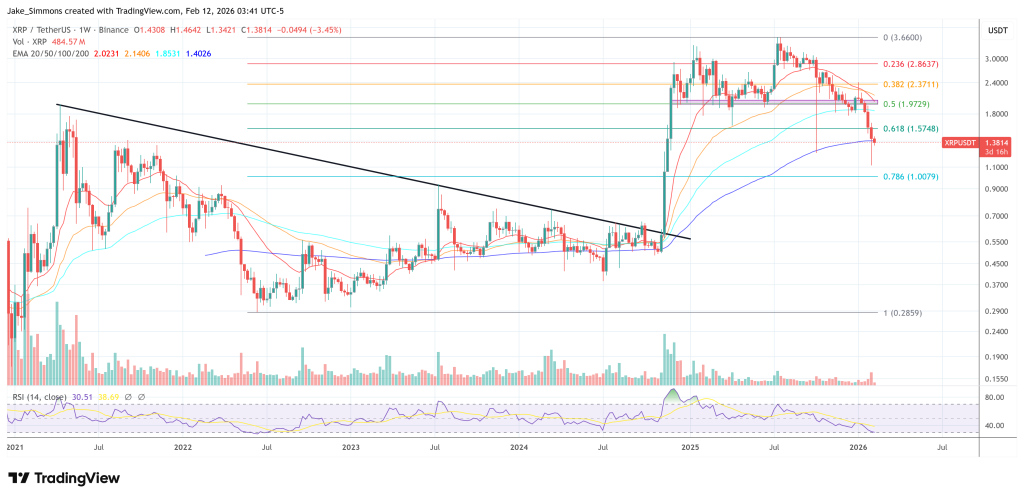
Featured image created with DALL.E, chart form on TradingView.com

bitcoinist’s editorial process focuses on providing thoroughly researched, accurate, and unbiased content. We adhere to strict sourcing standards, and each page is carefully reviewed by our team of top technology experts and experienced editors. This process ensures the integrity, relevance, and value of your content to your readers.
