


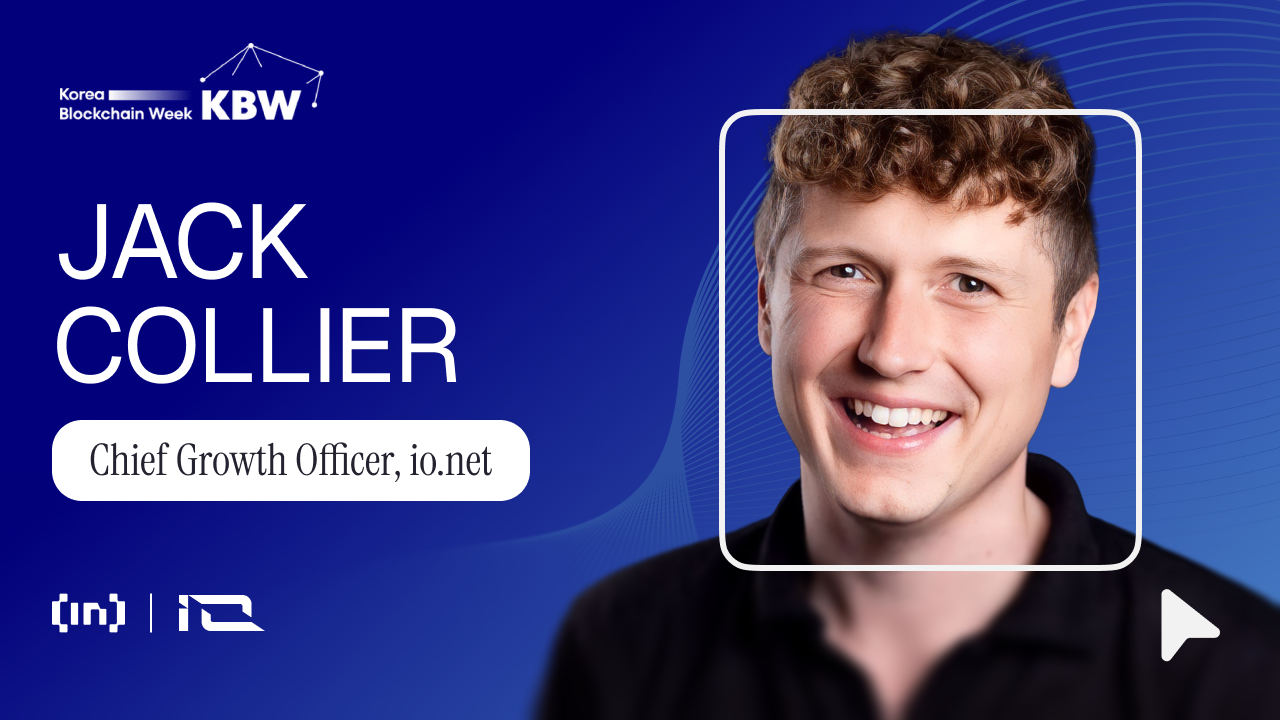
Jack Collier paves a unique path through the crypto industry. IO.NET’s Chief Growth Officer brings experience from Circle and Near Protocol. This shows his third venture to blockchain technology, deepening his belief in the possibility of decentralizing each role.
Speaking at the main event venue of Korea Blockchain Week, Collier highlighted what sets IO.NET apart. Unlike many Web3 projects that promise future utilities, io.net offers today’s tangible value. The platform creates a distributed computing network that connects available GPU resources globally and already serves businesses.
What initially attracted to IO.NET, and how decentralized calculations differ from the other blockchain applications you worked for?
“What really led me to IO was decentralized calculations. In blockchain, we actually have real use cases. That makes sense. It’s not an abstract idea. People can put their supply in the network. Today, there are a lot of stories and promises that Web3 really suffers, but my philosophy was barely there.
IO.NET reported strong revenue growth in the last quarter despite the challenging crypto market. Which partnerships or technology developments contributed the most to this outcome?
“When we first launched, our main market was Web3 projects, but for the past six to 12 months we have been trying to sell to Web2 businesses, regular startups and regular companies. A large part of the revenue growth is driven from that segment. Wandera.ai and Sahara AI for inference – the low computational costs that can be provided primarily through distributed networks, so we save a lot from what we used before.”
IO Explorer shows an usage rate of approximately 50%. How will IO.NET maintain a sustainable business with GPU supply and demand?
“We need to balance the amount of GPU available to consumers. With 100% utilization, new users will not be able to access them. GPUs are idle in the sense that someone is ready to come and buy when they need it.
IO.NET recently launched IO Intelligence, an automated AI model deployment platform. How has this impacted the company’s recruitment and developer engagement so far?
“One of the biggest issues that developers face when trying to engage with AI is that they often need to use a variety of tools. They need a computing provider. They need to choose an open source model. Developers can come onto a single platform and perform all the tasks they need.
With pivoting IO.NET’s VMAA (Virtual Machines as a Service), what is the strategic reason behind this approach?
“I don’t call it pivot. If people need to calculate, they can get a bare metal – it’s a chipset with nothing pre-installed. But many people need a pre-installed layer on top. A virtual machine is like installing Windows on a Mac. The chip is complementary to all other layers (bare metal, ray).
How does IO.NET address the challenge of ensuring reliable uptime and performance across a distributed pool of GPUs, especially when dealing with enterprise clients?
“We use blockchain to validate and protect supply. When placing suppliers in a network, we need to bet an IO token to validate the chipset’s performance claim. This applies whether to use a community member with a single machine or a data center. After that, the stock may be reduced.
You can verify your supply, see how reliable your supply is uptime, and see the supplier’s history. This is very different from centralized providers like AWS. On AWS, nothing happens if they don’t meet their claims. In our network, we can literally see what happens in an open network. ”
Given the global nature of GPU providers and blockchain payments, how does IO.NET prepare for the challenges of potential regulatory and data sovereignty?
“We work with local local suppliers. If I’m in the US and want to make sure my machines are in the US because of my data compliance needs, we can now be on the platform and secure a GPU in the US. We have a supply team working with the suppliers to ensure that local and local regulations are being complied with.”
The recent token unlock event raised concerns about market volatility. How does IO.NET manage talknomics and community confidence to ensure sustainable growth?
“We are using emissions from tokens to encourage suppliers to join our network. We are constantly looking at the design of tokenomics. It’s not necessarily how things are released, but how tokens are used to power the network. We are looking at incentivizing our suppliers in the right way and providing utility to our users.
Web3 technology makes most sense when it has the ability to solve real-world problems that other solutions can’t solve. The lack of access and lack of computing costs for most of the global AI projects is one of the problems Web3 can solve. So I’m very excited to be on this journey with io.net. ”
