


President Trump never asked what he could do for his country. In his second term, just like his first, he is testing the limits of what the country can do for itself.
He has focused his energy and creativity on using the presidency to find out how much money people, businesses, and other countries are willing to put into his pockets in hopes of bending government power to their own benefit.
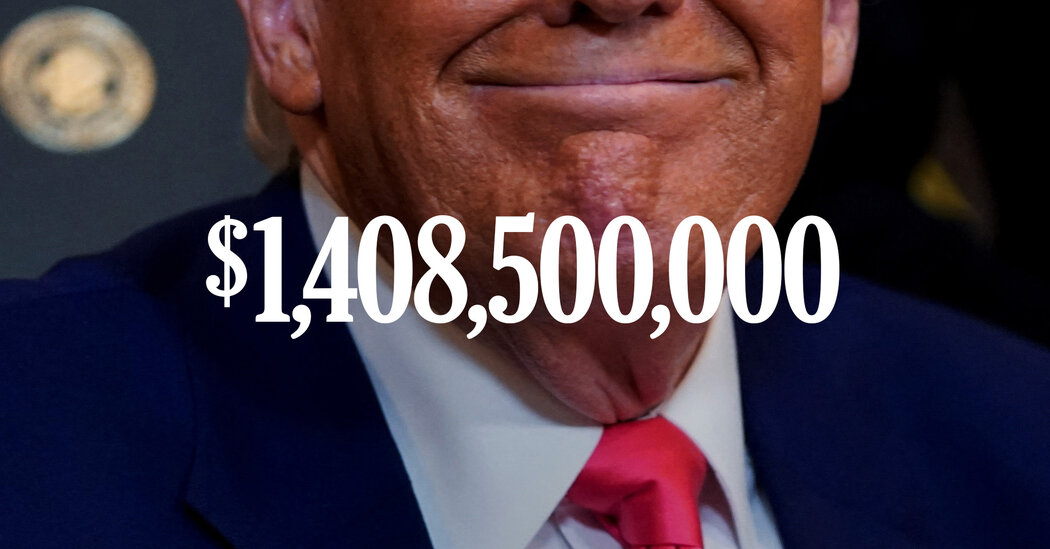
An editorial board investigation based on analysis of news outlets found that Trump used his presidency to make at least $1.4 billion. We know this figure is an underestimate, as some of his profits are hidden from public view. And they continue to grow.
Trump’s thirst for wealth is brazen. Throughout the nation’s history, presidents of both parties have been careful to avoid even the appearance of profiting from public services. This president gleefully milks American companies, flaunts gifts from foreign governments, and celebrates the rapid growth of his fortune.
When President Harry Truman left office in 1953, he didn’t even own a car. He and his wife took the train back to Missouri and lived for a time on an Army pension. He refused to accept any job that would be seen as commercializing the public service, explaining, “I knew they weren’t interested in hiring someone named Harry Truman, but the person they wanted to hire was a former president of the United States.” When Trump leaves office, he said he plans to take home a $400 million Boeing 747 gift from Qatar and display it in his presidential library.
The tally focuses on Trump’s documented interests. The $1.4 billion figure is a minimum and not a complete calculation. Mr. Trump likely collected hundreds of millions of dollars in additional profits from his cryptocurrency ventures over the past year. Even the Trumps acknowledge that. When the Financial Times asked one of the president’s sons, Eric Trump, for an estimate of the family’s crypto profits, he said it was probably even larger than the news organization thought.
Our accounting also does not include other ways the president encouraged influence-seekers to make politically advantageous donations, such as his planned White House renovations. During the government shutdown, Trump even used private gifts to fund his policy priorities. No other president acted this way.
Trump was already the richest person to serve as president of the United States. He began his second term with a large portfolio of real estate holdings and ownership of a social media company. These companies have benefited from his presidency. His real estate company, for example, has made millions of dollars from deals that license the use of Trump’s name on new projects abroad. But what’s even more surprising is the huge profits the Trump family has made from creating and selling cryptocurrencies, allowing him to raise money from people seeking his favor.
It’s impossible to know how often Mr. Trump makes public decisions partly or completely because he wants to get richer. And that’s exactly the problem. A culture of corruption is harmful. Because it’s not just about deviating from government in the public interest. It is also the destruction of the country’s democratic legitimacy. It undermines the necessary belief that the people’s representatives are acting in the people’s interest.
Aristotle, writing more than 2,000 years ago, clearly saw and warned that while a government whose leaders worked to enrich the wealthy may still call itself a republic and carry on, its constitution becomes a mere shell when the purpose of government shifts from the public good to private profit. Government is no longer for the people.
The demands of greed gradually corrupt government work as officials facilitate the accumulation of personal wealth. Worse, such governments corrupt the people living under their control. They learn by experience that they live in a society where the laws are written by the highest bidder. They are less likely to obey these laws and participate in democratic activities such as speaking, voting, and paying taxes. The United States risks falling into this cynical spiral as Mr. Trump hollows out government institutions for personal gain.
Methodology These figures are based on publicly available information and analysis by news outlets. License and cryptocurrency estimates come from a Reuters analysis published in October. Estimates for both categories are based on data from the first half of 2025. Estimates for the $Melania meme coin come from The Financial Times. It’s unclear how much of this money went to the Trumps and how much went to their business partners. Estimates of material related to “Melania” are taken from the Wall Street Journal. Estimates for legal settlement and Qatari jet taken from New York Times. A portion of these settlements will go to Trump’s presidential library and other plaintiffs in the lawsuit.
Although the Trumps and their business partners dispute some of these estimates, we believe they are more reliable than the Trumps’ claims.
Photo: Angela Weiss/Agence France-Presse — Getty Images and Nathan Howard/Reuters. Additional production by Jeremy Ashkenas.
Published January 20, 2026
