



MoonPay is changing gears.
The company, known for allowing users to purchase cryptocurrencies with credit cards, is now moving deeper into financial infrastructure. The company partnered with M0 to launch PYUSDx, a framework that allows developers to create application-specific stablecoins backed by PayPal USD.
This transforms PYUSD from a simple token to a launchpad. Instead of going through months of regulatory work to issue digital dollars, developers can spin up a custom stablecoin backed by PayPal.
The bigger question is: Will this usher in a new era of programmable money, or will it spread liquidity across dozens of niche tokens?
Introducing PYUSDx, a stablecoin tokenization framework from PayPal, @M0, and MoonPay.
Backed 1:1 by @PayPal USD
Build to release in days instead of months
Built for publication, distribution, and interoperability
Let’s build it together. pic.twitter.com/oLu6KDpopo
— Moonpay
(@moonpay) February 27, 2026
Discover: The best crypto exchanges to trade AI tokens in 2026
What is PYUSDx and Moonpay actually like?
Typically, companies accept existing stablecoins like USDC or try to launch their own stablecoins, which can be expensive and complex. PYUSDx falls somewhere in between.
It works like a white label layer. Game studios and fintech apps can issue branded stablecoins, but the underlying reserves are held in PayPal USD. MoonPay and M0 handle the infrastructure, so developers don’t need to build banking rails from scratch.
These tokens are separate from the main PYUSD issued by Paxos, but rely on its dollar backing. This allows apps to add custom features like automatic payments and AI integration without having to manage compliance or reserves themselves.
24 hours 7 days 30 days 1 year Always
Discover: Top Hardware Wallets to Secure Your AI Token Profits
The strategy is clear. Rather than competing head-to-head with Tether and Circle in terms of circulation, PayPal is expanding PYUSD by letting other platforms build PYUSD. Every app launched through PYUSDx increases demand for the underlying asset.
This fits in with broader industry changes. Banks, payment processors, and fintech companies are competing to control stablecoin infrastructure. MoonPay positions itself as a backend plumbing, targeting application layer use cases, including AI-driven platforms, rather than just retail token issuance.
Pitfall: It’s not just “PayPal Money”
Not everything is going in a good direction.
The biggest issue is interoperability. Tokens issued through PYUSDx are not the same as standard PYUSD within an exchange or PayPal. Not directly supported with PayPal or Venmo wallets.
This creates a closed loop. If you earn branded stablecoins within the app, you may need to exchange them for regular PYUSD or another asset before you can cash them out. It adds friction.
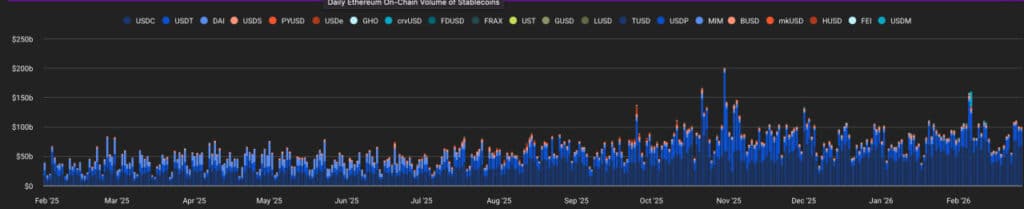
(Source: Daily Ethereum on-chain stablecoin volume/TheBlock)
There is also the risk of liquidity fragmentation. When dozens of apps launch their own versions, liquidity is spread across many smaller pools rather than being concentrated in a single deep market like USDC. Frameworks are built to manage this, but it introduces extra complexity.
To most users, this may look like backend infrastructure. In fact, it has the potential to restructure how money flows within apps, adding a new layer between income and expenses.
Discover: The best exchanges to buy and sell stablecoins in 2026
The article MoonPay PYUSDx Framework Brings App-Specific Stablecoins to the Mainstream appeared first on 99Bitcoins.
