


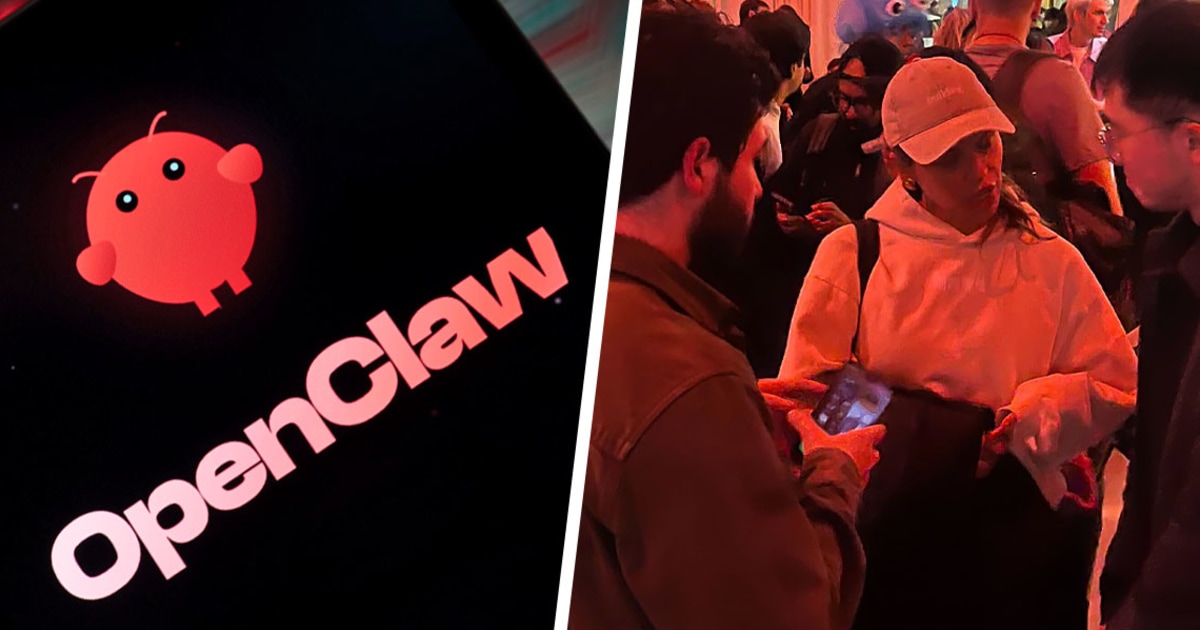
After Anthropic strongly suggested changing Steinberger’s name to avoid legal issues, the project kept its lobster-themed tradition and was eventually named OpenClaw. The software’s popularity has skyrocketed in recent months, with several ClawCon attendees who started using the software in January calling themselves “veterans.”
This software acts as a bridge between today’s powerful AI systems, such as Claude and OpenAI’s GPT family of models, and the real-world tasks that people actually want AI systems to perform.
After setting up their own OpenClaw agent on a physical computer or through a virtual provider, users can send it a text or WhatsApp message and instruct it to perform various tasks within the wheelhouse of today’s AI systems. For example, users say they can instruct OpenClaw agents to listen to episodes of their favorite podcasts, send summaries of important ideas to users’ inboxes, negotiate the price of a new car with a car dealer, or order and pay for grocery deliveries, all without direct human input.
Many ClawCon attendees registered to attend the event after catching wind of this seafood-tinged, cutting-edge and free use of OpenClaw. The convention functioned like a high-energy meet-and-greet, with several main stage presentations, rap performances, an open dance floor, and a less crowded VIP area upstairs, with a live stream of the event happening on the first floor.
“There’s a kind of electricity and energy that you can feel in the room,” said programmer and ClawCon organizer Thomas Taylor. “OpenClaw is like a catalyst for personal AI systems, and I think personal AI is going to be very important in the overall evolution of AI.” Taylor used his own OpenClaw system to help plan ClawCon and interact with vendors.
OpenClaw is designed to be accessible to everyone and can be used in paid AI systems from OpenAI and Anthropic, or in free downloadable AI models, many of which are provided by Chinese companies such as DeepSeek and Alibaba. The agent also teaches itself how to perform new tasks and keeps detailed notes about the user’s preferences, allowing the agent to shape itself to the user’s preferences over time. OpenClaw itself relies on a small group of volunteers to maintain the code, respond to user issues, and fix security bugs.
One of these volunteers, Vincent Koc, emphasized that although the technology is still in its infancy, it is already having a big real-world impact on many experienced programmers and engineering novices alike.
“We are having another personal computer moment, but this time with actual personal AI systems,” Koch exclaimed over the noise of the party. “We’re hearing from mothers and artists and ordinary people who can actually create things with AI. And I think that’s kind of magical.”
As the deep bass of a DJ’s techno beats shook cups of cocktail sauce on a nearby table, Koch, a software engineer by day, gestured to the hundreds of OpenClaw disciples on the dance floor, insisting that the excitement was more than just a passing fad.
“I believe in this so much, I’m willing to die on the sword for this,” Koch said. To figure out his tax liability earlier this year, Koch instructed OpenCrow’s agents to find an accountant and get an estimate. “The system sends emails to various tax attorneys and they respond with actual quotes for their services.”
But many in the male-dominated crowd don’t have much faith in the system, and its prestige, its claim to the ability to perform meaningful actions without human oversight, may also be its Achilles heel, or its closest crustacean equivalent.
The freewheeling nature of the OpenClaw system recently made headlines after Summer Yue, a leading AI security researcher at Meta, nearly lost her entire inbox to the OpenClaw agent. Because OpenClaw can be linked to personal emails and financial accounts, vulnerabilities in the system could easily expose users’ sensitive data to hackers around the world.
“These systems are not for the general public,” Koch said, referring to a general public that may not be familiar with cutting-edge AI technology or AI in general. “Essentially, you’re literally letting the AI take over the machine. You’re giving the AI access to information, which can be daunting. But people need to use common sense. Let’s take baby steps when it comes to something like this.”
As ClawCon gears up for upcoming stops in Austin, Tokyo, and London, even the most enthusiastic attendees acknowledged that the technology comes with significant risks.
“We trust Claw!” said Mark Moret, an intellectual property lawyer, as he observed the scene from the second floor, proudly holding up a lobster-shaped necklace. “At least until AI Hindenburg.”
“People are blindly trusting untested and unsafe agent tools, and will continue to do so until some disaster occurs,” Moret said. Several participants said they set up cryptocurrency accounts for their agents and asked them to make money on prediction market websites like Polymarket.
Downstairs, after the talk on the main stage had finished and a chrome-plated guitarist took center stage, the catering staff was immersed in a lively conversation about workflow, guardrails, and trying to find the owners of the remaining lobster tails.
