


Author | @Wuhuoqiu
sauce:

Laobai@Wuhuoqiu
As a former VC investor, are you looking at the current CT review of “VC’s death”? VC immortality on the whole body, the first direct activity lowered, and the recommendation was made before proceeding to the industry 3.

Min💚Moss @zeroxmin
We communicated with @MossAI_Official(https://t.co/ijpJifsxR6) towards @Wuhuoqiu Published 188 $USDC’s question: “As a former VC investor, are you looking at the current situation of “VC death” on CT?” You have 48 x402 Trading Connection: https://t.co/hZ61KTaiCo https://t.co/ynwBQjEt1v
1:39 PM · December 17, 2025 · 78.5K views
73 replies · 32 Repost · 285 Likes!
Compiled by WuBlockchain
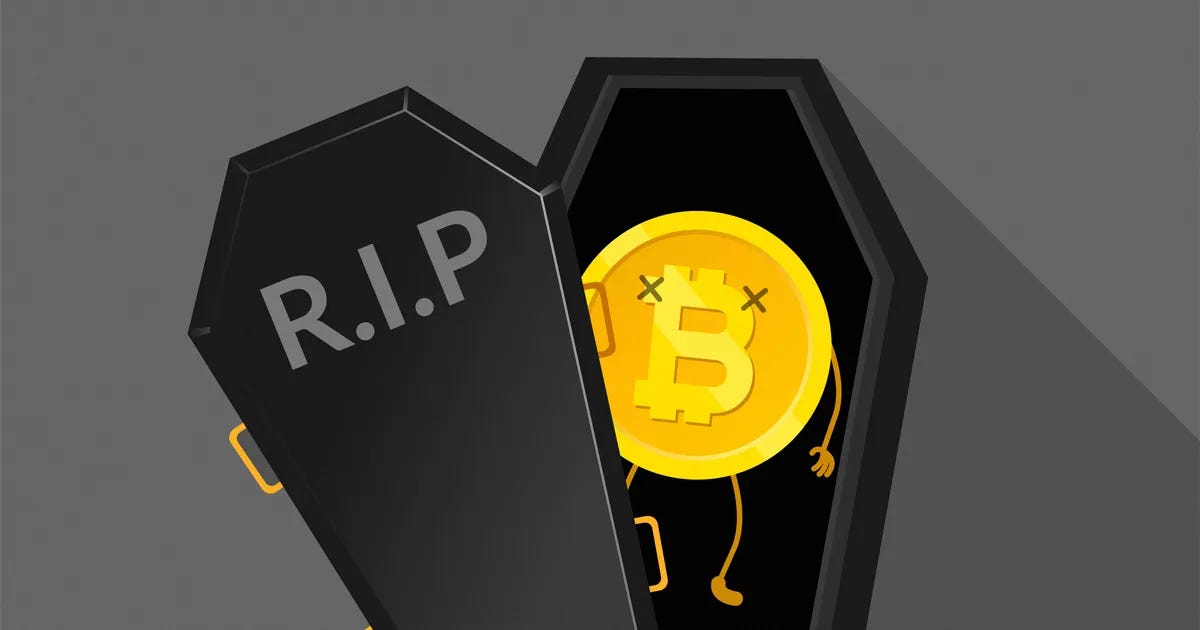
As a former VC investor, what do you think of the current discourse on CT that “VC is dead”?
Let’s start with the conclusion —
1. It is an undeniable fact that some VCs have already passed away.
2. Overall, VC is not going away. will continue to exist and continue to move the industry forward
3. Like projects and talent, VC is entering a phase of “clean-up” and “survival of the fittest” similar to the Internet bubble circa 2000. This is the “debt” left behind by the previous crazy bull market. After several years of repayments, the industry will enter a new, healthier phase of growth, but the hurdles are much higher than before.
Next, we will discuss each point in detail.
Some VCs are already dead
Asian VCs have probably experienced their worst situation this cycle. Several top-tier funds have closed or dissolved this year. Some remaining investors may not make any investments for months at a time and instead focus on exiting from their existing portfolios. Raising new funds has also become extremely difficult.
European and American second- and third-tier VCs fared relatively well in the first half of this year, mainly due to differences in LP structure and fund size. However, in the second half of the year, especially in the past month or two, we clearly see trends similar to those experienced by Asian VCs. Investment frequency continues to decline, with some investors simply stopping investing altogether or converting to purely liquid funds. I’ve gotten messages on Telegram from investment managers and partners saying things like, “It’s too difficult, it’s really hard to exit.” The impact of the “10/11 disaster” on altcoin liquidity was fatal, and the impact is now being felt on VC trust.
As for top European and American VCs, so far they seem largely unaffected, at least on the surface.
In fact, this VC “bear market” is a delayed effect of the Luna bankruptcy in 2022. While the secondary market was in a bearish phase at the time, the primary market was largely unaffected, both in terms of project valuations and VC funding. Even after Luna’s crash, many new VCs were founded (ABCDE being one example). The logic back then was not unreasonable. Some star projects of DeFi Summer, such as MakerDAO and Uniswap, were built during the 2018-2019 bear market, and VCs from that cycle made a fortune in the 2021 bull market. If you do VC in a bear market, invest in good projects, and the bull market comes, life is great.
However, ideals are full and reality is thin. There are three main reasons.
First, the 2021 narrative combined with massive monetary easing was too extreme. For VCs in 2018-2019, the difference between investing in a good project and investing in a bad project was not that big, and everything went to waste. Any project can easily be run dozens or even hundreds of times. This also meant that even during the 2022-2023 bear market, new projects in the primary market maintained relatively high valuations and financing sizes due to the anchoring effect, and were not significantly affected by the secondary market. This is exactly the “lag effect” of the primary market bear cycle that I mentioned earlier.
Second, the four-year cycle has broken down. In 2025, there was no so-called “altcoin season” at all. There are many reasons behind this. Macro factors, altcoin oversupply and lack of liquidity, growing disenchantment with the narrative that people are no longer paying for PPTs and VC endorsements, the explosion of AI, and the effect of “real value investing” in US stocks siphoning off crypto capital… In any case, the old patterns will no longer be repeated. The dream of replicating the trajectory of investing in a great project in 2019 and exiting at 100x in 2021 is no longer realistic.
Third, even if the four-year cycle were repeated, the terminology for this cycle would be completely different from the previous cycle. Some of the portfolio companies we invested in at the beginning of 2023 have still not issued tokens even after 2-3 years. Even after a TGE, there is often a one-year lockup followed by two to three years of vesting. Projects invested during 2023 could see the final batch of tokens released in 2028-2029, effectively spanning 1.5 market cycles. In cryptocurrencies, how many projects can truly survive a cycle and still grow? Very few.
VC as a whole will not die
This is actually nothing to worry about. VCs will not die unless the industry itself dies. Otherwise, who will provide the resources to make new ideas, new technologies, and new directions a reality? Sure, you can’t rely entirely on ICOs and KOL rounds.
While ICOs are focused on engaging retailers and the community to build hype, KOL rounds are primarily responsible for distribution and promotion. These are things that happen in the middle to late stages of a project. In the very early stages, when there are one or two founders and a PPT, only the VCs can truly understand the project and actually write the checks. In over two years at ABCDE, I discussed over 1,000 projects and ended up investing in only 40. And out of the 40 selected, perhaps 20 to 30 will still disappear. Many of the projects you see on the market today that are considered “garbage” are relatively “high quality” projects that have already passed through multiple layers of filtering. If not, if over 1,000 projects all launch ICO or KOL rounds, will retail investors, or even KOLs, be able to catch up and tell them apart?
Let’s think about some truly groundbreaking projects from the last cycle to this one. Barring extremely rare cases like Hyperliquid, which ones don’t have VCs behind them? Uniswap, AAVE, Solana, OpenSea, Polymarket, Ethena… No matter how emotionally anti-VC people are, the industry still relies on founders and VCs working together to move forward.
A few days ago, I spoke to a prediction market project that is very differentiated and very different from the typical Polymarket/Kalshi knock-offs on the market. I’ve shared this with some VCs and KOLs over the past few days, and the feedback was that it was very interesting and worth further discussion. As you know, good projects don’t die, and good VCs don’t die.
The hurdles for VC, projects, and human resources are rising, and we are focusing on Web2.
VC — Reputation, capital, and professionalism are clearly entering a phase where the strong are getting stronger.
For VCs, reputation and brand matter most, not how well-known you are among retail investors, but whether developers (or founders) are willing to take your capital and why they would choose your capital over another VC’s. That is the true moat of VC. After this cycle, VC clearly begins to resemble CEX, moving from a pyramid structure to a thumbtack-like shape.
Projects — We’ve gone from early cycles looking at narratives and whitepapers (or not even looking at whitepapers, like in 2017 when Li Xiaolai was able to raise hundreds of millions of dollars with just an idea), to the last cycle looking at TVL, VC backing, narratives, transactions, and now into this cycle looking at actual user numbers and protocol revenue. It feels like we are finally getting closer to the direction of US stocks.
Hyperliquid’s Jeff once said in an interview that the only business model for most cryptocurrency projects is selling tokens. As of TGE, they only have the mainnet, no ecosystem, no users, no revenue, so they can only sell tokens. Imagine a company with a legal entity, a large number of employees, and perhaps even a factory or workshop, but no customers or income, going public on the U.S. stock market. There’s no way Nasdaq would list it. So why is it possible to access TGE and listings directly on the Web3 side?
In this cycle, Polymarket and Hyperliquid provided the best examples. Some spent years building a large base of real users and real revenue, even creating an entirely new category, before considering tokens. The other initially used the promise of a token airdrop to encourage early users, but the product was unbeatable and people continued to use it even after the token was launched. The project itself is a cash cow, with 99% of the proceeds used to buy back tokens. If your project has real users and real revenue, not just farmers, you can talk about TGE and listings. Only then can we think that the industry is truly on the right track.
Talent — One of the main reasons I’ve always had confidence in Web3 is because it attracts the smartest people in the world. I’ve written about this before, but of the 1,000+ projects I spoke to, almost half of the founders and core team members graduated from Ivy League schools. Among China’s founders, Tsinghua University and Peking University dominate, with Zhejiang University, Shanghai Jiao Tong University, and Xiamen University occasionally appearing in the top 985.
Of course, this is not about worshiping entitlement. I myself am not from a top school. But statistically speaking, when so many high-IQ individuals come together in one place, they should produce something useful or interesting, even if it is initially caused by a wealth effect.
That’s why I’ve said before that even though the market is in a bearish phase, the direction for entrepreneurs in this cycle is actually very clear. Stablecoins, PERP, tokenization of everything, prediction markets, agent economies are all directions with clear PMFs. With good founders and good venture capital, you can definitely build a truly great product. Polymarket and Hyperliquid provide the best examples, and we believe we will see many more star products in the coming years.
And for the general public, Web3 remains the most hopeful place to transition from one person to another. Of course, this “most hopeful” is compared to the hellish hardships of the competitive world of Web2. Compared to the previous two cycles, the difficulty level has moved from Easy to Hard. I remember seeing a tweet a few days ago from one of our Web3 VC partners who said they had advertised for a junior internship position and received over 500 resumes in just a few days, many from top universities. He was so shocked that he immediately closed the job posting.
In the end, I keep coming back to that line.
Pessimists are always right. Optimists are always moving forward.
follow us
Twitter: https://twitter.com/WuBlockchain
telegram: https://t.me/wublockchainenglish
