


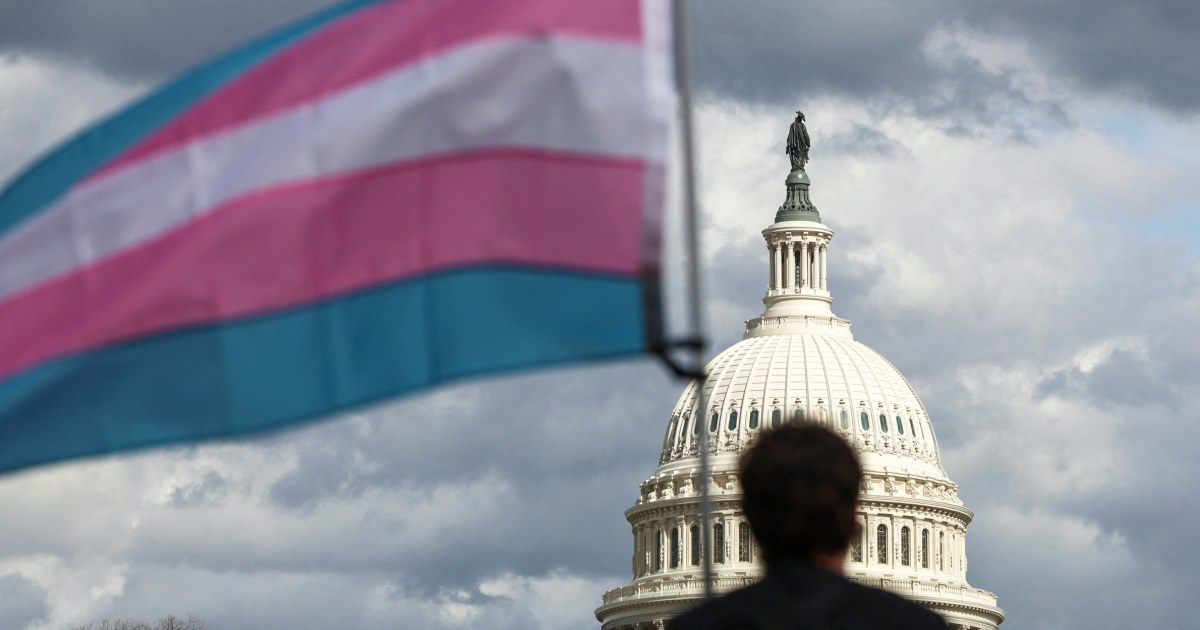
The Trump administration announced Thursday it would begin measures aimed at eliminating transition-related care, or what the Department of Health and Human Services calls “gender refusal procedures,” for minors across the country.
“These actions ensure that the federal government will never directly fund gender reassignment procedures for minors, nor will it fund the facilities that perform these procedures,” department officials said in a call with reporters Thursday.
Health and Human Services Secretary Robert F. Kennedy Jr. and other department officials are expected to announce details about the move later Thursday.
HHS officials said the Centers for Medicare and Medicaid Services will begin a rulemaking process to prohibit hospitals from providing puberty blockers, hormone therapy or surgery to minors as a condition of participating in Medicare Medicaid, and to prohibit Medicaid funds from being used for such care.
Dr. Kenneth Haller, a St. Louis-based pediatrician, called HHS’ actions “anti-science” Tuesday at a press conference held by the Human Rights Campaign, the nation’s largest LGBTQ advocacy group. He said efforts to limit access to these treatments still allow children with other conditions that affect hormone production to be treated.
As long as the treatment confirms the child’s birth sex, “these people don’t have a problem,” Haller said. He added: “The same consideration for transgender children is saying they’re wrong. There’s no science behind it.”
HHS also announced Thursday that the Food and Drug Administration will issue warning letters to 12 manufacturers and retailers of breast binders for minors to treat gender dysphoria, the distress that results from a discrepancy between a person’s gender identity and sex at birth, alleging the manufacturers participate in illegal marketing, agency officials said.
The HHS Office for Civil Rights also proposed amending Section 504 of the Rehabilitation Act of 1973, which prohibits discrimination in federally funded programs, to clarify that the definition of “disability” excludes gender dysphoria that is not due to a physical disability. HHS officials said the clarification was intended to “resolve an ambiguity” that the Biden administration introduced in the preamble to section 504 in 2024 that suggested gender dysphoria could qualify as a disability, thereby “creating confusion about the scope of obligations that HHS funding recipients have on these individuals under section 504’s disability rights requirements.”
The proposed CMS rule will be finalized after a 60-day comment period, a department official said.
The HHS proposal is the Trump administration’s latest effort to restrict access to certain transgender care for both minors and adults.
President Donald Trump has issued multiple executive orders targeting transgender people in the first weeks of his second term. These include an order declaring that there are only two genders that cannot be changed and an order banning federal funding to hospitals that provide transition-related care to minors. In May, HHS released a review declaring the quality of evidence on the effects of gender-affirming care on minors to be “very low,” at odds with the majority of U.S. medical associations that support access to such care and condemn efforts to limit it.
The Trump administration’s policies are built on an increasingly restrictive environment for transgender care. In recent years, 27 states have enacted measures barring minors from accessing certain transition-related treatments, according to the Movement Advancement Project, an LGBTQ think tank. Families who could afford to do so began traveling to the remaining states where long-term care remained legal.
But in July, the federal government launched a review of health care providers across the country, resulting in more than 20 hospitals, including those in liberal cities such as Los Angeles and Boston, reducing or ending gender-affirming care programs for minors and some young people.
This environment has led some transgender adults and families with transgender children, like the Gonzalez family, to leave the country. Rachel Gonzalez’s three children are fifth-generation Texans who have been fighting the state’s anti-trans laws since their transgender daughter, Libby, was 6 years old. She has said for years that she had no plans to leave the state. But because of federal measures restricting access to transitional care, she and her husband moved Libby, now 15, and two other children outside the United States to a country Gonzalez declined to disclose.
“Living in Texas, we became the targets of politicians who boldly rejected the consensus of the medical profession, decided they knew better than Libby, my husband and I, and our team of doctors, and chose to use us as political targets instead of granting us the parental rights they claimed,” Gonzalez said at a press conference held by the Human Rights Campaign.
Just a day before the HHS announcement, the House of Representatives passed a bill that would charge doctors with a felony punishable by up to 10 years in prison if they provide gender-affirming care to minors. The bill, introduced by Rep. Marjorie Taylor Greene (R-Ga.), is expected to fail in the Senate, but would impose the harshest federal penalties for doctors providing transition-related care to minors ever passed by the House.
In a post on X on Wednesday, Greene called the bill’s passage “a victory for children across America.”
Rep. Dan Crenshaw (R-Texas) has introduced another bill that the House is scheduled to vote on Thursday. The bill would prohibit Medicaid from covering gender transition procedures for anyone under 18.
