


The Commerce Department reported Friday that while core inflation will rise in early 2026, economic growth in the final three months of 2025 was much slower than expected.
Gross domestic product (GDP), a measure of all goods and services produced across the vast U.S. economy, rose at an annual rate of just 0.7% in the fourth quarter, adjusted for seasonality and inflation, the department’s Bureau of Economic Analysis said.
The first revised GDP figure was significantly revised downward from the previous estimate of 1.4%, and was well below the Dow Jones consensus estimate of 1.5%. In addition, due to the record-breaking prolonged government shutdown, which caused government spending to decline by 16.7%, growth slowed significantly from the previous quarter’s 4.4% increase.
For the full year, GDP increased by 2.1%, or one-tenth of a percentage point less than the previous reading. In 2024, the economy grew at a pace of 2.8%.
BEA said the downward revision was due to adjustments in consumer and government spending and exports. Strictly speaking, the decline in imports, which is deducted from GDP, was also smaller than in the previous estimate.
Consumer spending rose 2% in the quarter, but was revised down by 0.4 percentage points from the 3.5% increase in the third quarter. According to the release, the biggest contributor to the downward revision was services, particularly health spending.
On the inflation front, January’s data was mostly in line with expectations, but showed that prices were rising much faster than the Federal Reserve wanted.
The Federal Reserve’s main inflation forecasting tool, the Personal Consumption Expenditure Price Index, rose a seasonally adjusted 0.3% in the month, for an annual rate of 2.8%. Economists surveyed by Dow Jones had called for readings of 0.3% and 2.9%, respectively.
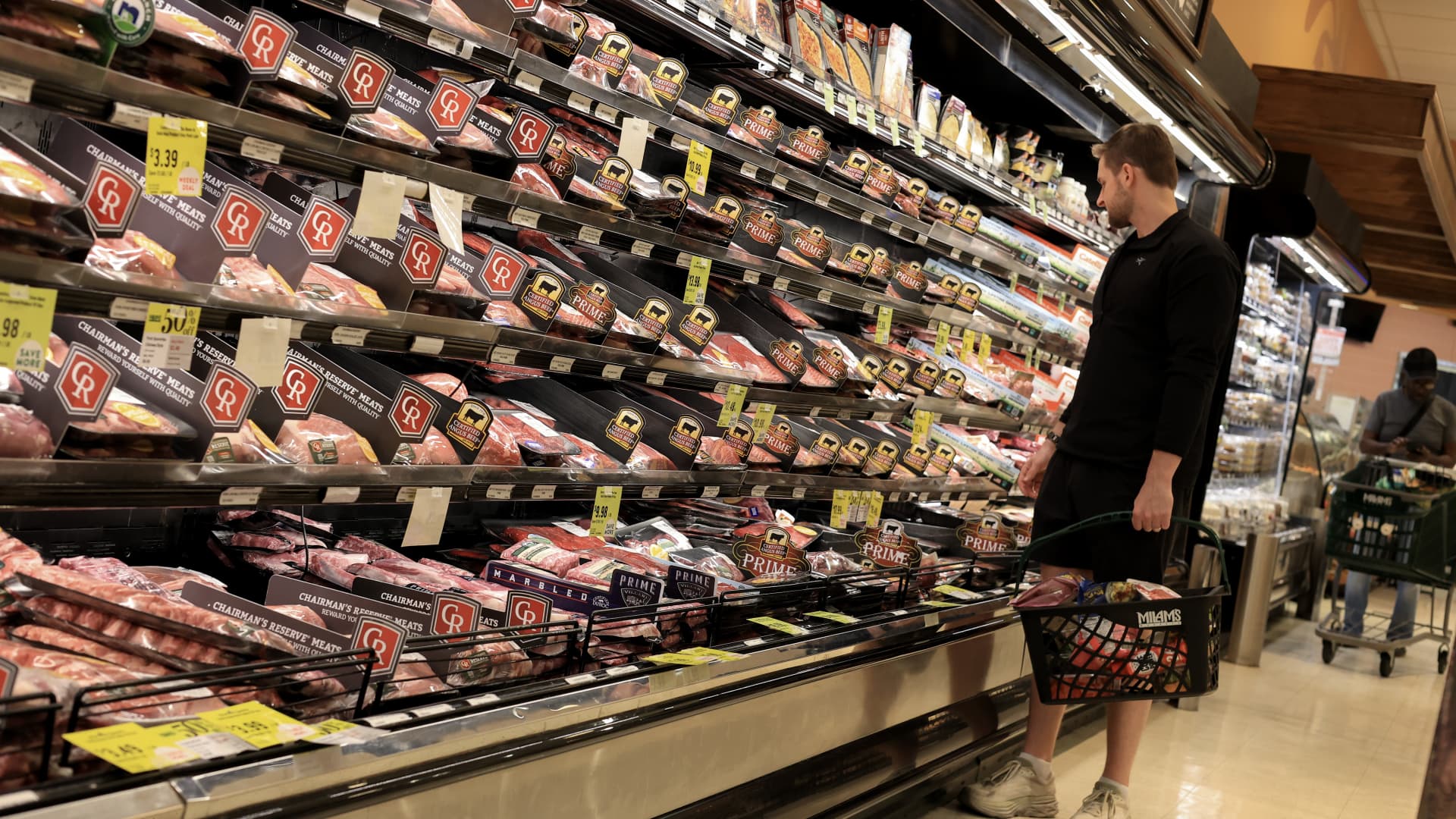
A customer shops at a grocery store on March 11, 2026 in Miami, Florida.
Joe Radle | Getty Images
Excluding volatile food and energy costs, core PCE inflation rose 0.4% in January and 3.1% on a 12-month basis. Fed officials are placing more emphasis on core numbers as a better indicator of long-term trends. The core measure was 0.1 points higher than in December.
A separate Commerce Department report said orders for long-term goods such as transportation equipment, home appliances and computers were flat in January, an improvement from December’s 0.9% decline but well below the expected 1.3% increase. Orders excluding transportation increased by 0.4%.
“The large downward revision in GDP is a gut check in the face of this energy crunch, and the risk of stagflation is rising,” said David Russell, global head of market strategy at TradeStation. “Weak January durable goods data suggests the economy entered this crisis weaker than expected. PCE inflation remains well above the Fed’s target, which poses a challenge for investors.”
Although the numbers are old, they still provide a snapshot of inflationary pressures and economic growth in the run-up to the Supreme Court’s ruling invalidating many of the tariffs President Donald Trump imposed under the International Emergency Economic Powers Act. Economists generally assumed that tariffs increased inflation trends by about 0.5 percentage points or more.
The report also predates the February 28 attack launched by the United States and Israel against Iran. Energy prices have soared in the two weeks since the conflict began, with the international benchmark price for Brent crude reaching $100 a barrel on Thursday.

Sonu Varghese, chief macro strategist at Carson Group, said the inflation statistics “show that inflation conditions were not good even before the Middle East crisis.” “An already big headache for the Fed is likely to get even bigger. The Fed is unlikely to cut rates in 2026, and could start talking about raising rates before the end of the year.”
Personal income and spending both rose 0.4% in January, compared to expectations of 0.5% and 0.3% increases, respectively. The personal savings rate increased by 0.5 points to 4.5%.
In the GDP report, a measure of demand known as private sales to domestic private buyers rose just 1.9% in the fourth quarter, revised down by 0.5 percentage point from the previous quarter and by 1 percentage point.
Fed officials monitor the PCE measure closely because they consider it a broader measure of inflation than the consumer price index and use the private sales measure as a proxy for broader economic activity. Earlier this week, the Bureau of Labor Statistics reported February headline CPI of 2.4% and core CPI of 2.5%, the latter the lowest since March 2021 but still above the Fed’s 2% target.
The central bank is expected to announce its next interest rate decision on Wednesday. The market has a nearly 100% chance that the Federal Open Market Committee, which decides interest rates, will be put on hold.
