


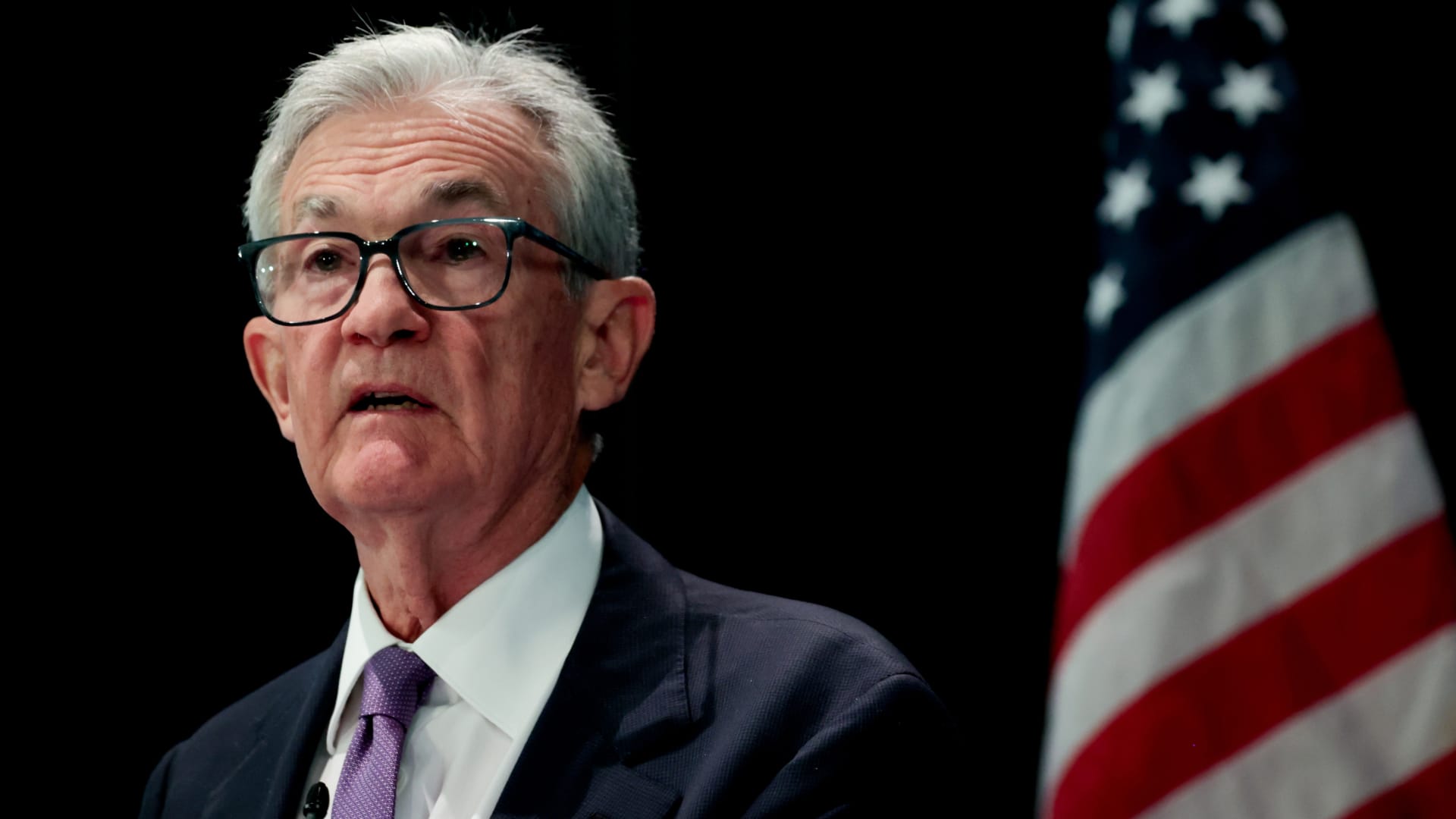
US Federal Reserve Chairman Jerome Powell during a press conference after the Federal Open Market Committee (FOMC) on Wednesday, September 17, 2025 in Washington, DC, USA.
Kent Nishimura | Bloomberg | Getty Images
Federal Reserve Chairman Jerome Powell on Tuesday suggested the central bank is nearing the point where it will stop reducing its bond holdings and offered several hints that further rate cuts are possible.
Powell presented a paper at the National Association for Business Economics conference in Philadelphia on where the Fed stands on “quantitative tightening,” or efforts to reduce the more than $6 trillion in securities it holds on its balance sheet.
He did not give a specific date for when the program would end, but said there are signs the Fed is getting closer to its goal of “adequate” reserves available to banks.
“Our long-standing plan is to prevent balance sheet drains when reserves are slightly above a level that we believe is consistent with reserve adequacy,” Powell said in prepared remarks. “We may be approaching that point in the coming months and are closely monitoring a wide range of indicators to inform this decision.”
On interest rates, the central bank governor gave no concrete guidance on the path to lower interest rates, but his comments on labor market weakness showed that easing is firmly on the table, as expected by financial markets.
“If we act too quickly, we could leave the anti-inflation package unfinished and have to come back and finish it later. If we act too slowly, we could cause unnecessary and painful losses in the job market. So we are in a difficult situation of balancing the two,” he said.
“The data we received immediately after the July meeting shows that the labor market has indeed softened considerably, and we are in a situation where the two risks are nearing equilibrium,” Powell added.
Other Fed officials have recently said that the weakening labor market is a priority and could lead to further rate cuts.
balance sheet calculation
But Powell focused much of his speech on the Fed’s holdings of U.S. Treasuries and mortgage-backed securities.
Balance sheet issues are in the weeds for monetary policy, but they are important for financial markets.
When financial conditions are tight, the Fed aims for “abundant” reserves to help banks maintain liquidity and keep the economy afloat. As the situation evolves, the Fed is aiming for “adequate” reserves, a gradual drawdown to prevent too much capital floating around the system.
During the coronavirus pandemic, the central bank has aggressively purchased U.S. Treasuries and mortgage-backed securities, swelling its balance sheet to nearly $9 trillion.
Starting in mid-2022, the Fed has gradually allowed the maturity proceeds of these securities to be rolled off its balance sheet, effectively tightening one side of monetary policy. The question was how far the Fed would have to go, but Powell’s comments suggest the end is near.
“We are starting to see some signs that the liquidity situation is gradually tightening,” he said, noting that further reductions in foreign exchange reserves could hamper growth. But he also said the Fed has no plans to return to its pre-coronavirus balance sheet size, which is close to $4 trillion.
In this regard, Chairman Powell raised concerns about the Fed’s continued interest payments on reserves.
The Fed typically transfers interest earned on its holdings to the Treasury Department’s general fund. But it incurred operating losses because it had to raise interest rates rapidly to curb inflation. Congressional leaders such as Sen. Ted Cruz (R-Texas) have proposed suspending reserve payments.
But Powell said that was a mistake and would hamper the Fed’s ability to pursue policy.
“Due to the rapid increase in policy rates to control inflation, our net interest income temporarily turned negative, which is highly unusual. As has been the case throughout our company’s history, we expect our net income to turn positive again shortly.” “The Fed will lose control of interest rates if it no longer has the ability to pay interest on reserves and other debt.”
View of the economy
On the larger issue of interest rates, Powell generally stuck to the recent scenario, in which policymakers are concerned about a tightening labor market and a skewed balance of risks between employment and inflation.
“Unemployment remained low through August, but wage growth has slowed sharply, likely due in part to lower labor force growth due to immigration and lower labor force participation,” he said. “In this less dynamic and somewhat softer labor market, downside risks to employment appear to be increasing.”
Powell noted that the Federal Open Market Committee responded to the situation by lowering the federal funds rate by a quarter of a percentage point in September. Markets are strongly predicting two more rate cuts this year, and several Fed officials have recently endorsed that view, but Powell did not take a firm stance.
“There is no risk-free path for policy as we navigate the tension between employment and inflation targets,” he said.
The Fed has been somewhat hampered by the government shutdown and its impact on economic data releases. Policymakers base their decisions on indicators such as non-farm employment reports, retail sales, and various price indexes.
Powell said the Fed continues to analyze the situation based on available data.
“Based on the data we have, I would say that the outlook for employment and inflation does not appear to have changed significantly since our September meeting four weeks ago,” Powell said. “However, data available before the shutdown suggests that growth in economic activity may be on a somewhat firmer trajectory than expected.”
The Bureau of Labor Statistics announced it has brought back its staff to prepare the monthly Consumer Price Index report to be released next week.
Powell said available data shows the rise in commodity prices is primarily a function of tariffs rather than underlying inflationary pressures.
