


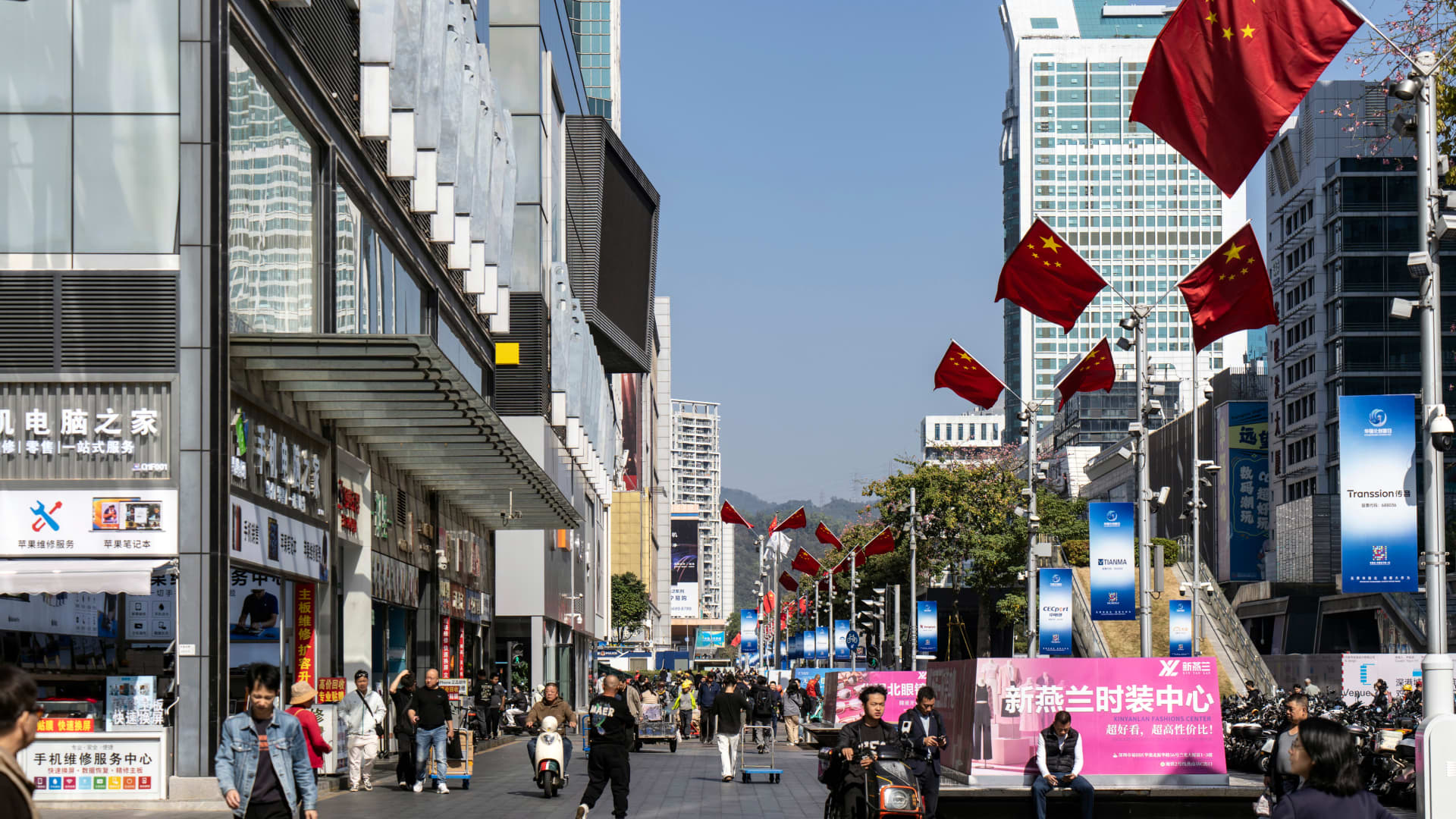
Pedestrians in the Huaqiangbei electronic market area in Shenzhen, China, Wednesday, January 14, 2026.
Shen Qilai | Shen Qilai Bloomberg | Getty Images
China’s economic growth slowed in the fourth quarter to the slowest pace in nearly three years as domestic demand weakened, but full-year growth was in line with Beijing’s target despite escalating trade tensions with the United States and a prolonged real estate recession.
Gross domestic product (GDP) increased by 4.5% in the October-December period, according to data released by the National Statistics Office on Monday. This slowed down from 4.8% in the third quarter and was the lowest level since the first quarter of 2023, which also grew at 4.5%.
Economic output for the year was 5%, achieving the official target of about 5%.
Individual statistics for December showed that while the manufacturing industry improved, domestic consumption slumped and the decline in investment widened.
Retail sales rose 0.9% in December compared to the same month last year, falling short of the 1.2% increase expected by economists and slowing from the 1.3% increase seen in the previous month. This was the slowest growth since December 2022, when the consumption index decreased by 1.8% year-on-year, according to Wind Information.
Industrial production rose 5.2% in December, beating expectations for 5% growth and up from 4.8% the previous month.
Fixed asset investment, including real estate, fell 3.8% last year, worse than the 3% decline expected by economists polled by Reuters. As the real estate crisis continues to drag on, investment in real estate development continues to decline, dropping by 17.2% in 2025, which is even worse than the 10.6% decline in 2024.
The urban unemployment rate remained unchanged at 5.1% in December.
Mainland China’s CSI300 index rose 0.6% after the data release, then pared its gains, while Hong Kong’s Hang Seng index fell 0.8%. The offshore yuan rose slightly against the US dollar to 6.9604 yuan, the highest level since May 2023, according to LSEG data.
“We must adopt more proactive and effective macro policies and continue to expand domestic demand,” the statistics bureau said in an official English release.
Imbalance of demand and supply
The world’s second-largest economy showed resilience in 2025, helped in large part by lower-than-expected tariff rates and a push by exporters to diversify away from the United States, which allowed policymakers to delay a major stimulus package.
China reported a record trade surplus of about $1.2 trillion last year, driven by a surge in exports to markets outside the U.S. as manufacturers redirected shipments to avoid higher U.S. tariffs.
Tommy Hsieh, managing director of OCBC Bank, said the expected impact of front-loaded shipments, stricter transshipment regulations and currency appreciation is limited. Xie expects China’s exports to increase by about 3% in 2026.
China’s total trade will account for nearly a third of its gross domestic product (GDP) in 2025, and consumption will contribute to 52% of its economic output, Statistics Bureau Director Kang Yi told reporters on Monday.
Exports continue to face headwinds. US President Donald Trump has threatened to impose 25% tariffs on countries doing business with Iran, including China, and a trade ceasefire with the US is set to expire later this year. China’s alarming trade imbalance has also drawn criticism from trading partners seeking to protect domestic industries from an influx of cheap Chinese goods.
Economists warn of long-term risks to the current growth model and call for economic reforms that shift the growth model to domestic consumption and reduce dependence on exports and investment.
“The sharp drop in investment and weak household consumption have made China’s economy more reliant on exports to support growth, a situation that is unsustainable for both China and the world economy,” said Eswar Prasad, professor of trade policy and economics at Cornell University.
The Chinese government is trying to curb excess industrial production capacity and curb fierce price competition. Consumer inflation accelerated to 0.8% in December, the fastest pace in nearly three years, while producer prices fell 1.9%.
Still, China’s GDP deflator, the broadest measure of overall prices of goods and services, has been negative since 2023 and is expected to fall by 0.5% in 2026, the longest streak in history, according to Larry Hu, Macquarie’s chief China economist.
The economy continues to suffer from weak domestic spending amid a long-term real estate recession and persistent deflationary tensions. New bank lending is expected to fall to 16.27 trillion yuan ($2.33 trillion) in 2025, a seven-year low, highlighting weak borrowing demand and increasing pressure on the government to provide more stimulus.
Last week, the People’s Bank of China announced a series of credit easing measures, including cutting interest rates on various lending instruments by 25 basis points and expanding quotas for loan programs targeting key sectors such as agriculture, technology and private enterprises.
Economists at Goldman Sachs expect the central bank to cut reserve requirements by 50 basis points and policy rates by 10 basis points in the first quarter.
