


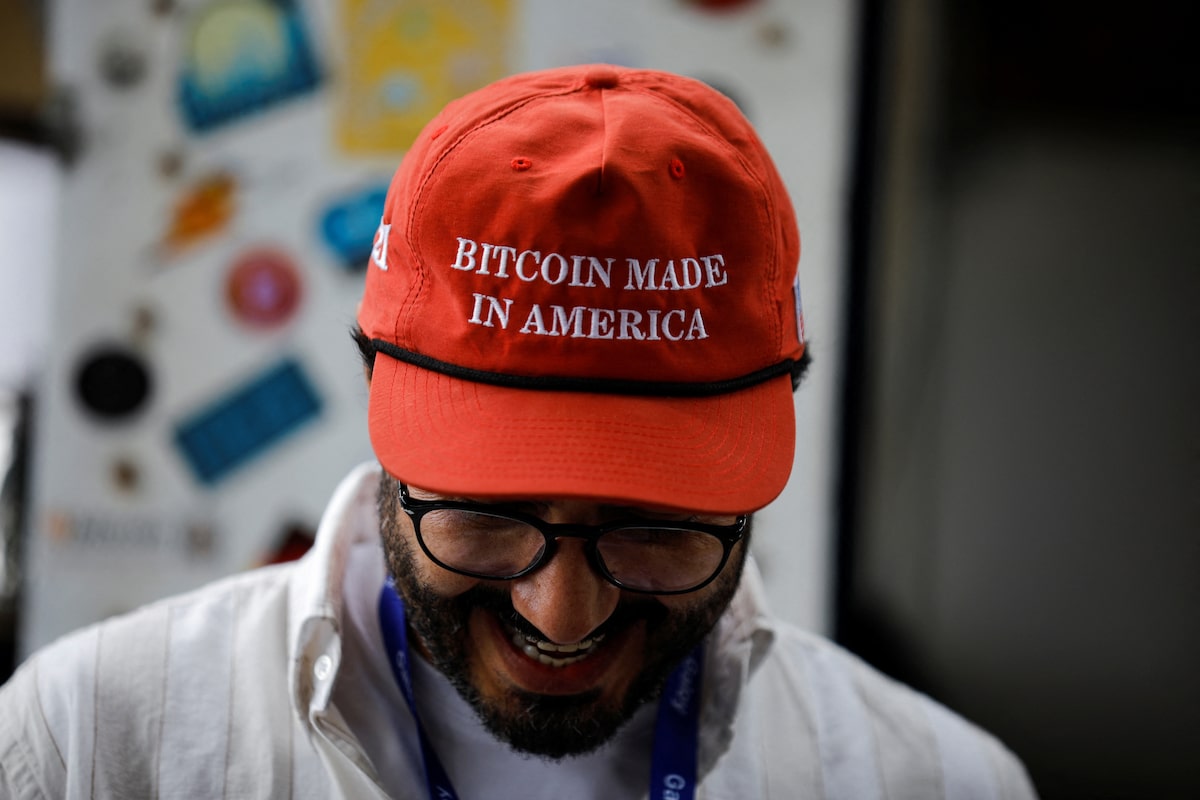
Without effective higher government regulations, the rise of Bitcoin could lead to serious concerns regarding financial stability and consumer safety. A man observes Bitcoin transactions during a recruitment event in Nuevo Cuscatlan, El Salvador, on November 16.Jose Cabezas/Reuters
In the week following Donald Trump’s announcement as the winner of the US presidential election, Bitcoin’s value surged by 35%, reaching approximately $130,000. The crypto community is abuzz with excitement, buoyed by Trump’s re-election and the increasing presence of pro-crypto lawmakers in both the Senate and House of Representatives.
Many are envisioning a time when Bitcoin transitions into a commonly accepted method of payment, rather than remaining merely a speculative investment. Yet, fresh research has surfaced glaring contradictions that challenge this vision.
A recently published paper in the Journal of Behavioral and Experimental Economy delves into the motivations behind Bitcoin investors. It reveals that these individuals are not solely driven by financial gain; they also yearn for financial independence and harbor significant skepticism towards traditional financial institutions. They favor meritocracy over welfare-based systems.
Essentially, they advocate for a free-market economy where wealth is allocated based on personal achievement, with minimal government oversight, in contrast to wealth redistribution advocated by social programs. They consider themselves disruptors challenging established norms.
This aligns with Bitcoin’s fundamental allure as a currency devoid of government influence. It’s evident that Bitcoin investors differ greatly from traditional stock market participants, who often prioritize stability and are used to regulatory scrutiny. Bitcoin advocates tend to embrace risk, seeking unique opportunities, and may display gambling-like tendencies.
Some cryptocurrency supporters may even adopt anarchist principles. For instance, Dogecoin, initially launched as a playful parody, has experienced a remarkable surge in value post-election, especially following Trump’s announcement of a new Department of Government Efficiency (DOGE), which will be co-led by Elon Musk. Musk’s history of ambiguous social media comments regarding Dogecoin often precipitates dramatic price swings.
However, a paradox arises. Should Bitcoin achieve widespread use as a currency, it would necessitate more government regulations. The very decentralization that entices investors might unleash financial chaos without adequate oversight. The potential rampant adoption of Bitcoin could endanger both financial stability and consumer safeguards.
Additionally, if individuals believe Bitcoin’s value will consistently escalate, there is little motivation to use it as currency. Why spend Bitcoin on a coffee today when it might be worth twice as much tomorrow? This speculative mentality diminishes Bitcoin’s utility as a currency. A currency should circulate to facilitate commerce and spur economic activity.
If everyone chooses to hoard Bitcoin, it will fail to serve its purpose as a transactional instrument.
Thus, a dilemma persists. For Bitcoin to gain acceptance in the mainstream, it must embrace the very regulations and oversight it was designed to evade. This stands in direct opposition to the fundamental beliefs of its investors, which emphasize decentralization and avoidance of government control. Furthermore, altering the prevailing hoarding mentality is essential for a shift in how investors perceive and utilize Bitcoin.
Bitcoin finds itself at a pivotal moment. The characteristics that attract investors may simultaneously impede its adoption as a daily currency.
For individual investors, these inconsistencies cannot be overlooked when weighing Bitcoin as part of their investment strategy. While the allure of steep price hikes is compelling, a cautious approach is critical. Bitcoin’s volatility can lead to substantial value swings over short durations, which could greatly impact financial stability if one is overly invested.
Financial advisors frequently suggest that high-risk assets like Bitcoin should only constitute a small fraction of a diversified investment portfolio, with some advocating a limit of 1% or less. Regular rebalancing of investments is wise to prevent any one asset class from carrying an excessive risk load. By maintaining proper proportions in Bitcoin holdings, investors can help mitigate potential losses while maximizing opportunities for profit.
Ultimately, it remains uncertain whether Bitcoin can resolve its intrinsic contradictions and emerge as a mainstream currency. Achieving this future requires a balance between the ideals of decentralization and the practical necessities of regulation and routine usage. Meanwhile, investors should stay grounded, diversify their portfolios, and carefully reconcile innovation with risk as prudent strategies moving forward.
Preet Banerjee is a consultant in the wealth management sector, focusing on the real-world applications of behavioral finance research.
