


Bitcoin dipped below $83,000 on Thursday as market focus shifted to how liquidity was built up on exchanges. According to the report, traders are feeling trapped due to a mix of large orders and narrow ranges.
Some analysts warn that a break below a key level could trigger a sharp selloff, while others say concentrated buying orders could cushion the decline.
Related books
Order book pressure and liquidity
According to trading room data, one group or cluster of large accounts appears to be shaping short-term moves by placing large bids and offers in the order book.
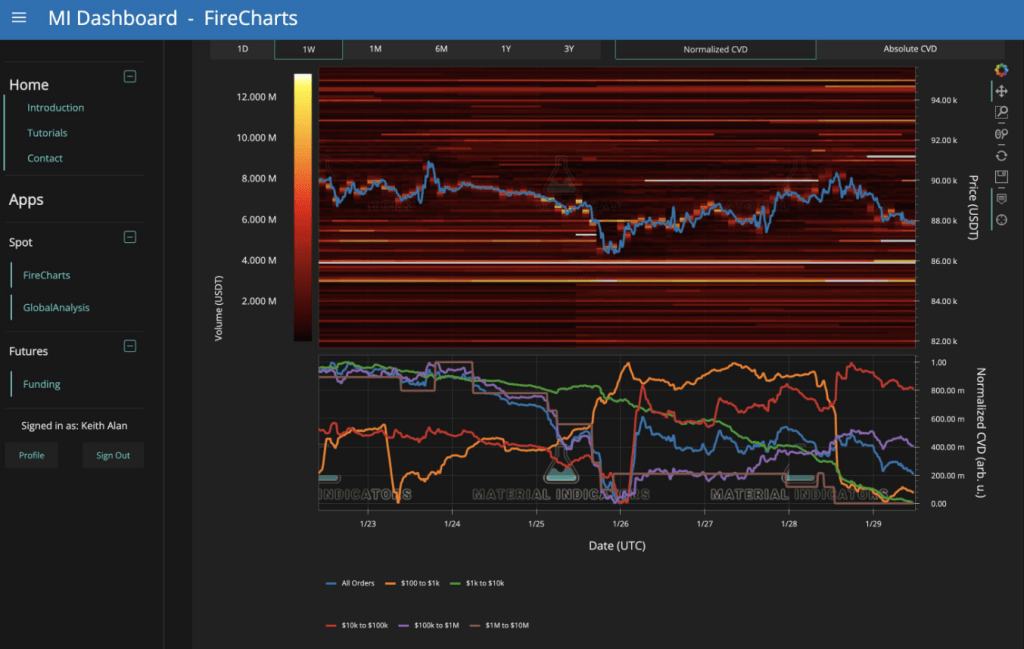
This can cause prices to remain within a narrow range. Material Indicators research has found a pattern in which bids are concentrated around $85,000 to $87,500. This may serve as a lower bound for now.
The idea is simple. By building up liquidity at a particular price, large players can get orders filled or prevent quick withdrawals before options expire.
Market participants argue that this kind of behavior can trap inexperienced traders who react to sudden movements. At times, the pressure seems intentional. It can also be a byproduct of many traders aiming for the same level. In any case, the result was volatile price movements and increased market tension.
FireCharts indicates that some companies are suppressing the $BTC price, using liquidity strategies to push the price down, potentially locking in their own bids or keeping the price locked in at the lower end of the range before Friday’s option expiration.
A considerable amount… pic.twitter.com/c63miAxBkh
— Material Indicator (@MI_Algos) January 29, 2026
Whales, Wyckoff, and Spring Ideas
The report notes that a group of traders using Wyckoff’s thinking expects a “spring,” or a decline below recent lows, followed by a strong rebound as powerful investors buy at lower prices.
Pseudonymous analysts point to $86,000 as a strong buying wall driven by large orders. One commentator shared a chart showing how the plunge below $80,000 acts as a spring before the rebound.
Some traders see this pattern as part of an accumulation. Some consider it a risky setup that could magnify losses if support fails. The truth may lie between these views. Both accumulation and flush risks are possible in tense markets.
Bitcoin price fluctuation
Bitcoin has been unable to break above $90,000 and remains within a narrow range. Prices fell to around $82,300 as renewed concerns about monetary policy and global conditions hit risk assets.
Volatility can be low at times but quickly spike up, making trading difficult. Buyers are intervening at a certain level, but the price has not yet broken through a clear level.
Geopolitics and Fed movements
Reports say rising tensions in some parts of the Middle East and talk of choosing a new Federal Reserve chairman are adding to the uncertainty.
Some investors are concerned that policy tightening will drain liquidity from the market, weighing on cryptocurrencies. On the topic of markets, he even mentioned US President Donald Trump in relation to political changes that could affect economic policy.
We see money flowing out of safe-haven assets and into other assets when news headlines worsen, and these moves pull money away from riskier holdings.
Related books
Key levels to focus on
Traders should closely monitor the $83,000 to $85,000 zone. If the stock closes below $86,000 for the day, many will take it as a negative sign and could lead to a deeper selloff. Conversely, if large liquidity holders decide to cancel their offers, a bull market could begin if buying at these levels continues.
The market is being pushed by both order book strategy and external news, and both factors can cause prices to move quickly, so patience and clear stop rules are key for most people at this time.
Featured image from Unsplash, chart from TradingView
