



In a wide-ranging interview with Coin Stories published on October 21, David Marcus, co-founder and CEO of Lightspark, former president of PayPal, and co-founder of Diem, a cryptocurrency project launched by Facebook, laid out his theory that Bitcoin will eventually surpass gold in value, evolving from a pure “store of value” asset to the invisible, neutral money settlement layer of the internet.
How Bitcoin will reach $1.5 million
“I think Bitcoin is more valuable than gold,” Marcus told host Natalie Brunel. “At today’s price of gold, Bitcoin will be worth $1.3 million and have a higher market cap than gold.” He emphasized that he is “good at predicting direction” but “bad at timing,” and cast an inevitable trajectory as a five- to 10-year outlook rather than a near-term decision. Due to the impact of gold’s market cap outpacing growth, Bitcoin’s potential value is well over $1.3 million per coin, and over $1.53 million at gold’s recent ATH of $4,381.58/oz.
Marcus’ price views are inseparable from his broader argument that BTC must progress beyond the narrow “digital gold” narrative. Brunel quoted analyst Matt Pines as saying, “If Bitcoin is just a store of value, then Bitcoin has failed,” which Marcus “totally” agreed with, but added the important caveat that the savings stage is a necessary prerequisite for practicality.
“We believe that the store of value phase is absolutely essential for us to be able to actually build the practical phase of Bitcoin on top of that,” he said, arguing that institutional adoption, ETFs, and nation-state accumulation gave it enough legitimacy to start scaling up payments in the real world. “Now that all the institutions…whether it’s BlackRock, Fidelity, others, actually support Bitcoin…we can actually start building payments utilities on top of it.”
That vision of utility hinges on using Bitcoin more like TCP/IP (an invisible payment infrastructure) rather than as a volatile unit of account for everyday spending. Marcus spoke candidly about behavioral and financial constraints. “People don’t want to use Bitcoin for everyday purchases because Bitcoin is volatile and people actually want to benefit from the gratitude… They don’t want to be a Bitcoin pizza shop.”
Lightspark’s approach is to move fiat currencies end-to-end while using BTC in the middle. “You can send dollars from a U.S. bank account to someone in Mexico who receives Mexican pesos…The settlement asset is Bitcoin in between. So you have dollars, Bitcoin, Mexican pesos, and it’s invisible to the people using it.”
Technically, Lightspark goes beyond Lightning’s channel model while maintaining backward compatibility. Marcus praised Lightning’s trust model and speed, but highlighted the friction of liquidity and self-custody when scaling to “billions of endpoints.”
The company’s newly launched Spark is described as a Lightning-compatible, non-channel payment system that can spin up “billion wallets” with “minimal new trust assumptions.” The important thing is that the safety valve is maintained, he said. “While not as trustless as Lightning, we believe it is trustless enough that there is a unilateral exit to Layer 1…no one can prevent you from pulling the ripcord and recovering funds at L1.”
Stablecoins and their introduction
Marcus also argued that stablecoins, despite their centralized issuer model, are an inevitable part of global payments, and pinning stablecoins to the BTC payments layer will strengthen resilience. Describing his personal “schizophrenic journey” with stablecoins, he said that while he hates “choking on one throat,” he embraced the ubiquity of stablecoins, avoided individual gas tokens, and tried to minimize trust by maintaining a unilateral exit to Bitcoin L1.
Regarding adoption, Marcus pointed to a change in institutional sentiment. He said a New York-based panel “compiled by Citadel Securities” of about 450 large traditional financial investors said a “majority” said they owned BTC, but far fewer held ETH, stablecoins and other tokens. “This is a room that traditionally would have been very resistant to Bitcoin…Now times have changed a lot.” Still, he estimates there are “just under a few hundred million” unique holders around the world, which gives him a lot of headroom, and he envisioned retail penetration early on.
Overall, Marcus’ paper returns to first principles. That is, BTC as neutral, scarce, programmable collateral and a reliable decentralized payment layer. He dismissed criticism that Bitcoin lacks “intrinsic value,” arguing that “the underlying scarcity of Bitcoin protected by code is its intrinsic value, and it is the only thing that is inherently deflationary.”
That’s why Bitcoin has to outcompete gold over time, he argues. “When the first gold ETFs were launched, they started mining more gold. You can’t do that with Bitcoin.” If that market capitalization crossover were to materialize, it would vindicate the structural imperative embedded in his statement, and thus the headline-grabbing notion that BTC’s fair value is not just above seven digits, but is ultimately “worth more than gold” (currently valued at $1.5 million).
At the time of writing, BTC was trading at $109,060.
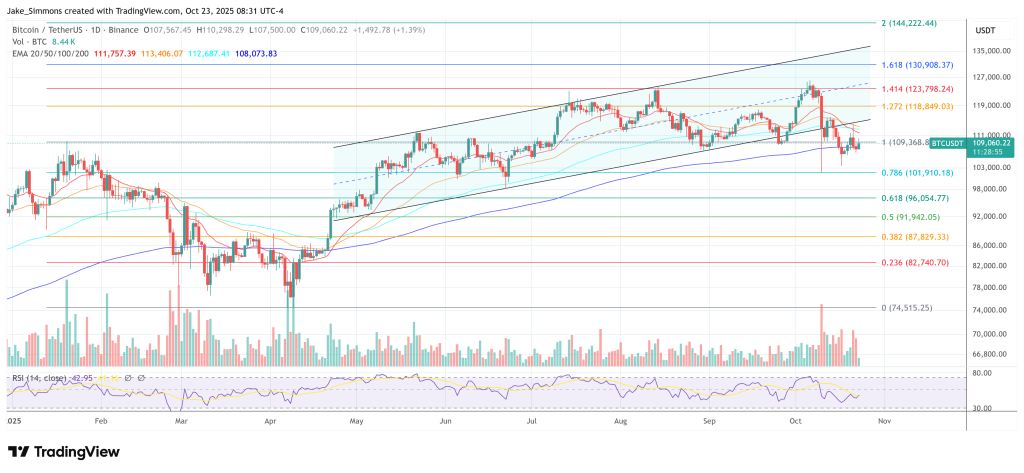
Featured image created with DALL.E, chart on TradingView.com

bitcoinist’s editorial process focuses on providing thoroughly researched, accurate, and unbiased content. We adhere to strict sourcing standards, and each page is carefully reviewed by our team of top technology experts and experienced editors. This process ensures the integrity, relevance, and value of your content to your readers.
