


With the ongoing conflict in the Middle East, many enthusiastic investors are hoping to turn into investments in crude oil and surge as the Strait of Hormuz is on the brink of closure. However, after 30 minutes of trading, oil prices only rose 3%.
If more than 20% of the world’s oil flows through the Strait of Hormuz and at what point it is actually closed, oil prices could skyrocket. Many investors are focusing on $100 per barrel, a level not seen since July 2022.
If Iran threatened to close the Strait of Hormuz 25 years ago, crude oil prices would have skyrocketed by 50%. No one cares today. Another world. #crudeoil pic.twitter.com/trdvqndnzo
– Dave Reiter (@tradesbydave) June 22, 2025
Oil prices are slow to respond to ongoing conflicts in the Middle East
Many had hoped oil prices would surge at 6pm ET just 30 minutes after the deal, following the overnight strike at US military Iranian nuclear facilities, but oil rose just 3%.
This type of attack, coupled with the ongoing threat of the Strait of Hormuz closing at any time, has led many investors to buy crude oil stocks in anticipation of a major reverse move.
However, at 6:27pm on June 22, Brent crude was up 3.17% at $79.45 per barrel, while US crude oil benchmark West Texas Intermediate (WTI) rose $3.18 at $76.19 per barrel during the early trading sessions in New York.
Previous incidents at this level have sparked much greater movement in the oil market. In some instances, Brent Futures jumped nearly 20% in one day, marking the biggest day price rise in history when Iran-linked extremists attacked Saudi Aramco’s ABQAIQ facility in September 2019, temporarily halting 5% of global oil production.
Discover: Buy Now 12+ Hottest Crypto-Precels
Another such event rose by about 4% amid fears of regional retaliation following the US drone strike against Iranian military officer Kasem Soleimani in early 2020. Today’s lukewarm water further emphasizes how insulated markets have become from geopolitical events.
Coordinated US airstrikes hit Fordow, Natanz and Isfahan overnight, causing visible damage to enrichment and research infrastructure. Tehran has pledged to retaliate, but it bets that the energy market will remain limited in escalation.
President Trump had announced that all three nuclear sites had been completely wiped out. However, since then, Fordow has not been destroyed, and the Iranians may have moved uranium deposits before the attack.
A major movement in oil prices is unlikely until the Iranians decide on the Strait of Hormuz. If they decide to destroy or close the strait, the crude barrels can run towards $100.
Like many people who are believed to regain $100,000, oil isn’t surged – is BTC a WW3 hedge?
(Coingecko)
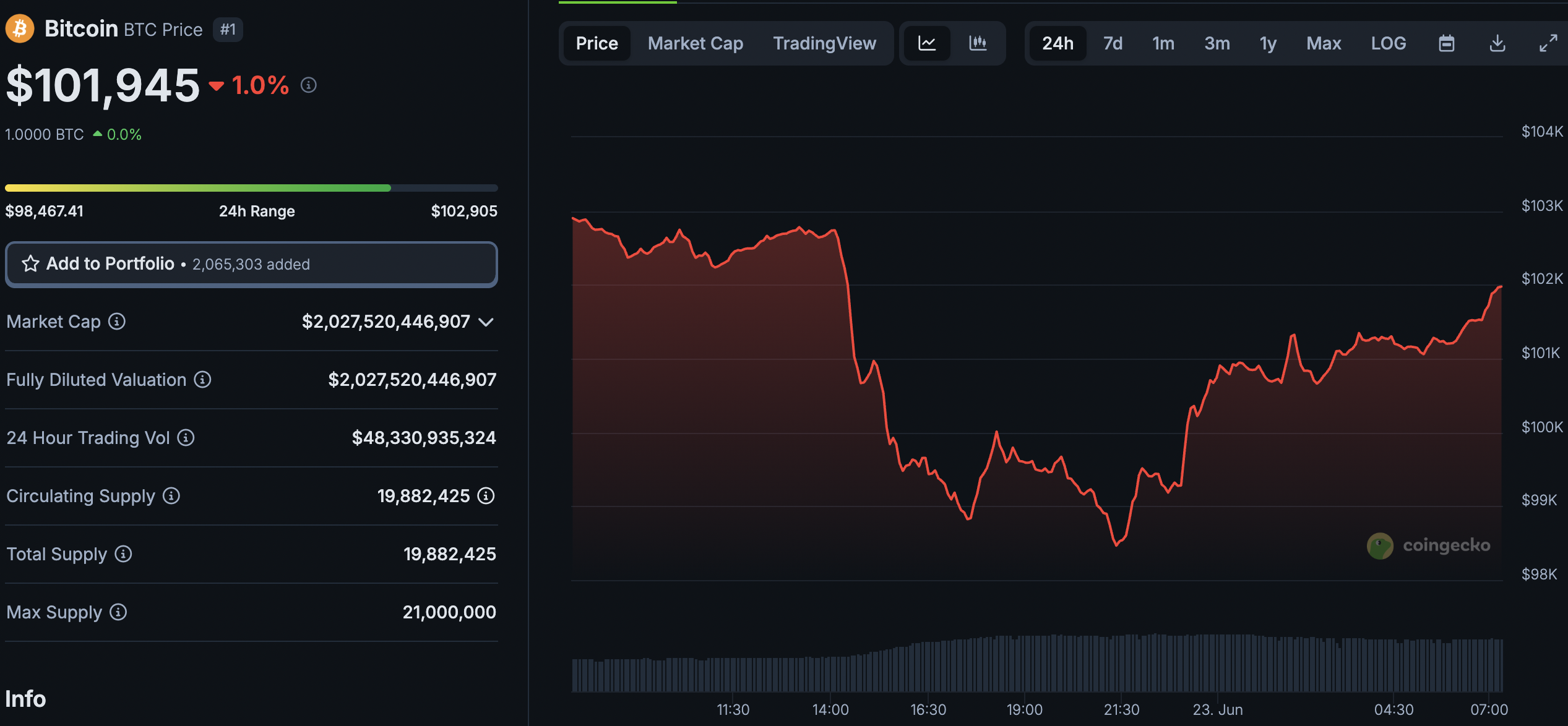
Late yesterday, Bitcoin fell to $98,500, with many people believing that a slide of $80,000-$85,000 would come. However, less than two hours later, BTC quickly revived $100,000 and is currently trading at $101,900.
Compared to oil prices that have not responded reasonably as expected by market participants, this is a continuing strength from Bitcoin, highlighting key digital assets as investments during this conflict in the Middle East.
Previously, Iran and Israel were in fierce conflict with each other and added warnings that the US would be involved, acting as a Black Swan event in Crypto, with Bitcoin crashing and dragging the rest of the market.
However, BTC’s refusal to fall below $100,000 is extremely bullish and is also supported by BlackRock’s continuing to post positive net influxes to Bitcoin ETF. Other asset managers, such as Fidelity, have also experienced a healthy influx into their BTC ETFs.
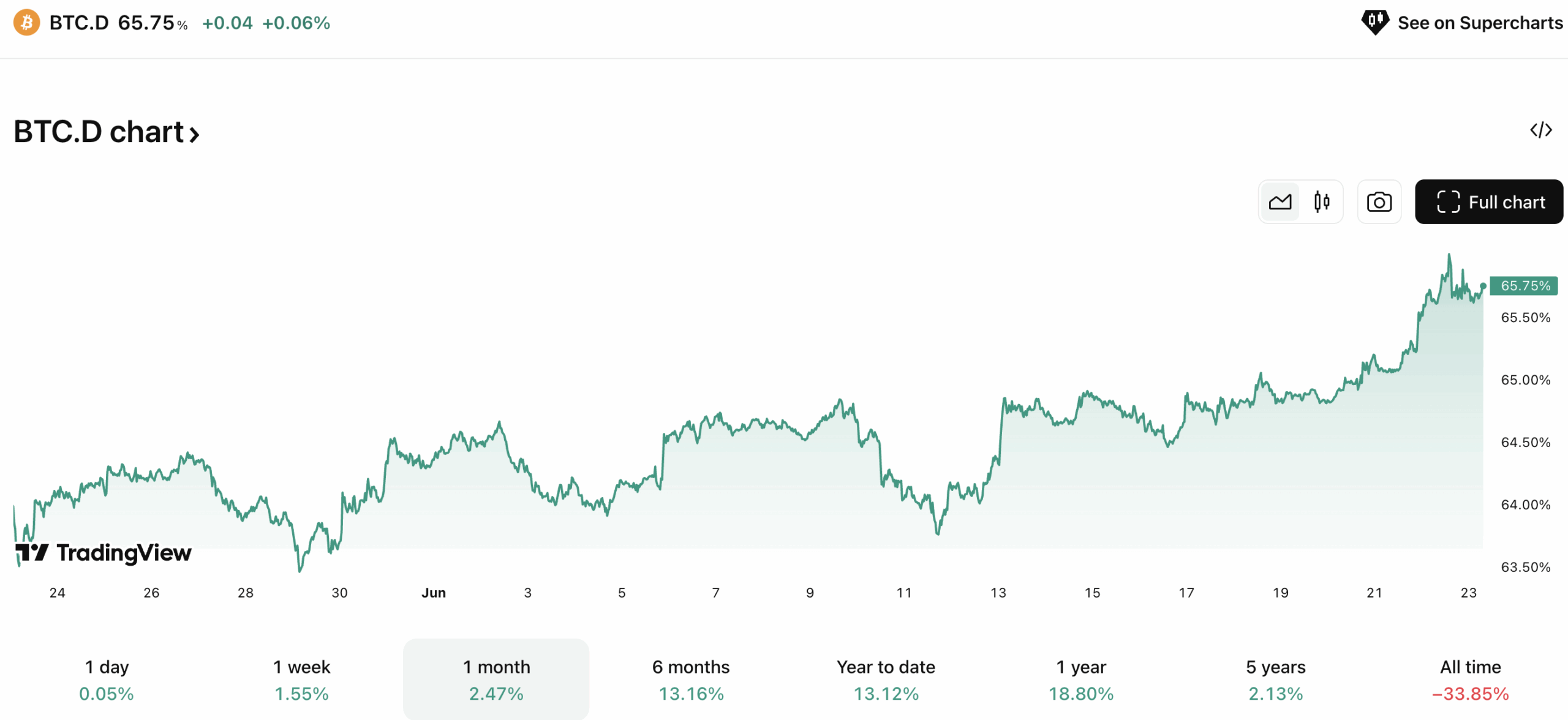
Another signal that Bitcoin is the current major investment asset is the continuous rise of BTC control (BTC.D), which measures the share of total crypto market capitalization. As most altcoins continue to bleed and Bitcoin remains stable, BTC.D has risen from 64.8% to 65.8% in the last three days alone.
(TradingView)
The rise of BTC.D highlights the weaknesses of Altcoins today, but also shows the strength of Bitcoin and its new status as a hedge on pending wars.
Now, all eyes are taking part in a new announcement from President Trump on today’s US Tradfi market and the US plan for the Israeli/Iran conflict.
There is optimism that the conflict could end after no reported missile attacks from Iran, as Israel says it does not want to be drawn into the war of attrition, after no reported missile attacks from Iran.
News of this bloody conflict ceasefire and complete ending in the Middle East could see a massive surge across the crypto market, catapulting Bitcoin to fresh highs, turning the $110,000 level into support before starting the much-anticipated run towards $150,000.
Exploration: 20+ Next Cryptographs to Explode in 2025
For the latest market updates, please join us in the discrepancy in 99bitcoins news here
The post is oil prices surged through the Iran-Israel conflict. What does this mean for Bitcoin prices in June? It first appeared in 99 Bitcoin.
