


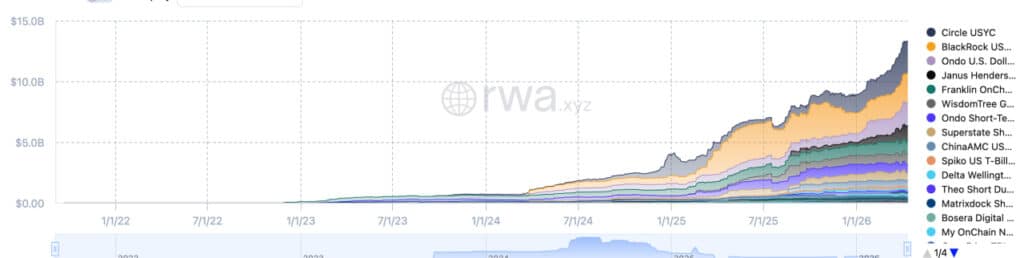
Tokenized US Treasuries just topped $13.53 billion. This is close enough to $14 billion that the milestone is essentially already here. But the detail missing from most headlines is that this number has increased approximately 50 times since 2024, and has increased while the broader cryptocurrency market has experienced one of the most turbulent years on record.
This is a signal about what kinds of crypto products institutional investors actually believe in, and who is building them.
Circle and BlackRock sit at the top of this market, and that’s more important than the actual numbers. Here’s what’s actually going on underneath that number.
Discover: Next 1000x Crypto Gems before being listed on Binance
Current RWA market: $13.53 billion in 74 assets
As of April 12, 2026, the Tokenized Treasury sector valued at $13.53 billion, registering a weekly increase of 0.63%. This is the largest single segment of the overall RWA market, currently valued at $29.22 billion.
To put this growth into context, the 2024 market started at approximately $750 million. In the first two months of 2026 alone, $2.12 billion was added, outpacing stablecoin growth in absolute terms for the first time.
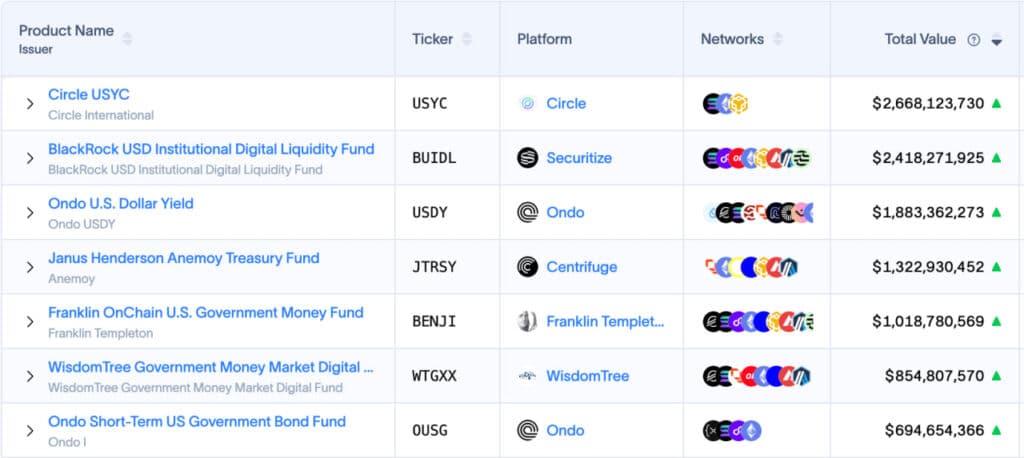
The top five products accounted for $9.31 billion, or 68.8% of the total sector. Circle’s USYC leads with $2.67 billion, structured primarily for non-U.S. investors and based in Bermuda. BlackRock’s BUIDL was second at $2.42 billion, managed through Securitize, and targeted to eligible US buyers with a minimum entry amount of USD5 million. It is not a retail product. Ondo’s USDY ranks third with $1.88 billion, with 16,568 holders and an APY of 3.55%, making it the widest distribution of the top three.
Janus Henderson’s Anemoy Treasury Fund (JTRSY) came in fourth with $1.32 billion, has an AA+ credit rating from S&P, and focuses on short-term government bonds. Franklin Templeton’s BENJI ranks fifth with $1.02 billion, and is notable for its minimum investment of $20. This means that the barrier to entry into the top tier is overwhelmingly low. The complete ecosystem spans 60,893 holders across 74 different assets.
Discover: Ethereum’s dominance in RWA payments – and what the IMF warns about tokenization
Why BlackRock and Circle, leaders in the crypto market, are changing categories
BlackRock manages over $10 trillion in assets. When Larry Fink compares tokenization to the early internet, he’s not a CEO chasing trends.
This is the world’s largest asset management company’s direction for storage, payments, and product distribution. BlackRock’s broader crypto efforts have been steadily building, and BUIDL is RWA’s institutional expression of that belief.
Circle, on the other hand, is the issuer of USDC, the second-largest stablecoin by market capitalization. Their infrastructure already moves billions of dollars of fiat value on blockchain rails every day. USYC sits on top of that plumbing, expanding its circle from dollar payments to high-yield government debt. These are not crypto-native startups experimenting with how DeFi works.
These are regulated, compliance-focused institutions that have built products specifically designed to withstand regulatory scrutiny, and that distinction is extremely important for any institution looking to enter this space.
It is no different that the stablecoin market simultaneously hit an all-time high of $318.6 billion. Stablecoins and tokenized U.S. Treasuries are two ends of the same institutional infrastructure construction, with one providing dollar liquidity on-chain and the other providing yield.
Together they form the basis of a parallel financial layer that is beginning to look more like a market structure than an experiment.
Discover: The Best Meme Coins ICOs to Invest in in 2026
For more cryptocurrency news and analysis, follow 99Bitcoins on X, YouTube, and Telegram.
The post Tokenized Crypto U.S. Treasuries Approach $14 Billion as Circle and BlackRock Lead Growth appeared first on 99Bitcoins.
